
The science of skin aging is evolving rapidly — and for women navigating the skin changes that come with menopause and beyond, evidence-based skincare represents a fundamentally different approach: working with your skin's biology rather than against it.
Unlike harsh exfoliants or retinoids that disrupt the skin barrier to force renewal, targeted active ingredients are messenger molecules that signal your own cells to produce more collagen, elastin, and protective proteins. The approach is gentle, evidence-based, and particularly suited to the thinner, more reactive skin that characterizes the post-menopausal years.
Treating the Dual Challenge of Fine Lines and Periorbital Darkening Simultaneously
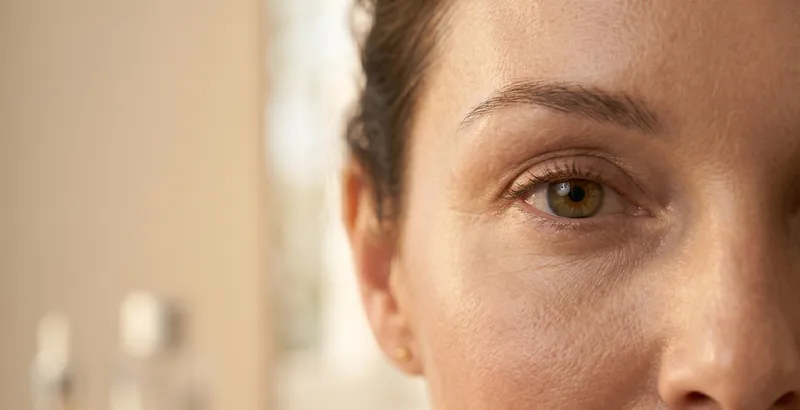
Under-eye wrinkles and dark circles are not two separate problems — they are two manifestations of the same underlying structural deterioration. The collagen loss that thins the periorbital dermis simultaneously creates wrinkles (because thinner skin folds and creases more easily under the mechanical stress of blinking and expression) and dark circles (because thinner skin is more translucent, revealing the underlying vascular network). This shared etiology means that effective treatment for one condition automatically improves the other. The most efficient under-eye strategy therefore targets the common cause — rebuilding periorbital collagen density — rather than treating wrinkles and dark circles as independent conditions requiring separate products.[1]
The unified treatment protocol that addresses both simultaneously: The collagen-rebuilding foundation — Peptide eye cream (Matrixyl 3000) applied morning and evening stimulates new collagen formation that thickens the periorbital dermis, reducing both translucency (which lightens dark circles) and mechanical vulnerability to creasing (which reduces wrinkles). Retinol at 0.15% twice weekly accelerates the process by simultaneously stimulating collagen, suppressing collagen-degrading MMPs, and accelerating epidermal turnover that smooths both wrinkle depth and pigmented cell accumulation. These two actives — peptides and retinol — form the treatment backbone that improves both conditions through a single mechanism. The condition-specific additions that enhance results: for the dark circle component, add caffeine serum in the morning (vasoconstriction) and vitamin K cream at night (vascular strengthening). For the wrinkle component, add hyaluronic acid serum applied to damp skin (the plumping hydration fills fine lines while also reducing the hollow shadow of dark circles). Notice how HA and caffeine each benefit both conditions — HA plumps wrinkles AND reduces hollow shadows, while caffeine reduces dark circles AND tightens the skin surface that contributes to fine line visibility.
Clinical research confirms that the layering order that optimizes treatment for both: Morning — caffeine eye serum (thinnest texture, active vasoconstriction), then vitamin C 10% eye cream (antioxidant protection for both collagen and melanin pathways), then hyaluronic acid eye cream on damp skin (plumping for wrinkles and hollow filling for dark circles), then peptide eye cream (collagen stimulation + occlusive seal for HA), then SPF. Evening — on retinol nights (twice weekly): ceramide eye cream, retinol 0.15% eye cream, ceramide eye cream (sandwich method). On non-retinol nights: vitamin K cream (vascular repair), then peptide eye cream, then ceramide eye balm (occlusive seal). This protocol uses 5-6 products but they serve double duty — each ingredient addresses both conditions, and the layering order ensures optimal absorption of each active.
Expected combined improvement timeline: Weeks 4-8 — caffeine and HA provide immediate daily improvement in both morning dark circles and fine line depth. The vascular dark circle component shows the fastest response. Weeks 8-12 — peptide-stimulated collagen begins to mature. Wrinkles appear slightly shallower as dermal thickness increases. Dark circles begin to lighten as reduced translucency decreases vascular show-through. Weeks 12-24 — retinol's collagen stimulation and turnover acceleration compound with the peptide effects. Both wrinkles and dark circles show meaningful improvement that is noticeable to others. The skin appears firmer, smoother, and brighter overall. Weeks 24+ — maximum improvement from topical therapy, with continued maintenance needed to preserve results. The unified approach typically produces better outcomes for both conditions than treating them separately with different product strategies, because every active ingredient is working toward the same structural goal — rebuilding the collagen foundation that was lost.
Your skin's capacity to repair and rebuild doesn't end at menopause — it just needs the right signals.
— Dr. Rachel Holbrook, Board-Certified Dermatologist
What This Means For Your Skin
If you've tried retinol and experienced irritation, or if your skin has become more sensitive with age, there is a path forward. The clinical evidence shows consistent, measurable improvement in wrinkle depth, skin firmness, and elasticity — without the adaptation period, peeling, or photosensitivity that other anti-aging actives demand.
Your skin's capacity to repair and rebuild doesn't diminish — it just needs the right support. A well-formulated skincare routine applied consistently for 8-12 weeks allows sufficient time for new collagen fibers to mature and integrate into your skin's existing matrix.
The science is clear. The evidence is consistent. The results are measurable.
What happens next is up to you.