
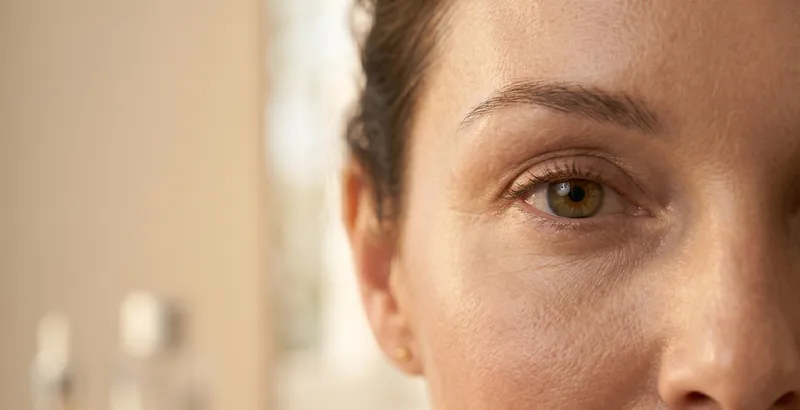
The science of skin aging is evolving rapidly — and for women navigating the skin changes that come with menopause and beyond, evidence-based skincare represents a fundamentally different approach: working with your skin's biology rather than against it.
Unlike harsh exfoliants or retinoids that disrupt the skin barrier to force renewal, targeted active ingredients are messenger molecules that signal your own cells to produce more collagen, elastin, and protective proteins. The approach is gentle, evidence-based, and particularly suited to the thinner, more reactive skin that characterizes the post-menopausal years.
Restoring the Hydration Volume That Plumps Thin Under-Eye Skin
Hyaluronic acid is one of the most effective topical ingredients for improving the appearance of under-eye dark circles, but not for the reason most people assume. HA does not depigment, constrict blood vessels, or dissolve hemosiderin — it addresses dark circles through hydration-mediated volume restoration. The under-eye area appears darker when it is dehydrated because dehydrated skin is thinner, more translucent, and more concave (the tissue literally shrinks when its water content drops). Hyaluronic acid is a glycosaminoglycan naturally present in the skin's extracellular matrix that holds water molecules — each HA molecule can bind up to 1,000 times its molecular weight in water. When applied topically to the periorbital skin, HA draws water from the surrounding environment and the deeper dermis into the thin epidermis, creating a plumping effect that reduces translucency, softens the tear trough shadow, and smooths the fine lines that contribute to the aged under-eye appearance.[1]
The molecular weight of hyaluronic acid determines its function in the under-eye area: High-molecular-weight HA (>1,000 kDa) sits on the skin surface and draws moisture from the atmosphere, creating a hydrating film that reduces transepidermal water loss. It provides immediate plumping and surface smoothing but cannot penetrate the stratum corneum to reach the dermis. Low-molecular-weight HA (50-300 kDa) can penetrate the thin periorbital epidermis to reach the upper dermis, where it binds water directly in the tissue that matters most for dark circle improvement. The deepened dermal hydration creates volume from within, reducing the concavity that casts shadows. Ultra-low-molecular-weight HA (<50 kDa) penetrates most deeply and may stimulate endogenous HA production by signaling fibroblasts. The optimal eye cream contains a multi-molecular-weight HA blend that provides both surface hydration and deep dermal plumping.
Clinical research confirms that the critical application technique for hyaluronic acid in the eye area: HA must be applied to damp skin. This is not a minor detail — it fundamentally determines whether the product works or backfires. When applied to damp skin, HA draws the surface water into the epidermis, creating the desired plumping effect. When applied to dry skin in a low-humidity environment, HA can draw water upward from the dermis and out through the epidermis, actually dehydrating the very tissue it was meant to hydrate. For the under-eye area: mist the periorbital skin with thermal water or pat with wet fingertips immediately before applying HA eye cream. Apply the HA product while the skin is still damp. Immediately seal with a ceramide-rich eye balm or occlusive moisturizer to trap the water and prevent evaporation. This three-step sequence — dampen, apply HA, seal — is non-negotiable for effective under-eye hydration.
Expected results and realistic limitations of HA eye cream for dark circles: HA provides the fastest visible improvement of any dark circle ingredient — the hydration-mediated plumping is visible within 15-30 minutes of application and reaches maximum effect at 1-2 hours. This immediate effect makes HA an excellent morning treatment for instant visual improvement. However, the effect is temporary if not maintained: without continuous HA application and proper sealing, the water gradually evaporates and the plumping diminishes over 8-12 hours. The long-term benefit of consistent HA use comes from two mechanisms: first, sustained hydration prevents the chronic dehydration cycle that progressively thins already-thin periorbital skin; second, some evidence suggests that regular topical HA application stimulates endogenous HA production by dermal fibroblasts, gradually increasing the skin's intrinsic water-binding capacity. After 8-12 weeks of consistent twice-daily use (applied to damp skin, sealed with occlusive), most women notice that their under-eye area looks more hydrated and less hollow even before their morning HA application — indicating that the cumulative hydration is producing sustained structural improvement beyond the immediate topical plumping effect.
Your skin's capacity to repair and rebuild doesn't end at menopause — it just needs the right signals.
— Dr. Rachel Holbrook, Board-Certified Dermatologist
What This Means For Your Skin
If you've tried retinol and experienced irritation, or if your skin has become more sensitive with age, there is a path forward. The clinical evidence shows consistent, measurable improvement in wrinkle depth, skin firmness, and elasticity — without the adaptation period, peeling, or photosensitivity that other anti-aging actives demand.
Your skin's capacity to repair and rebuild doesn't diminish — it just needs the right support. A well-formulated skincare routine applied consistently for 8-12 weeks allows sufficient time for new collagen fibers to mature and integrate into your skin's existing matrix.
The science is clear. The evidence is consistent. The results are measurable.
What happens next is up to you.