
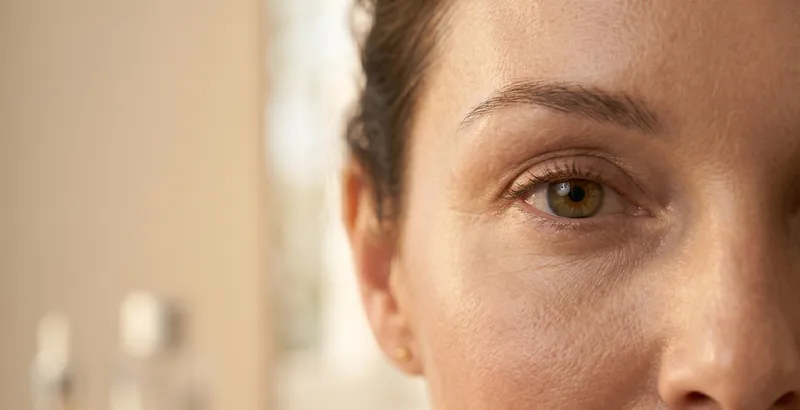
The science of skin aging is evolving rapidly — and for women navigating the skin changes that come with menopause and beyond, evidence-based skincare represents a fundamentally different approach: working with your skin's biology rather than against it.
Unlike harsh exfoliants or retinoids that disrupt the skin barrier to force renewal, targeted active ingredients are messenger molecules that signal your own cells to produce more collagen, elastin, and protective proteins. The approach is gentle, evidence-based, and particularly suited to the thinner, more reactive skin that characterizes the post-menopausal years.
Understanding the Volume Loss That Creates the Deep Under-Eye Shadow
The tear trough is the crescent-shaped groove running from the inner corner of the eye along the orbital rim toward the cheek. In youth, this groove is shallow or invisible because the orbital fat pads — dense cushions of fat that sit between the eyeball and the orbital bone — fill the space between the lower eyelid and the cheek, creating a smooth, convex transition from the eye to the mid-face. After 40, two changes deepen the tear trough dramatically: first, the orbital septum (the connective tissue membrane holding the fat pads in position) weakens, allowing the fat to either herniate forward (creating bags) or descend inferiorly (contributing to mid-face volume loss); second, the malar fat pad in the upper cheek descends gravitationally, creating a visible step-off between the lower eyelid and the cheek. The resulting concavity catches light differently than the surrounding convex surfaces, creating a dark shadow that is often interpreted as dark circles but is actually a structural void.[1]
Why tear trough hollowing accelerates during perimenopause: estrogen plays a direct role in maintaining facial fat distribution and collagen density. The perimenopausal estrogen decline reduces fat pad volume across the face (the fat doesn't simply descend — it also atrophies), and the concurrent collagen loss weakens the connective tissue structures that hold fat pads in their youthful position. The result is a cascade: less fat volume, weaker supporting structures, gravitational descent of remaining volume, and deepening of the grooves and hollows that were previously filled. The tear trough is one of the earliest areas to show this volume depletion because the orbital fat pads are small and the overlying skin is the thinnest on the face, meaning even modest volume changes create visible concavities. Many women report that their tear troughs seemed to deepen overnight during their mid-40s — this perception reflects the threshold effect where gradual underlying changes suddenly become visible.
Clinical research confirms that topical treatment for tear trough hollowing focuses on two achievable goals: improving the quality and thickness of the overlying skin, and maximizing hydration-mediated volume in the thin periorbital dermis. Goal 1 — Skin thickening: peptide eye cream (Matrixyl 3000 or Haloxyl-containing formulations) applied morning and evening stimulates collagen production in the periorbital dermis. Over 12-16 weeks, measurable increases in dermal thickness reduce the shadowing effect by creating a slightly thicker, less translucent tissue layer over the tear trough. Retinol at 0.15% applied twice weekly further stimulates collagen while suppressing MMPs that degrade the existing collagen matrix. Goal 2 — Hydration volume: hyaluronic acid serum (multi-molecular weight, including low-molecular-weight HA that penetrates the thin periorbital epidermis) applied to damp under-eye skin attracts and binds water, creating temporary but cumulative plumping that reduces tear trough depth. Seal immediately with a ceramide eye balm to prevent transepidermal water loss from the thin periorbital barrier.
The realistic expectation for topical tear trough treatment: topical therapy cannot recreate lost orbital fat volume or reverse gravitational descent of the malar fat pad. What it can achieve is a 20-35% visible improvement through skin quality enhancement and hydration optimization — enough to soften the shadow and reduce the need for heavy concealer, but not enough to eliminate a deep tear trough. For women with moderate-to-severe hollowing, hyaluronic acid dermal filler injected into the tear trough by a skilled injector provides the most dramatic improvement — restoring the volume that creates the smooth eyelid-cheek transition of youth. Topical optimization of the overlying skin complements and extends filler results: women who maintain a peptide and retinol eye care routine typically need filler touch-ups less frequently (12-18 months versus 8-12 months) because the healthier skin stretches more smoothly over the restored volume. The combined approach — professional volume restoration plus ongoing topical skin optimization — produces the most natural, sustained improvement for age-related tear trough hollowing.
Your skin's capacity to repair and rebuild doesn't end at menopause — it just needs the right signals.
— Dr. Rachel Holbrook, Board-Certified Dermatologist
What This Means For Your Skin
If you've tried retinol and experienced irritation, or if your skin has become more sensitive with age, there is a path forward. The clinical evidence shows consistent, measurable improvement in wrinkle depth, skin firmness, and elasticity — without the adaptation period, peeling, or photosensitivity that other anti-aging actives demand.
Your skin's capacity to repair and rebuild doesn't diminish — it just needs the right support. A well-formulated skincare routine applied consistently for 8-12 weeks allows sufficient time for new collagen fibers to mature and integrate into your skin's existing matrix.
The science is clear. The evidence is consistent. The results are measurable.
What happens next is up to you.