
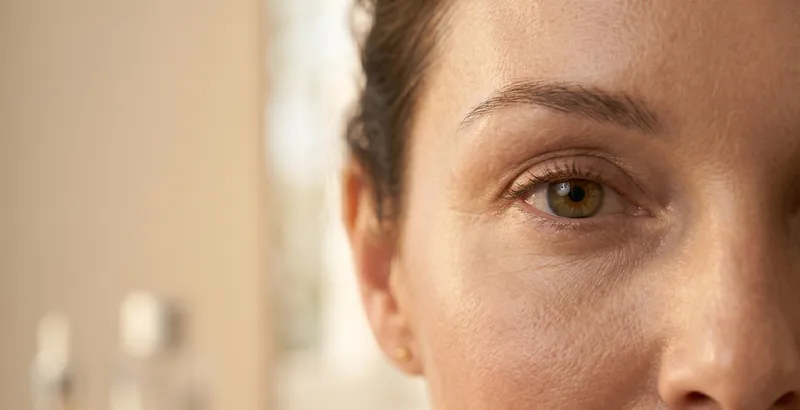
The science of skin aging is evolving rapidly — and for women navigating the skin changes that come with menopause and beyond, evidence-based skincare represents a fundamentally different approach: working with your skin's biology rather than against it.
Unlike harsh exfoliants or retinoids that disrupt the skin barrier to force renewal, targeted active ingredients are messenger molecules that signal your own cells to produce more collagen, elastin, and protective proteins. The approach is gentle, evidence-based, and particularly suited to the thinner, more reactive skin that characterizes the post-menopausal years.
When Topical Treatment Is Sufficient and When Volume Restoration Is Needed
The comparison between under-eye filler and eye cream is not actually a competition — they address different aspects of periorbital aging and are most effective when understood as complementary rather than competing treatments. Eye creams (topical treatments) address skin quality: collagen density, epidermal thickness, vascular health, pigmentation, hydration, and barrier function. Under-eye filler (injectable hyaluronic acid) addresses tissue volume: the lost orbital fat, deepened tear trough, and sunken hollows that create structural shadows. A woman with excellent skin quality but significant volume loss will see minimal improvement from eye cream alone. Conversely, a woman with minimal volume loss but significant vascular dark circles, fine lines, and pigmentation will see minimal improvement from filler alone. Most women over 40 have both skin quality changes and volume loss, making the combined approach the most effective strategy.[1]
When eye cream alone is sufficient: Mild dark circles primarily caused by vascular show-through (blue-purple color that changes with fatigue and improves with caffeine or cold compresses). Fine lines and mild crepiness without significant hollowing. Pigmentation-based dark circles (brown, melanin-mediated) that respond to depigmenting ingredients. Early periorbital aging where the tear trough is shallow and volume loss is minimal. In these cases, a comprehensive topical protocol (peptides, retinol, caffeine, HA, vitamin K) can produce 40-60% visible improvement over 6-12 months, which may be sufficient for the individual's cosmetic goals. When filler should be considered: Moderate-to-deep tear trough hollowing creating shadows that dominate the under-eye appearance regardless of skin color or quality. Significant volume loss where the lower lid-cheek junction shows a visible step-off or concavity. Dark circles that persist despite 6+ months of consistent, comprehensive topical treatment — the residual darkness is likely structural shadow from volume loss that topical treatment cannot address.
Clinical research confirms that the optimal combined approach: Start with 3-6 months of comprehensive topical treatment before considering filler. This optimizes the skin quality overlying any future filler, which produces better filler results (the hyaluronic acid gel looks more natural under healthy, thick, well-hydrated skin than under thin, dehydrated, damaged skin). After 3-6 months of topical optimization, reassess: if significant hollowing persists, consult with an experienced injector for tear trough filler. Continue the topical protocol after filler — the ongoing skin quality maintenance extends filler longevity (women who maintain topical eye care typically need filler touch-ups every 12-18 months versus 8-12 months for those who rely on filler alone).
The cost-benefit analysis: eye cream is lower cost (investment of products used daily over months) with gradual, sustained improvement in skin quality that benefits the entire periorbital area. The improvement compounds over time and requires ongoing maintenance to sustain. Filler is higher cost (single treatment session, approximately renewed annually) with immediate, dramatic improvement in volume and shadow that is visible the same day. The improvement requires periodic renewal as the hyaluronic acid is gradually metabolized. For many women, the practical approach is: invest in the topical protocol as the foundation, and add filler only if the residual volume loss exceeds what topical treatment can address. This minimizes the injectable investment while maximizing the benefit from each filler session through optimized skin quality. The women who report the highest satisfaction with their under-eye appearance are those who combine modest filler with excellent topical care — the filler provides the structural foundation while the topical protocol provides the skin quality that makes the result look natural rather than simply filled.
Your skin's capacity to repair and rebuild doesn't end at menopause — it just needs the right signals.
— Dr. Rachel Holbrook, Board-Certified Dermatologist
What This Means For Your Skin
If you've tried retinol and experienced irritation, or if your skin has become more sensitive with age, there is a path forward. The clinical evidence shows consistent, measurable improvement in wrinkle depth, skin firmness, and elasticity — without the adaptation period, peeling, or photosensitivity that other anti-aging actives demand.
Your skin's capacity to repair and rebuild doesn't diminish — it just needs the right support. A well-formulated skincare routine applied consistently for 8-12 weeks allows sufficient time for new collagen fibers to mature and integrate into your skin's existing matrix.
The science is clear. The evidence is consistent. The results are measurable.
What happens next is up to you.