
The science of skin aging is evolving rapidly — and for women navigating the skin changes that come with menopause and beyond, evidence-based skincare represents a fundamentally different approach: working with your skin's biology rather than against it.
Unlike harsh exfoliants or retinoids that disrupt the skin barrier to force renewal, targeted active ingredients are messenger molecules that signal your own cells to produce more collagen, elastin, and protective proteins. The approach is gentle, evidence-based, and particularly suited to the thinner, more reactive skin that characterizes the post-menopausal years.
Why Dark Circles Deepen After 40 and the Multi-Cause Approach That Actually Works
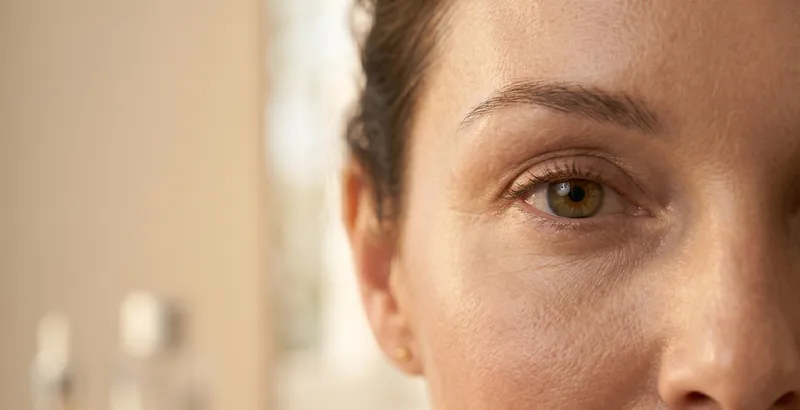
Under-eye dark circles that deepen after 40 are fundamentally different from the occasional dark circles of youth caused by late nights or allergies. Age-related periorbital darkening is a structural condition driven by multiple simultaneous changes: the orbital fat pads that cushion the eye begin to descend and thin, creating hollows (the tear trough) that cast shadows even in good lighting; the periorbital skin — already the thinnest on the body at 0.5mm — loses additional collagen and becomes increasingly translucent, allowing the underlying orbicularis oculi muscle and its purple-blue vascular network to show through; and the microvascular network itself deteriorates, with increased capillary fragility leading to chronic micro-leakage of hemoglobin that deposits hemosiderin (an iron-based pigment) in the periorbital dermis. These three mechanisms — volume loss, skin thinning, and vascular pigment deposition — combine to create the persistent dark hollows that no amount of sleep can resolve.[1]
The color of the dark circles reveals the dominant mechanism: Blue-purple circles indicate vascular show-through — the thin, translucent skin is revealing the underlying muscle and blood vessels. This type worsens with fatigue (which dilates vessels, increasing visibility) and improves temporarily with cold compresses (which constrict vessels). Brown circles indicate true hyperpigmentation — melanin deposition in the periorbital skin, often driven by the same hormonal mechanisms as melasma. This type is more common in Fitzpatrick types III-VI and does not change with fatigue or cold. Red-purple circles suggest hemosiderin deposition — chronic capillary leakage has deposited iron-based pigment in the dermis. This type is particularly stubborn because hemosiderin is not affected by depigmenting agents designed for melanin. Dark hollows (shadows) indicate volume loss — the tear trough deepens as orbital fat descends, creating a concavity that casts a shadow regardless of skin color or vascular health. Most women over 40 have a combination of two or more types.
Clinical research confirms that the treatment protocol must address each identified mechanism: For vascular show-through — caffeine-based eye serums (2-5% caffeine) constrict periorbital capillaries and reduce the bluish appearance. Vitamin K oxide cream helps strengthen capillary walls and reduce micro-leakage over time. Niacinamide 5% thickens the epidermis through increased ceramide production, reducing the translucency that allows vessels to show through. For melanin hyperpigmentation — vitamin C at 10% (lower than facial concentration to account for periorbital sensitivity) provides mild tyrosinase inhibition. Tranexamic acid 3% can be used in the periorbital area for melanin-mediated dark circles. Retinol must be limited to 0.15% maximum in the eye area and applied no more than twice weekly — the periorbital skin is too thin and sensitive for standard facial retinol concentrations. For hemosiderin deposition — topical vitamin C helps convert ferric iron to the more easily mobilized ferrous form, and arnica-based creams may support the slow clearance of hemosiderin deposits over 3-6 months.
For volume loss — topical treatments cannot restore orbital fat volume, but they can improve the skin quality that contributes to the hollow appearance. Peptide eye creams (Matrixyl, Argireline) stimulate collagen production in the thin periorbital dermis, providing modest volume restoration. Hyaluronic acid serums applied to the under-eye area attract water that plumps the thin skin, reducing the depth of the tear trough shadow. For significant volume loss, professional treatments (hyaluronic acid filler injections into the tear trough) provide the most dramatic improvement, but topical optimization of the overlying skin quality enhances and extends filler results. The comprehensive daily protocol: Morning — caffeine eye serum (applied with ring finger using gentle tapping motion, never dragging), followed by vitamin C 10% eye cream, then SPF applied carefully to the orbital area. Evening — retinol 0.15% eye cream twice weekly on alternating nights with peptide eye cream on other nights, always followed by a ceramide-rich eye balm to seal hydration. Expected timeline: 8-12 weeks for visible improvement in vascular-type circles, 12-16 weeks for melanin-type, 16-24 weeks for measurable improvement in skin thickness and overall under-eye appearance.
Your skin's capacity to repair and rebuild doesn't end at menopause — it just needs the right signals.
— Dr. Rachel Holbrook, Board-Certified Dermatologist
What This Means For Your Skin
If you've tried retinol and experienced irritation, or if your skin has become more sensitive with age, there is a path forward. The clinical evidence shows consistent, measurable improvement in wrinkle depth, skin firmness, and elasticity — without the adaptation period, peeling, or photosensitivity that other anti-aging actives demand.
Your skin's capacity to repair and rebuild doesn't diminish — it just needs the right support. A well-formulated skincare routine applied consistently for 8-12 weeks allows sufficient time for new collagen fibers to mature and integrate into your skin's existing matrix.
The science is clear. The evidence is consistent. The results are measurable.
What happens next is up to you.