
The science of skin aging is evolving rapidly — and for women navigating the skin changes that come with menopause and beyond, evidence-based skincare represents a fundamentally different approach: working with your skin's biology rather than against it.
Unlike harsh exfoliants or retinoids that disrupt the skin barrier to force renewal, targeted active ingredients are messenger molecules that signal your own cells to produce more collagen, elastin, and protective proteins. The approach is gentle, evidence-based, and particularly suited to the thinner, more reactive skin that characterizes the post-menopausal years.
How Estrogen Decline Accelerates Every Mechanism Behind Under-Eye Darkening
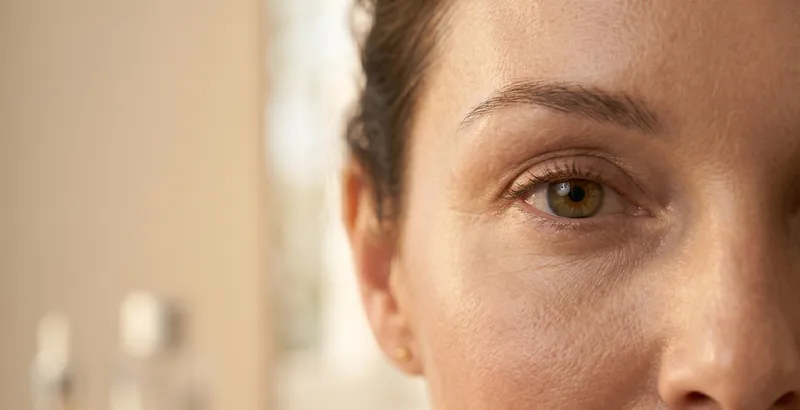
The sudden worsening of dark circles during perimenopause is not coincidental — estrogen decline directly accelerates every mechanism that produces periorbital darkening. Understanding this hormonal connection explains why dark circles that were manageable for years suddenly become resistant to traditional remedies like sleep, cold compresses, and basic eye creams. Estrogen maintains skin thickness through stimulation of collagen synthesis, glycosaminoglycan production, and epidermal hydration. When estrogen fluctuates and ultimately declines during perimenopause, the periorbital skin — already the thinnest on the body — loses thickness disproportionately fast because it has the least collagen reserve to begin with. A 1% annual collagen decline that is barely perceptible on the cheeks produces visible changes in the 0.5mm-thick under-eye skin within 2-3 years. The result: increased translucency that reveals the underlying vascular network as bluish-purple darkness.[1]
The hormonal impact extends beyond skin thinning: estrogen supports vascular integrity through stimulation of nitric oxide production and maintenance of capillary wall structure. As estrogen declines, the periorbital capillaries become more fragile, increasing the frequency and volume of micro-hemorrhages that deposit hemosiderin in the dermis. This iron-based pigment accumulates gradually, creating a brownish-purple discoloration that differs from the purely vascular blue of visible veins — it is actual pigment embedded in the tissue, not merely a shadow effect. Estrogen also modulates melanocyte activity, and the hormonal fluctuations of perimenopause can trigger melanin-mediated hyperpigmentation in the periorbital area, adding a brown component to the existing vascular darkening. The convergence of all three mechanisms — thinner translucent skin, hemosiderin deposition, and melanin activation — during the same 2-8 year perimenopausal window explains why this period produces the most dramatic worsening of dark circles.
Clinical research confirms that the perimenopause-specific dark circle protocol addresses the hormonal amplification of each mechanism: For the thinning skin — the primary goal is to rebuild collagen in the periorbital dermis at a rate that partially compensates for the estrogen-driven decline. Peptide eye cream (Matrixyl 3000) applied morning and evening provides TGF-beta-mediated collagen stimulation. Retinol at 0.15% applied twice weekly supplements collagen production while reducing MMP activity. Niacinamide 5% in the eye cream increases ceramide production that thickens the epidermal layer, reducing translucency. For the vascular fragility — vitamin K oxide cream applied nightly helps strengthen capillary walls. Caffeine eye serum in the morning constricts dilated capillaries and reduces the visible blue-purple color. Arnica-based formulations may support hemosiderin clearance over time, though evidence is limited.
For the melanin component — vitamin C 10% eye serum provides dual benefit as an antioxidant (protecting against UV-triggered melanogenesis) and a mild tyrosinase inhibitor. For women with significant brown periorbital hyperpigmentation, tranexamic acid 3% can be used in the eye area — its plasminogen pathway inhibition reduces melanocyte activation without the irritation of traditional depigmenting agents. The SPF consideration is critical: many women avoid applying sunscreen to the eye area due to stinging concerns, but unprotected periorbital skin receives significant UV exposure that triggers both melanogenesis and collagen degradation. Use a mineral SPF (zinc oxide-based) specifically formulated for the eye area, or ensure the facial tinted SPF is applied up to the lower lash line. Expected perimenopausal timeline: visible improvement begins at 8-12 weeks as the first round of stimulated collagen reaches maturity. Progressive improvement continues for 6-12 months. Women who start the protocol in early perimenopause see better results than those who begin after significant structural changes have accumulated — early intervention preserves more of the existing periorbital architecture.
Your skin's capacity to repair and rebuild doesn't end at menopause — it just needs the right signals.
— Dr. Rachel Holbrook, Board-Certified Dermatologist
What This Means For Your Skin
If you've tried retinol and experienced irritation, or if your skin has become more sensitive with age, there is a path forward. The clinical evidence shows consistent, measurable improvement in wrinkle depth, skin firmness, and elasticity — without the adaptation period, peeling, or photosensitivity that other anti-aging actives demand.
Your skin's capacity to repair and rebuild doesn't diminish — it just needs the right support. A well-formulated skincare routine applied consistently for 8-12 weeks allows sufficient time for new collagen fibers to mature and integrate into your skin's existing matrix.
The science is clear. The evidence is consistent. The results are measurable.
What happens next is up to you.