
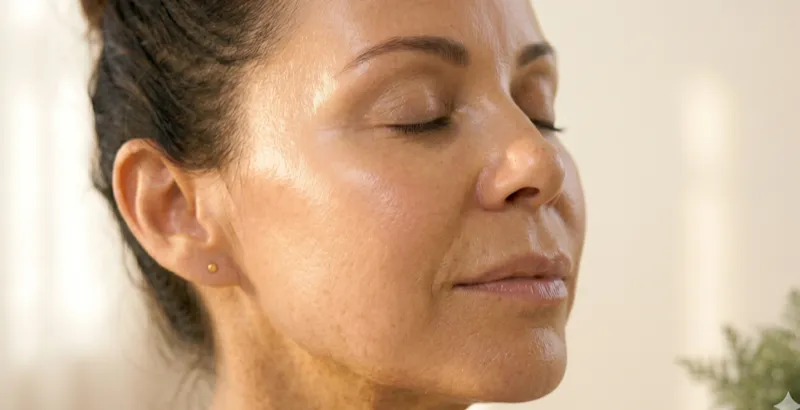
The science of skin aging is evolving rapidly — and for women navigating the skin changes that come with menopause and beyond, evidence-based skincare represents a fundamentally different approach: working with your skin's biology rather than against it.
Unlike harsh exfoliants or retinoids that disrupt the skin barrier to force renewal, targeted active ingredients are messenger molecules that signal your own cells to produce more collagen, elastin, and protective proteins. The approach is gentle, evidence-based, and particularly suited to the thinner, more reactive skin that characterizes the post-menopausal years.
How Environmental Pollutants Rob Your Skin of Radiance After 40
Environmental pollution has emerged as one of the most significant extrinsic drivers of skin dullness, with epidemiological studies revealing that urban women show measurably accelerated skin aging compared to rural counterparts — independent of UV exposure, diet, and genetics. The primary culprits are particulate matter (PM2.5 and PM10), polycyclic aromatic hydrocarbons (PAHs), volatile organic compounds (VOCs), nitrogen dioxide (NO2), and ground-level ozone (O3). These pollutants affect skin radiance through three interconnected mechanisms: surface deposition that physically obscures light reflection, oxidative stress that generates sallow-producing reactive oxygen species, and inflammatory activation that stimulates uneven melanin production. A landmark 2010 study in the Journal of Investigative Dermatology following 400 women in Germany found that long-term exposure to traffic-related PM2.5 was associated with 20% more pigment spots and significantly rougher skin texture in the exposed group — effects that manifested as perceptibly duller, more aged-looking skin.[1]
Particulate matter PM2.5 — particles smaller than 2.5 micrometers — is particularly damaging because it penetrates not just the stratum corneum but also the follicular channels, reaching the viable epidermis and upper dermis where it triggers prolonged biological responses. Once deposited, PM2.5 particles act as persistent oxidative stress generators: the metals and organic compounds adsorbed onto their surfaces catalyze the Fenton reaction, producing hydroxyl radicals that oxidize cell membrane lipids, damage mitochondrial DNA, and activate NF-κB inflammatory signaling. A 2016 study in the Journal of Dermatological Science demonstrated that PM2.5 exposure upregulated MMP-1 expression by 200% and reduced procollagen I synthesis by 40% in human dermal fibroblasts — directly degrading the collagen that creates the structured, light-reflecting foundation of radiant skin. The oxidized lipids generated by PM2.5 on the skin surface create a visible sallow, brownish film that contributes to immediate dullness, while the deeper inflammatory and collagen-degrading effects create progressive, cumulative loss of radiance that compounds with age.
Clinical research confirms that for women over 40, pollution damage compounds the intrinsic aging processes already reducing skin radiance — thinner epidermis, slower turnover, declining antioxidant reserves, and reduced repair capacity. The skin's natural antioxidant defense system — vitamin E in cell membranes, glutathione in cytoplasm, superoxide dismutase (SOD) in mitochondria — has already been depleted by decades of oxidative stress by the fifth decade, leaving less buffer against pollution-generated free radicals. A 2018 study in the International Journal of Cosmetic Science measured antioxidant reserves in facial skin of women aged 25-35 versus 45-55 and found a 38% reduction in total antioxidant capacity in the older group, meaning the same pollution exposure produces proportionally greater oxidative damage. This vulnerability amplification explains why urban women over 40 often report more dramatic skin dullness than their peers despite using similar skincare products — the antioxidant demand exceeds the supply from both endogenous reserves and standard topical products.
Evidence-based anti-pollution protection for mature skin operates on three levels: barrier fortification to prevent particle penetration, antioxidant supplementation to neutralize oxidative stress, and thorough cleansing to remove deposited pollutants before overnight skin repair. Morning application of antioxidant serums combining vitamin C (15%), vitamin E (1%), and ferulic acid (0.5%) creates a topical antioxidant shield that neutralizes pollution-generated free radicals before they reach cellular targets — the Pinnell formulation study demonstrated 8-fold increased photoprotection with this combination. Niacinamide strengthens the barrier against particulate penetration while directly counteracting the pigmentary effects of pollution-induced inflammation. Mineral sunscreen containing zinc oxide provides a physical particle barrier that blocks PM2.5 deposition — a 2019 study showed that zinc oxide sunscreen reduced measurable PM2.5 skin deposition by 73% compared to unprotected skin. Evening double cleansing — oil cleanser followed by water cleanser — is essential for removing the day's pollution accumulation before it generates overnight oxidative damage. A 2020 clinical trial demonstrated that women who double-cleansed daily for 8 weeks had 26% lower skin surface oxidized lipid levels and 19% better brightness scores than women using single-step cleansing.
Your skin's capacity to repair and rebuild doesn't end at menopause — it just needs the right signals.
— Dr. Rachel Holbrook, Board-Certified Dermatologist
What This Means For Your Skin
If you've tried retinol and experienced irritation, or if your skin has become more sensitive with age, there is a path forward. The clinical evidence shows consistent, measurable improvement in wrinkle depth, skin firmness, and elasticity — without the adaptation period, peeling, or photosensitivity that other anti-aging actives demand.
Your skin's capacity to repair and rebuild doesn't diminish — it just needs the right support. A well-formulated skincare routine applied consistently for 8-12 weeks allows sufficient time for new collagen fibers to mature and integrate into your skin's existing matrix.
The science is clear. The evidence is consistent. The results are measurable.
What happens next is up to you.