
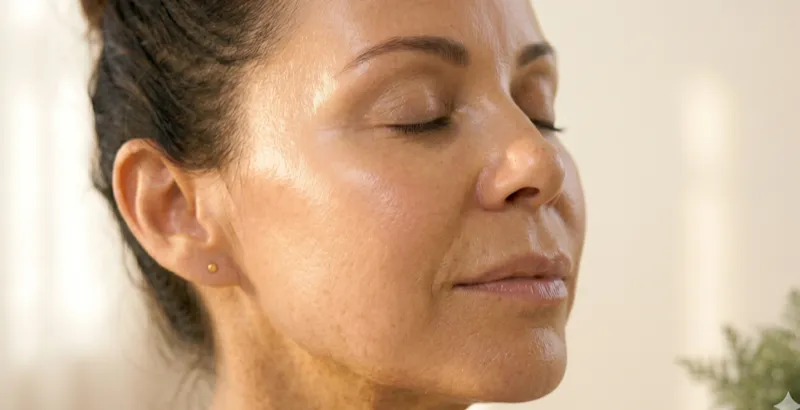
The science of skin aging is evolving rapidly — and for women navigating the skin changes that come with menopause and beyond, evidence-based skincare represents a fundamentally different approach: working with your skin's biology rather than against it.
Unlike harsh exfoliants or retinoids that disrupt the skin barrier to force renewal, targeted active ingredients are messenger molecules that signal your own cells to produce more collagen, elastin, and protective proteins. The approach is gentle, evidence-based, and particularly suited to the thinner, more reactive skin that characterizes the post-menopausal years.
How Sleep, Stress, Diet, and Habits Affect Your Skin's Radiance
Diet and lifestyle factors account for a substantial portion of skin dullness that is independent of — and additive to — the intrinsic aging process, making them modifiable targets for brightening that are often overlooked in favor of topical treatments. Sleep deprivation is the most immediately impactful lifestyle contributor to dull skin, with a 2013 study in the journal Sleep demonstrating that sleep-deprived individuals were perceived as having 'more hanging eyelids, redder eyes, more swollen eyes, darker circles under the eyes, paler skin, more wrinkles/fine lines, and more droopy corners of the mouth' compared to well-rested controls — a cluster of features that collectively constitute 'dull, tired-looking skin.' The mechanism involves cortisol elevation during sleep deprivation, which increases dermal collagen degradation, reduces growth hormone release (the primary driver of overnight skin repair), and constricts superficial blood vessels, diminishing the rosy undertone that contributes to perceived radiance. Chronic sleep restriction (less than 6 hours nightly) also disrupts the circadian regulation of melanin production, contributing to uneven pigmentation that reads as dullness.[1]
Dietary factors influence skin radiance through several interconnected pathways. High-glycemic diets — rich in refined carbohydrates, added sugars, and processed foods — promote advanced glycation end-product (AGE) formation, creating the yellow-brown collagen crosslinks responsible for the sallow, muddy undertone characteristic of dull mature skin. A 2010 study in the British Journal of Dermatology correlated dietary glycemic load with skin autofluorescence (a measure of tissue AGE content) and found that women consuming high-glycemic diets had 28% higher skin AGE levels and correspondingly lower brightness scores than women consuming low-glycemic diets, independent of age and sun exposure. Alcohol consumption contributes to dullness through multiple mechanisms: it causes acute and chronic dehydration (reducing the epidermal water content that creates light-reflecting plumpness), it dilates then constricts blood vessels (creating the alternating flushing and pallor that disrupt even skin tone), and it depletes vitamin A (retinol) stores that are essential for cell turnover regulation. Even moderate alcohol intake (1-2 drinks daily) has been associated with measurably poorer skin hydration and brightness metrics in prospective studies.
Clinical research confirms that chronic psychological stress exerts profound effects on skin radiance through the hypothalamic-pituitary-adrenal (HPA) axis and its cutaneous equivalent. Cortisol — the primary stress hormone — directly degrades collagen through MMP activation, reduces hyaluronic acid synthesis in fibroblasts, and impairs the skin barrier by disrupting lipid synthesis in the stratum corneum. A 2014 study in Brain, Behavior, and Immunity demonstrated that women with chronically elevated cortisol levels had measurably thinner dermis, lower skin hydration, and reduced wound healing capacity — all factors that contribute to dull skin appearance. Beyond cortisol, chronic stress increases substance P and nerve growth factor in cutaneous nerves, triggering neurogenic inflammation that stimulates melanocytes and creates the stress-related pigmentation changes that contribute to uneven, dull tone. Oxidative stress — the systemic imbalance between free radical production and antioxidant defense — compounds these effects by damaging cellular DNA, proteins, and lipids in skin cells, creating the cumulative molecular damage that manifests visually as loss of radiance.
Evidence-based lifestyle modifications for skin brightening complement topical interventions by addressing the internal drivers of dullness. Sleep optimization (7-8 hours, consistent schedule, cool dark environment) restores the nocturnal growth hormone surge that drives overnight collagen synthesis and skin repair, with a 2017 study documenting measurable improvement in skin brightness scores after just 2 weeks of optimized sleep in previously sleep-deprived women. Dietary modification toward a Mediterranean pattern (rich in omega-3 fatty acids, polyphenols, vitamin C, and low-glycemic carbohydrates) reduces both AGE formation and systemic inflammation — a 2018 longitudinal study in the American Journal of Clinical Nutrition found that adherence to Mediterranean dietary patterns correlated with significantly better skin aging scores including radiance at 15-year follow-up. Regular moderate exercise improves skin microcirculation, delivering more oxygen and nutrients to the dermis and creating the warm, rosy undertone associated with healthy radiance — a 2015 study demonstrated that regular exercisers had measurably better skin structure in the dermis and epidermis compared to sedentary controls, even after adjusting for sun exposure. Stress management through mindfulness, meditation, or yoga reduces cortisol and its skin-degrading effects — skin-specific improvements have been documented within 8 weeks of regular practice.
Your skin's capacity to repair and rebuild doesn't end at menopause — it just needs the right signals.
— Dr. Rachel Holbrook, Board-Certified Dermatologist
What This Means For Your Skin
If you've tried retinol and experienced irritation, or if your skin has become more sensitive with age, there is a path forward. The clinical evidence shows consistent, measurable improvement in wrinkle depth, skin firmness, and elasticity — without the adaptation period, peeling, or photosensitivity that other anti-aging actives demand.
Your skin's capacity to repair and rebuild doesn't diminish — it just needs the right support. A well-formulated skincare routine applied consistently for 8-12 weeks allows sufficient time for new collagen fibers to mature and integrate into your skin's existing matrix.
The science is clear. The evidence is consistent. The results are measurable.
What happens next is up to you.