
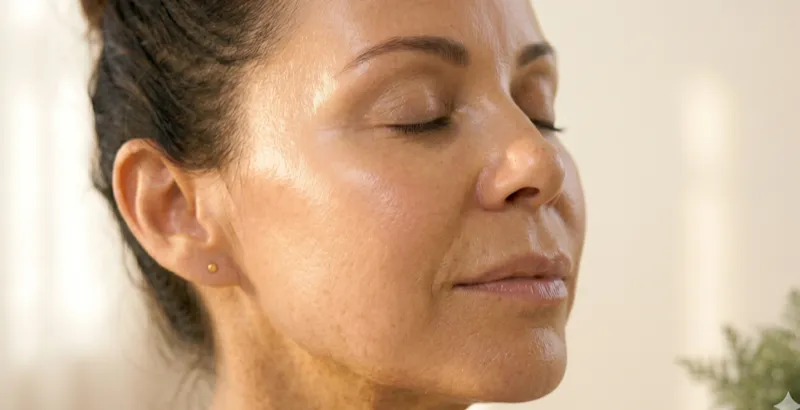
The science of skin aging is evolving rapidly — and for women navigating the skin changes that come with menopause and beyond, evidence-based skincare represents a fundamentally different approach: working with your skin's biology rather than against it.
Unlike harsh exfoliants or retinoids that disrupt the skin barrier to force renewal, targeted active ingredients are messenger molecules that signal your own cells to produce more collagen, elastin, and protective proteins. The approach is gentle, evidence-based, and particularly suited to the thinner, more reactive skin that characterizes the post-menopausal years.
Why Your Skin Loses Its Glow After 40 and How to Restore Radiance
Dull skin in women over 40 is a multifactorial condition driven primarily by the progressive slowdown of epidermal cell turnover — the natural process by which fresh keratinocytes migrate from the basal layer to the skin surface. In younger skin, this cycle completes in approximately 28 days, but research published in the British Journal of Dermatology demonstrates that by age 40, the turnover cycle extends to 40-45 days, and by age 50 it can reach 60-70 days. This deceleration means dead corneocytes accumulate on the skin surface for longer periods, creating a thicker, more irregular stratum corneum that scatters light diffusely rather than reflecting it uniformly. The result is a loss of the luminous, translucent quality associated with youthful skin. Simultaneously, the desquamation process — the shedding of surface cells — becomes less efficient as the enzymes responsible for dissolving intercellular bonds (kallikreins and cathepsins) decrease in activity, leaving a rougher surface texture that further diminishes radiance.[1]
Hormonal changes during perimenopause and menopause fundamentally alter the skin's optical properties through multiple interconnected mechanisms. Declining estrogen reduces the production of hyaluronic acid — the glycosaminoglycan responsible for binding up to 1,000 times its weight in water — leading to decreased dermal hydration that accounts for much of skin's plump, light-reflecting quality. A 2003 study in the American Journal of Clinical Dermatology documented that skin water content decreases by approximately 25% in the first five postmenopausal years, creating a deflated, dull appearance even in women with otherwise healthy skin. Estrogen also regulates melanocyte activity, and its decline can lead to uneven melanin distribution — patches of hyperpigmentation interspersed with lighter areas create an optically heterogeneous surface that reads as 'dull' because the eye perceives uniformity of color as brightness. The loss of estrogen-driven microcirculation further compounds the problem: reduced blood flow to the papillary dermis diminishes the warm, rosy undertone that contributes to perceived radiance.
Clinical research confirms that cumulative environmental damage from UV radiation, pollution, and oxidative stress creates a layer of photodamaged tissue in the upper dermis that permanently alters light interaction with the skin. Solar elastosis — the replacement of organized collagen and elastin with amorphous, dysfunctional elastotic material — changes the dermal architecture from a smooth, light-transmitting matrix to an irregular, light-scattering one. Advanced glycation end-products (AGEs) accumulate in dermal collagen, creating yellowish-brown crosslinks that shift the skin's undertone from luminous ivory-pink toward sallow, muddy tones. A 2012 study in the Journal of Biomedical Optics used spectrophotometry to demonstrate that photoaged skin reflects 15-23% less visible light than age-matched sun-protected skin, with the greatest reduction in the blue-violet spectrum that contributes to the perception of brightness. Particulate matter from urban pollution deposits on the skin surface and penetrates the stratum corneum, further dulling surface reflectivity and generating free radicals that accelerate the oxidative browning of melanin and lipids.
Evidence-based restoration of skin radiance in women over 40 requires addressing all three contributors simultaneously: accelerating cell turnover, restoring hydration and optical uniformity, and repairing environmental damage. Chemical exfoliation with alpha-hydroxy acids (glycolic acid 8-12%) or retinoids accelerates the removal of the accumulated corneocyte layer, revealing the fresher, more uniformly pigmented cells beneath. A 2016 randomized controlled trial in the Journal of Cosmetic Dermatology demonstrated that 8 weeks of nightly glycolic acid application restored cell turnover rates in women aged 45-55 to within 15% of premenopausal baselines, with corresponding improvements in spectrophotometric brightness measurements. Vitamin C (L-ascorbic acid at 15-20%) addresses pigmentary dullness through tyrosinase inhibition while providing antioxidant protection against ongoing environmental damage. Hyaluronic acid restores the dermal water reservoir that creates light-refracting plumpness. The most effective brightening protocols combine these three approaches — exfoliation, antioxidant protection, and hydration — in a systematic routine that respects the mature skin barrier's reduced recovery capacity.
Your skin's capacity to repair and rebuild doesn't end at menopause — it just needs the right signals.
— Dr. Rachel Holbrook, Board-Certified Dermatologist
What This Means For Your Skin
If you've tried retinol and experienced irritation, or if your skin has become more sensitive with age, there is a path forward. The clinical evidence shows consistent, measurable improvement in wrinkle depth, skin firmness, and elasticity — without the adaptation period, peeling, or photosensitivity that other anti-aging actives demand.
Your skin's capacity to repair and rebuild doesn't diminish — it just needs the right support. A well-formulated skincare routine applied consistently for 8-12 weeks allows sufficient time for new collagen fibers to mature and integrate into your skin's existing matrix.
The science is clear. The evidence is consistent. The results are measurable.
What happens next is up to you.