
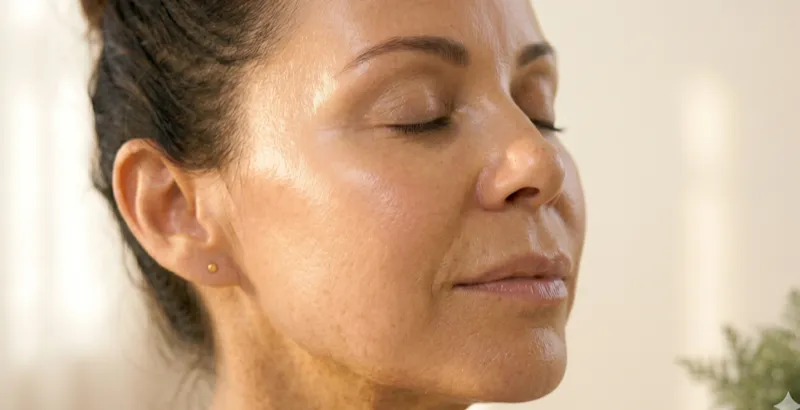
The science of skin aging is evolving rapidly — and for women navigating the skin changes that come with menopause and beyond, evidence-based skincare represents a fundamentally different approach: working with your skin's biology rather than against it.
Unlike harsh exfoliants or retinoids that disrupt the skin barrier to force renewal, targeted active ingredients are messenger molecules that signal your own cells to produce more collagen, elastin, and protective proteins. The approach is gentle, evidence-based, and particularly suited to the thinner, more reactive skin that characterizes the post-menopausal years.
Natural Brightening Methods That Restore Radiance to Mature Skin
Natural skin brightening after 40 centers on restoring the three optical properties that create perceived radiance: surface smoothness for uniform light reflection, adequate hydration for translucency, and even pigmentation for color uniformity. The most impactful natural brightening intervention is accelerating the cell turnover cycle back toward its youthful 28-day baseline, which can be achieved through both enzymatic and chemical exfoliation without harsh synthetic actives. Fruit-derived alpha-hydroxy acids — glycolic acid from sugarcane, lactic acid from fermented milk, mandelic acid from bitter almonds — dissolve the desmosomes binding dead corneocytes to the surface, revealing the fresher, more light-reflective cells beneath. A 2015 study in the Journal of Clinical and Aesthetic Dermatology found that twice-weekly application of 10% glycolic acid for 12 weeks improved skin luminosity scores by 34% in women aged 40-55, with the improvement correlating directly with measured reductions in stratum corneum thickness from an average of 18 micrometers to 12 micrometers.[1]
Vitamin C in its L-ascorbic acid form represents the cornerstone of natural brightening for mature skin, addressing both pigmentary and structural contributors to dullness through multiple mechanisms. As a potent tyrosinase inhibitor, vitamin C blocks the enzymatic conversion of tyrosine to melanin at the rate-limiting step, gradually reducing existing hyperpigmentation while preventing new discoloration. Simultaneously, vitamin C serves as the essential cofactor for prolyl and lysyl hydroxylase — enzymes required for collagen crosslinking — meaning it directly supports the dermal collagen matrix that creates the structured, light-reflecting foundation beneath the epidermis. A landmark 2002 study in Dermatologic Surgery demonstrated that topical 15% L-ascorbic acid applied daily for 12 weeks produced statistically significant improvements in both photoaging scores and skin brightness measurements, with histological biopsies confirming increased collagen deposition. The antioxidant function of vitamin C further protects against the ongoing free radical damage from UV and pollution that creates the oxidized, sallow compounds contributing to dull skin tone.
Clinical research confirms that botanical brightening agents with clinical evidence include licorice root extract (glabridin), arbutin from bearberry, and turmeric-derived curcumin, each targeting melanin overproduction through distinct pathways that complement vitamin C. Glabridin inhibits both tyrosinase activity and melanin transfer from melanocytes to keratinocytes — this dual mechanism makes it more effective than single-pathway inhibitors for the uneven pigmentation that contributes to mature skin dullness. A 2003 study in the Journal of Agricultural and Food Chemistry demonstrated that glabridin at 0.5% concentration inhibited UVB-induced pigmentation by 50% without cytotoxicity to melanocytes. Arbutin — a naturally occurring hydroquinone derivative — releases hydroquinone slowly upon enzymatic hydrolysis in the skin, providing sustained tyrosinase inhibition with significantly less irritation than synthetic hydroquinone. Curcumin provides anti-inflammatory and antioxidant benefits that address the chronic low-grade inflammation ('inflammaging') that stimulates reactive melanin production, particularly in perimenopause when inflammatory cytokines are elevated.
Hydration-based brightening — often underestimated in favor of active ingredients — provides the most immediately visible improvement in dull mature skin. The optical physics are straightforward: well-hydrated stratum corneum cells are plump, uniform in size, and lie flat against each other, creating a smooth surface that reflects light coherently (specular reflection). Dehydrated corneocytes curl at the edges, creating an irregular surface that scatters light diffusely (diffuse reflection), producing the matte, lifeless appearance associated with dullness. A 2018 study in Skin Research and Technology used optical coherence tomography to demonstrate that application of humectant-rich moisturizer increased stratum corneum water content by 42% within 2 hours, with corresponding improvements in skin reflectance measurements that persisted for 8-12 hours. The most effective natural humectants for mature skin include hyaluronic acid (multi-molecular weight), glycerin, aloe vera polysaccharides, and honey-derived sugars — all of which draw and retain water in the epidermis without the occlusive film that can exacerbate the enlarged pores common in perimenopausal skin.
Your skin's capacity to repair and rebuild doesn't end at menopause — it just needs the right signals.
— Dr. Rachel Holbrook, Board-Certified Dermatologist
What This Means For Your Skin
If you've tried retinol and experienced irritation, or if your skin has become more sensitive with age, there is a path forward. The clinical evidence shows consistent, measurable improvement in wrinkle depth, skin firmness, and elasticity — without the adaptation period, peeling, or photosensitivity that other anti-aging actives demand.
Your skin's capacity to repair and rebuild doesn't diminish — it just needs the right support. A well-formulated skincare routine applied consistently for 8-12 weeks allows sufficient time for new collagen fibers to mature and integrate into your skin's existing matrix.
The science is clear. The evidence is consistent. The results are measurable.
What happens next is up to you.