
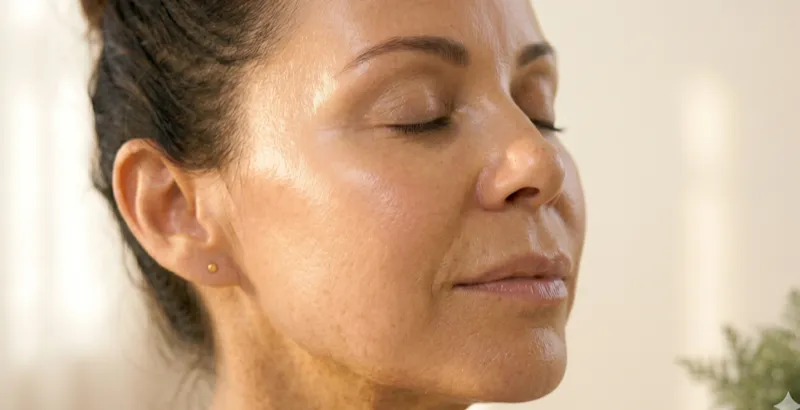
The science of skin aging is evolving rapidly — and for women navigating the skin changes that come with menopause and beyond, evidence-based skincare represents a fundamentally different approach: working with your skin's biology rather than against it.
Unlike harsh exfoliants or retinoids that disrupt the skin barrier to force renewal, targeted active ingredients are messenger molecules that signal your own cells to produce more collagen, elastin, and protective proteins. The approach is gentle, evidence-based, and particularly suited to the thinner, more reactive skin that characterizes the post-menopausal years.
Why L-Ascorbic Acid Is the Gold Standard for Brightening After 40
Vitamin C serum — specifically in its L-ascorbic acid form — is the most extensively validated topical brightening agent for mature skin, with over three decades of peer-reviewed clinical evidence supporting its efficacy across every mechanism that contributes to skin dullness. The molecule functions simultaneously as an antioxidant (neutralizing the reactive oxygen species that create the oxidized, sallow compounds dulling skin tone), a tyrosinase inhibitor (reducing the melanin overproduction responsible for uneven pigmentation), and a collagen synthesis cofactor (rebuilding the dermal matrix that creates light-reflecting depth and translucency). A 2017 systematic review in the Journal of Clinical and Aesthetic Dermatology analyzed 31 clinical trials and concluded that L-ascorbic acid at 10-20% concentration produced statistically significant improvements in skin brightness, pigmentation uniformity, and photoaging scores, with optimal results at the 15% concentration — higher concentrations did not improve outcomes but increased the risk of irritation, particularly in women over 40 whose epidermal barrier is thinner and more susceptible to penetration-related inflammation.[1]
The stability challenge of L-ascorbic acid is the primary obstacle to efficacious vitamin C use in mature skin. L-ascorbic acid is inherently unstable in aqueous solution, oxidizing rapidly when exposed to light, air, or water with a pH above 3.5 — the brown discoloration of a vitamin C serum that has turned amber indicates oxidation to dehydroascorbic acid and further to erythrulic acid, both of which are inactive for brightening and potentially pro-oxidant. For women over 40, this matters clinically: applying oxidized vitamin C not only fails to brighten but can generate free radicals that accelerate the very damage causing dullness. The formulation criteria for effective vitamin C are precise: pH 2.5-3.5 (enabling percutaneous absorption), anhydrous or minimally aqueous vehicles (reducing oxidation), and opaque, airless packaging (preventing light and oxygen exposure). The Pinnell formulation — 15% L-ascorbic acid at pH 3.5 with 1% vitamin E and 0.5% ferulic acid — demonstrated an 8-fold increase in photoprotection and superior stability compared to L-ascorbic acid alone, establishing the benchmark that subsequent formulations have attempted to match.
Clinical research confirms that alternative vitamin C derivatives — sodium ascorbyl phosphate, magnesium ascorbyl phosphate, ascorbyl tetraisopalmitate, and 3-O-ethyl ascorbic acid — offer improved stability at the cost of varying degrees of reduced efficacy. These derivatives require enzymatic conversion to L-ascorbic acid within the skin, and the conversion efficiency varies by derivative and skin type. Sodium ascorbyl phosphate (SAP) is the best-studied derivative, with a 2009 study in Skin Pharmacology and Physiology demonstrating significant brightening effects at 5% concentration, though the magnitude of improvement was approximately 60% of that achieved with equivalent L-ascorbic acid concentrations. For women over 40 with sensitive or rosacea-prone skin who cannot tolerate the low pH of L-ascorbic acid formulations, SAP at neutral pH provides a meaningful brightening effect with negligible irritation. Ascorbyl glucoside, another stable derivative, showed comparable tyrosinase inhibition to L-ascorbic acid in vitro but required 12-16 weeks for visible brightening versus 6-8 weeks for L-ascorbic acid, reflecting the slower enzymatic conversion rate.
The optimal vitamin C protocol for brightening dull mature skin involves specific timing, layering, and combination strategies that maximize dermal delivery and sustained activity. Morning application is preferred because vitamin C's antioxidant function provides daytime photoprotection — a 2008 study in the Journal of Investigative Dermatology demonstrated that pre-treatment with topical vitamin C reduced UV-induced erythema by 52% and MMP-1 expression by 64%, effectively functioning as a biological sunscreen complement. Application to bare, freshly cleansed skin at pH 5.5 ensures the acid-mantle environment supports L-ascorbic acid penetration; applying over other products creates a buffering layer that raises surface pH and reduces absorption. Wait 15 minutes for vitamin C penetration before applying subsequent products. Combining vitamin C with vitamin E and ferulic acid synergistically enhances both stability and efficacy — the Pinnell formulation study demonstrated that this triple combination maintained 90% potency for 7 days versus 24 hours for vitamin C alone. For maximum brightening, pair morning vitamin C with evening retinoid therapy: vitamin C addresses pigmentary dullness and provides daytime protection, while retinoids accelerate the cell turnover that removes the dull surface layer.
Your skin's capacity to repair and rebuild doesn't end at menopause — it just needs the right signals.
— Dr. Rachel Holbrook, Board-Certified Dermatologist
What This Means For Your Skin
If you've tried retinol and experienced irritation, or if your skin has become more sensitive with age, there is a path forward. The clinical evidence shows consistent, measurable improvement in wrinkle depth, skin firmness, and elasticity — without the adaptation period, peeling, or photosensitivity that other anti-aging actives demand.
Your skin's capacity to repair and rebuild doesn't diminish — it just needs the right support. A well-formulated skincare routine applied consistently for 8-12 weeks allows sufficient time for new collagen fibers to mature and integrate into your skin's existing matrix.
The science is clear. The evidence is consistent. The results are measurable.
What happens next is up to you.