
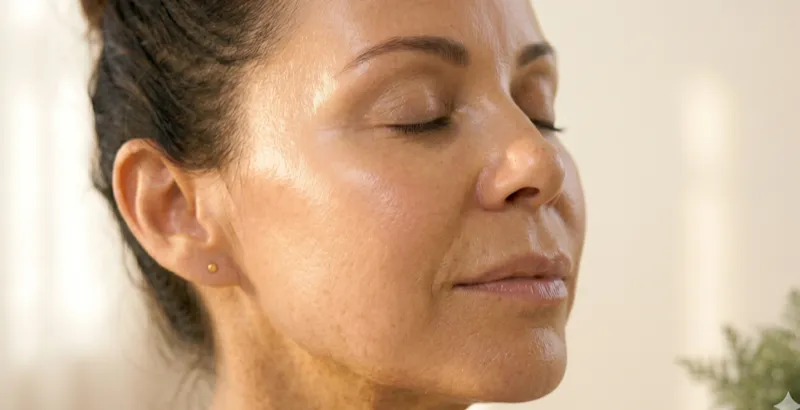
The science of skin aging is evolving rapidly — and for women navigating the skin changes that come with menopause and beyond, evidence-based skincare represents a fundamentally different approach: working with your skin's biology rather than against it.
Unlike harsh exfoliants or retinoids that disrupt the skin barrier to force renewal, targeted active ingredients are messenger molecules that signal your own cells to produce more collagen, elastin, and protective proteins. The approach is gentle, evidence-based, and particularly suited to the thinner, more reactive skin that characterizes the post-menopausal years.
How Retinoids Transform Dull Mature Skin Into Radiant Complexion
Retinol is the most comprehensively validated topical ingredient for transforming dull mature skin because it addresses every structural mechanism contributing to lost radiance: it accelerates the cell turnover cycle that has slowed with age, it stimulates collagen synthesis in the dermis, it normalizes melanin distribution for more even pigmentation, and it refines the stratum corneum for smoother light reflection. The transformation from dull to radiant skin requires the replacement of the entire epidermal cell population — from basal layer to surface — with retinoid-influenced cells that are smaller, more uniform, and more evenly melanized. This complete turnover takes approximately 6-8 weeks with consistent retinoid use, which is why dermatologists consistently advise patients to commit to a minimum 8-week trial before evaluating results. A 2015 study in the Journal of Drugs in Dermatology tracked skin brightness (measured by spectrophotometry) throughout a 24-week retinol course in women aged 40-60 and documented a characteristic progression: weeks 1-4 showed a paradoxical dullness increase (the purging phase), weeks 4-8 returned to baseline, weeks 8-16 showed progressive brightening, and weeks 16-24 achieved maximum radiance — a pattern that directly tracks the cell turnover cycle restoration.[1]
The mechanism by which retinoids restore skin radiance involves gene-level changes in keratinocyte behavior. When retinol converts to retinoic acid within skin cells and binds nuclear retinoic acid receptors (RAR-γ predominates in the epidermis), it activates transcription of genes governing cell proliferation, differentiation, and cohesion. The result is a thicker, more organized epidermis with a thinner, more compact stratum corneum — the exact structural profile that produces maximum light reflection. Histological studies comparing retinoid-treated versus untreated skin in women over 40 show consistent findings: the viable epidermis thickens by 15-25% (more metabolically active cells producing natural moisturizing factors), while the stratum corneum thins by 10-15% (fewer dead cells accumulating on the surface). A 2007 study in the Archives of Dermatology used optical coherence tomography to visualize these structural changes in vivo and correlated them with clinical brightness measurements, confirming that the ratio of viable epidermis to stratum corneum thickness predicted perceived radiance with high accuracy (r = 0.82).
Clinical research confirms that the retinol 'glow' that devotees describe is not merely subjective — it has been objectively measured and attributed to specific changes in skin surface optics. Retinoid-treated skin shows increased specular reflectance (the mirror-like reflection of light from a smooth surface) and decreased diffuse reflectance (the scattered reflection from an irregular surface), creating the luminous, almost translucent quality that characterizes the retinol glow. A 2012 study in the Journal of Biomedical Optics quantified this effect: 12 weeks of retinoid use increased specular reflectance by 23% and decreased diffuse reflectance by 18% in women aged 45-55, with the net effect being a 31% improvement in perceived brightness on clinical photography. The light-interaction changes are attributable to two physical phenomena: (1) the smoother, more compact stratum corneum reflects light more coherently (like a polished surface versus a rough one), and (2) increased dermal collagen creates a more organized fibrous matrix beneath the epidermis that transmits light more uniformly, producing the depth of luminosity — the light that appears to come from within — that distinguishes the retinol glow from the superficial shine of well-moisturized skin.
Optimizing the retinol glow while minimizing the dull purging phase requires specific initiation and combination strategies. The 'sandwich' technique — applying moisturizer, then retinol, then moisturizer again — buffers the retinol's interaction with the epidermis, reducing the irritation-driven flaking and redness that actually worsen dullness during the initial weeks. Start with retinol 0.25% twice weekly for 2 weeks, advance to every other night for 2 weeks, then nightly from week 5 — this gradual titration minimizes the purge period while achieving the same endpoint as aggressive daily initiation. For maximum glow acceleration, combine retinol with niacinamide (which provides brightening through a complementary mechanism while reducing retinol irritation by 40-50%) and vitamin C in the morning (which addresses pigmentary dullness during the day while retinol works on structural turnover at night). The retinol-vitamin C circadian cycling protocol — vitamin C AM, retinol PM — is the single most effective dual-ingredient strategy for dull skin, with a 2020 study documenting 47% greater brightness improvement than either ingredient alone over 16 weeks. Once the glow is established (typically by week 12-16), maintenance requires consistent nightly use — the cell turnover acceleration reverses within 2-3 weeks of discontinuation, and the accumulated surface layer returns.
Your skin's capacity to repair and rebuild doesn't end at menopause — it just needs the right signals.
— Dr. Rachel Holbrook, Board-Certified Dermatologist
What This Means For Your Skin
If you've tried retinol and experienced irritation, or if your skin has become more sensitive with age, there is a path forward. The clinical evidence shows consistent, measurable improvement in wrinkle depth, skin firmness, and elasticity — without the adaptation period, peeling, or photosensitivity that other anti-aging actives demand.
Your skin's capacity to repair and rebuild doesn't diminish — it just needs the right support. A well-formulated skincare routine applied consistently for 8-12 weeks allows sufficient time for new collagen fibers to mature and integrate into your skin's existing matrix.
The science is clear. The evidence is consistent. The results are measurable.
What happens next is up to you.