
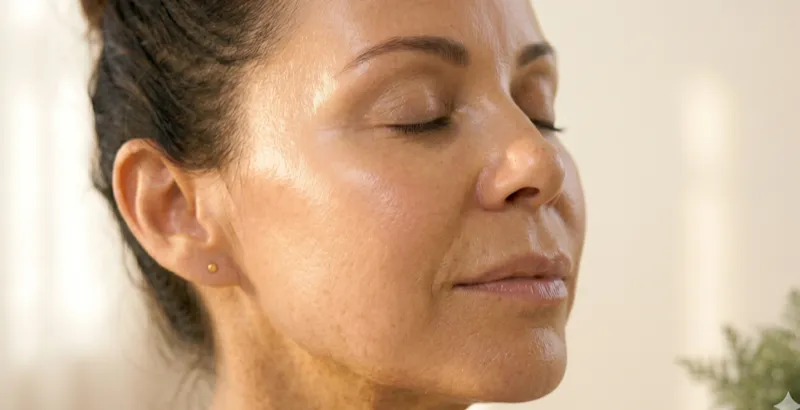
The science of skin aging is evolving rapidly — and for women navigating the skin changes that come with menopause and beyond, evidence-based skincare represents a fundamentally different approach: working with your skin's biology rather than against it.
Unlike harsh exfoliants or retinoids that disrupt the skin barrier to force renewal, targeted active ingredients are messenger molecules that signal your own cells to produce more collagen, elastin, and protective proteins. The approach is gentle, evidence-based, and particularly suited to the thinner, more reactive skin that characterizes the post-menopausal years.
How AHA Exfoliation Restores Luminosity After 40
Glycolic acid — the smallest alpha-hydroxy acid with a molecular weight of just 76 daltons — penetrates the stratum corneum more effectively than any other AHA, making it the most potent chemical exfoliant for addressing the thickened, irregular corneocyte layer responsible for dull skin appearance in women over 40. Its mechanism is well-characterized: glycolic acid chelates the calcium ions that stabilize desmosomes (the protein bridges connecting adjacent corneocytes), weakening intercellular adhesion and promoting the shedding of accumulated dead cells. This process — technically called corneolysis — reveals the newer, more uniform keratinocytes beneath that reflect light more efficiently. A 2009 study in the Journal of Cosmetic Dermatology measured stratum corneum thickness before and after 8 weeks of 10% glycolic acid use in women aged 40-60 and documented a 28% reduction in corneocyte layer depth, with direct correlation to spectrophotometric brightness improvement (r = 0.76). The exfoliation also enhances the penetration of subsequent brightening actives by reducing the barrier thickness they must traverse.[1]
For mature skin, glycolic acid provides brightening benefits beyond simple exfoliation through direct effects on dermal collagen and pigmentation. At pH 3.5-4.0, glycolic acid penetrates to the papillary dermis where it stimulates fibroblast activity and upregulates collagen synthesis — a 2003 histological study in Dermatologic Surgery confirmed increased procollagen I expression in the upper dermis after 12 weeks of 8% glycolic acid application in postmenopausal women. This new collagen formation improves dermal light transmission, contributing to the deep luminosity that distinguishes genuinely healthy skin from superficially smooth skin. Glycolic acid also inhibits melanin transfer from melanocytes to keratinocytes by disrupting the melanosome packaging process, gradually reducing the uneven pigmentation that creates the optical heterogeneity perceived as dullness. A 2014 split-face trial comparing glycolic acid to placebo in women with moderate photoaging found that glycolic acid produced 42% greater improvement in pigmentation uniformity scores after 16 weeks, with improvement continuing through 24 weeks as cumulative cell turnover cycles replaced hyperpigmented cells with evenly melanized ones.
Clinical research confirms that concentration and frequency calibration is critical for glycolic acid use on mature skin, where the thinner epidermis and compromised barrier increase the risk of over-exfoliation that paradoxically worsens dullness through chronic inflammation. Clinical dermatology guidelines recommend starting at 5-8% concentration for daily leave-on products and 15-30% for weekly peel treatments, with gradual escalation based on tolerance. The pH of the formulation determines free acid availability and therefore potency: a 10% glycolic acid product at pH 3.5 delivers approximately 75% free acid, while the same concentration at pH 4.5 delivers only 37% — this means a higher-concentration product at higher pH may be less potent than a lower-concentration product at optimal pH. For women over 40, the 'sweet spot' documented in clinical literature is 8-10% glycolic acid at pH 3.8-4.0 for nightly use, which provides effective exfoliation while maintaining sufficient buffering to protect the mature skin barrier. Signs of over-exfoliation — persistent tightness, visible flaking, increased sensitivity to previously tolerated products — should prompt immediate reduction in frequency or concentration.
Integration of glycolic acid into a comprehensive brightening routine requires strategic scheduling with other actives to prevent ingredient conflicts and barrier overload. The most effective evidence-based approach alternates glycolic acid with retinoid therapy: glycolic acid on Monday-Wednesday-Friday evenings removes surface corneocytes and enhances penetration, while retinoid on Tuesday-Thursday-Saturday drives deeper collagen stimulation and cell turnover regulation. Sunday serves as a barrier recovery day with hydrating and ceramide-rich products only. Morning vitamin C complements evening glycolic acid by addressing pigmentary dullness through a different mechanism (tyrosinase inhibition versus enhanced desquamation), and the combination produces brighter results than either alone — a 2019 clinical study reported 56% greater luminosity improvement with the glycolic-vitamin C combination versus vitamin C alone over 12 weeks. Niacinamide at 4-5% can be applied in the same routine as glycolic acid (over glycolic acid after a 5-minute wait) to provide anti-inflammatory and barrier-strengthening support that buffers glycolic acid's mild irritant potential.
Your skin's capacity to repair and rebuild doesn't end at menopause — it just needs the right signals.
— Dr. Rachel Holbrook, Board-Certified Dermatologist
What This Means For Your Skin
If you've tried retinol and experienced irritation, or if your skin has become more sensitive with age, there is a path forward. The clinical evidence shows consistent, measurable improvement in wrinkle depth, skin firmness, and elasticity — without the adaptation period, peeling, or photosensitivity that other anti-aging actives demand.
Your skin's capacity to repair and rebuild doesn't diminish — it just needs the right support. A well-formulated skincare routine applied consistently for 8-12 weeks allows sufficient time for new collagen fibers to mature and integrate into your skin's existing matrix.
The science is clear. The evidence is consistent. The results are measurable.
What happens next is up to you.