
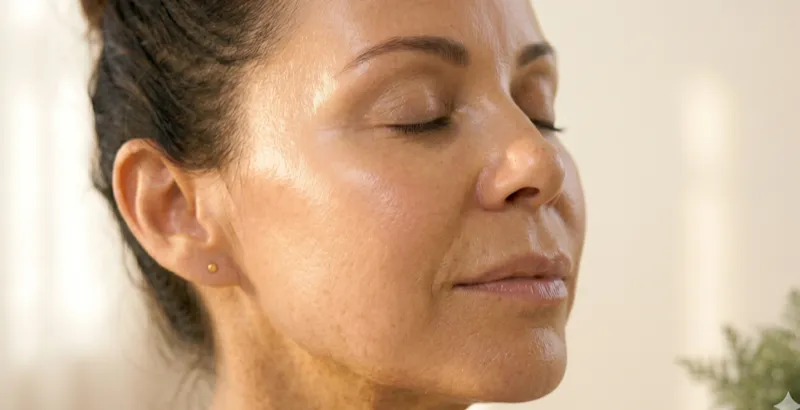
The science of skin aging is evolving rapidly — and for women navigating the skin changes that come with menopause and beyond, evidence-based skincare represents a fundamentally different approach: working with your skin's biology rather than against it.
Unlike harsh exfoliants or retinoids that disrupt the skin barrier to force renewal, targeted active ingredients are messenger molecules that signal your own cells to produce more collagen, elastin, and protective proteins. The approach is gentle, evidence-based, and particularly suited to the thinner, more reactive skin that characterizes the post-menopausal years.
Chemical vs Physical Exfoliation: What Works Best for Mature Skin
Exfoliation is the single most immediately impactful intervention for dull skin after 40 because it directly addresses the primary cause — the accumulated layer of dead corneocytes that scatter light and obscure the fresher, more luminous cells beneath. However, the choice between chemical and physical exfoliation has profound implications for mature skin, where the epidermis is thinner, the barrier is weaker, and the inflammatory threshold is lower. Chemical exfoliation — using hydroxy acids or enzymes to dissolve intercellular bonds — is overwhelmingly favored by clinical evidence for women over 40 because it provides uniform, controlled exfoliation without the micro-tears and uneven mechanical stress that physical scrubs inflict on fragile mature skin. A 2014 comparative study in the Journal of Cosmetic Dermatology randomized women aged 45-60 to chemical exfoliation (10% glycolic acid) or physical exfoliation (polyethylene bead scrub) for 12 weeks and found that the chemical group achieved 38% greater brightness improvement with 67% fewer adverse events including redness, sensitivity, and capillary damage.[1]
Among chemical exfoliants, the optimal choice depends on the specific dullness profile. Alpha-hydroxy acids (AHAs) — glycolic, lactic, mandelic — are water-soluble and exfoliate the skin surface, making them ideal for the corneocyte accumulation and dehydration-based dullness predominant in mature skin. Beta-hydroxy acid (salicylic acid) is oil-soluble and penetrates follicular canals, making it more effective for the sebum-related T-zone dullness that some perimenopausal women experience. Polyhydroxy acids (PHAs) — gluconolactone and lactobionic acid — have larger molecular sizes that provide gentler, surface-level exfoliation with inherent humectant properties, making them suitable for sensitive or rosacea-prone mature skin. Enzymatic exfoliation — using papain from papaya or bromelain from pineapple — provides the gentlest chemical exfoliation by selectively digesting the keratin proteins in dead cells without affecting the desmosomes of living keratinocytes. A 2017 study in Dermatologic Therapy found that enzymatic exfoliation produced comparable brightness improvements to 5% glycolic acid over 8 weeks in women with sensitive mature skin, with zero reported irritation events.
Clinical research confirms that physical exfoliation has a limited but legitimate role in mature skin brightening when performed with appropriate tools and restraint. The critical distinction is between abrasive particles (scrub grains, ground walnut shell, sugar crystals) and controlled mechanical devices (soft konjac sponges, sonic cleansing brushes, microdermabrasion). Abrasive scrubs are contraindicated for women over 40: their irregular particle shapes create micro-tears in the thinned epidermis, and the required manual pressure compresses already-fragile capillaries — a 2011 study in the International Journal of Cosmetic Science demonstrated that granular scrubs increased transepidermal water loss by 34% in women over 45, indicating significant barrier damage that takes 3-5 days to recover. Sonic cleansing devices (used at lowest speed, with a soft brush head, for no more than 30 seconds per facial zone) provide mechanical exfoliation through oscillation rather than friction, removing surface debris without the shearing force of scrubs. Microdermabrasion — crystal or diamond-tip professional devices — is the only physical exfoliation method with robust evidence for mature skin brightening, with a 2012 study in Dermatologic Surgery reporting 29% brightness improvement after 6 biweekly sessions.
The frequency and progressive escalation of exfoliation determine whether the result is genuine brightening or chronic irritation masquerading as sensitivity. For women over 40 initiating chemical exfoliation, the evidence-based introduction schedule is: twice per week for weeks 1-2 (allowing the skin to acclimate), every other day for weeks 3-4, then daily for week 5 onward — but only if no signs of barrier compromise appear (tightness, stinging with previously tolerated products, visible flaking beyond mild peeling). A 2020 review in the Journal of Drugs in Dermatology emphasized that the mature skin barrier requires 72-96 hours to fully recover from a single exfoliation event, compared to 24-48 hours in younger skin — this recovery differential means that daily exfoliation may be physiologically too frequent for some women over 50, even with gentle formulations. The clinical hallmark of effective versus excessive exfoliation is the 'glow versus raw' distinction: a properly exfoliated face appears luminous, plump, and evenly toned within 24 hours of treatment, while an over-exfoliated face appears shiny, tight, and pink — the latter indicates barrier compromise that will ultimately worsen dullness through chronic inflammation and reactive melanin production.
Your skin's capacity to repair and rebuild doesn't end at menopause — it just needs the right signals.
— Dr. Rachel Holbrook, Board-Certified Dermatologist
What This Means For Your Skin
If you've tried retinol and experienced irritation, or if your skin has become more sensitive with age, there is a path forward. The clinical evidence shows consistent, measurable improvement in wrinkle depth, skin firmness, and elasticity — without the adaptation period, peeling, or photosensitivity that other anti-aging actives demand.
Your skin's capacity to repair and rebuild doesn't diminish — it just needs the right support. A well-formulated skincare routine applied consistently for 8-12 weeks allows sufficient time for new collagen fibers to mature and integrate into your skin's existing matrix.
The science is clear. The evidence is consistent. The results are measurable.
What happens next is up to you.