
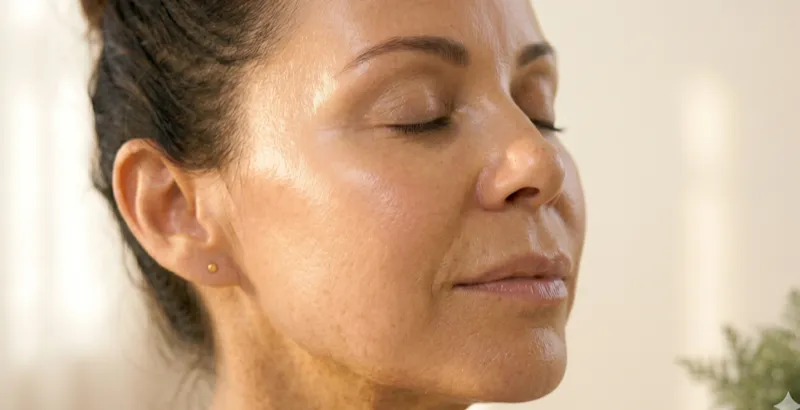
The science of skin aging is evolving rapidly — and for women navigating the skin changes that come with menopause and beyond, evidence-based skincare represents a fundamentally different approach: working with your skin's biology rather than against it.
Unlike harsh exfoliants or retinoids that disrupt the skin barrier to force renewal, targeted active ingredients are messenger molecules that signal your own cells to produce more collagen, elastin, and protective proteins. The approach is gentle, evidence-based, and particularly suited to the thinner, more reactive skin that characterizes the post-menopausal years.
Why Skin Feels Rough After 40 and How to Restore Smoothness
Skin texture roughness after 40 is a tactile and visual manifestation of the same epidermal structural changes that cause dullness — specifically, the accumulation of irregularly shaped, poorly hydrated corneocytes on the skin surface combined with reduced desmosomal dissolution and uneven desquamation patterns. In younger skin, corneocytes are uniform in size, lie flat against each other, and shed evenly through enzymatic breakdown of their intercellular bonds. After 40, the corneocyte transit time extends significantly, and the cells that reach the surface are larger, more variable in shape, and more firmly attached to their neighbors. A 2017 study in the International Journal of Cosmetic Science used confocal laser scanning microscopy to compare stratum corneum architecture in women aged 25-35 versus 45-55 and found that the older cohort had 34% greater variability in corneocyte surface area, 41% greater variability in cell thickness, and 52% more corneocyte 'stacks' (areas where cells failed to shed and accumulated vertically). This irregular surface topography creates the rough texture that women describe as 'bumpy,' 'grainy,' or 'crepe-like' — and that contributes significantly to dull appearance by scattering light diffusely.[1]
The dermal contribution to surface texture roughness involves collagen and elastin degradation that alters the structural foundation beneath the epidermis. When dermal collagen fibers degrade and fragment, the smooth, taut platform that supports the epidermis becomes uneven and less resilient — the epidermis follows this uneven contour, creating surface irregularities visible as texture issues. Solar elastosis — the accumulation of amorphous, degraded elastin material — further disrupts the orderly architecture of the papillary dermis, creating localized bumps and depressions that manifest as textural roughness on the skin surface. A 2014 study in Skin Research and Technology used silicone replica analysis to correlate dermal collagen density (measured by ultrasound) with surface roughness metrics in women aged 40-65 and found a strong inverse correlation (r = -0.71): the less collagen, the rougher the surface. This dermal-epidermal connection explains why treatments that only address the surface layer (scrubs, peels) produce temporary smoothness, while treatments that rebuild dermal collagen (retinoids, vitamin C) produce lasting textural improvement.
Clinical research confirms that barrier function decline directly contributes to perceived roughness through altered water distribution in the stratum corneum. The intercellular lipid matrix — composed of ceramides, cholesterol, and free fatty acids in a precise ratio — normally maintains an even distribution of moisture across the stratum corneum, keeping all corneocytes uniformly hydrated and flat. After 40, declining ceramide production (accelerated by estrogen loss) creates gaps in this lipid matrix, allowing uneven moisture distribution: some corneocytes remain hydrated and plump while adjacent cells dehydrate and curl at the edges, creating a micro-topography of bumps and valleys that the finger perceives as rough texture. A 2011 study in the Journal of Investigative Dermatology demonstrated that restoring ceramide levels in the stratum corneum of mature skin improved surface roughness metrics by 37% within 4 weeks — faster than any active ingredient-based approach — confirming that barrier repair is the most immediately impactful intervention for texture improvement.
The evidence-based approach to texture restoration in mature skin layers three strategies: surface refinement, barrier repair, and structural rebuilding. Surface refinement through chemical exfoliation (glycolic acid 8-10% nightly, or lactic acid 10% for sensitive skin) removes the accumulated, irregularly attached corneocytes that create rough texture, revealing the smoother cells beneath. Barrier repair through ceramide-containing moisturizers restores the even moisture distribution that keeps surface cells uniformly flat and smooth — look for formulations containing ceramide NP, ceramide AP, and ceramide EOP in combination with cholesterol and fatty acids, which replicate the skin's natural lipid ratio. Structural rebuilding through retinoid therapy and vitamin C addresses the dermal irregularity that creates lasting roughness — a 2016 study confirmed that the combination of nightly retinol with morning vitamin C produced 52% greater texture improvement at 24 weeks compared to either ingredient alone, as each addresses a different aspect of the rough texture complex (retinol: cell turnover and collagen; vitamin C: collagen crosslinking and antioxidant protection). Professional treatments including microneedling and fractional laser directly stimulate new collagen in the papillary dermis, producing the smooth dermal platform that allows the epidermis to lie flat and uniform.
Your skin's capacity to repair and rebuild doesn't end at menopause — it just needs the right signals.
— Dr. Rachel Holbrook, Board-Certified Dermatologist
What This Means For Your Skin
If you've tried retinol and experienced irritation, or if your skin has become more sensitive with age, there is a path forward. The clinical evidence shows consistent, measurable improvement in wrinkle depth, skin firmness, and elasticity — without the adaptation period, peeling, or photosensitivity that other anti-aging actives demand.
Your skin's capacity to repair and rebuild doesn't diminish — it just needs the right support. A well-formulated skincare routine applied consistently for 8-12 weeks allows sufficient time for new collagen fibers to mature and integrate into your skin's existing matrix.
The science is clear. The evidence is consistent. The results are measurable.
What happens next is up to you.