
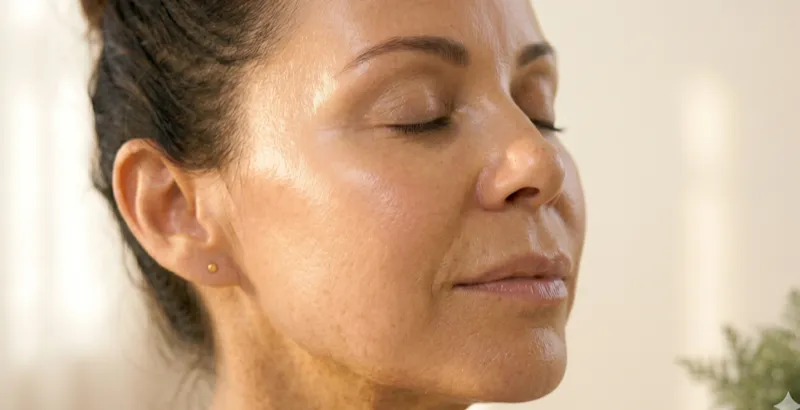
The science of skin aging is evolving rapidly — and for women navigating the skin changes that come with menopause and beyond, evidence-based skincare represents a fundamentally different approach: working with your skin's biology rather than against it.
Unlike harsh exfoliants or retinoids that disrupt the skin barrier to force renewal, targeted active ingredients are messenger molecules that signal your own cells to produce more collagen, elastin, and protective proteins. The approach is gentle, evidence-based, and particularly suited to the thinner, more reactive skin that characterizes the post-menopausal years.
How Vitamin B3 Restores Even Tone and Radiance to Mature Skin
Niacinamide (nicotinamide, vitamin B3) has emerged as one of the most versatile brightening ingredients for mature skin, with a uniquely gentle mechanism that addresses multiple dullness pathways without the irritation associated with direct acids or retinoids. Its primary brightening mechanism — inhibition of melanosome transfer from melanocytes to keratinocytes — is fundamentally different from tyrosinase inhibitors like vitamin C or hydroquinone. Rather than reducing melanin production, niacinamide prevents the dispersal of existing melanin granules to surrounding skin cells, gradually creating a more uniform, brighter complexion as old melanin-laden keratinocytes shed naturally and are replaced by cells with lower melanin loads. A landmark 2002 study in the British Journal of Dermatology demonstrated that 5% niacinamide reduced hyperpigmented spots by 35% and improved overall skin brightness by 22% over 8 weeks — effects achieved without any change in melanocyte activity or melanin synthesis rates, confirming the transfer-inhibition mechanism.[1]
The barrier-strengthening properties of niacinamide contribute to brightening through an indirect but clinically significant mechanism. By stimulating the synthesis of ceramides, cholesterol, and free fatty acids — the three lipid classes comprising the intercellular 'mortar' of the stratum corneum — niacinamide creates a smoother, more uniform epidermal surface that reflects light more coherently. A 2005 study in Dermatologic Surgery documented that 12 weeks of 2% niacinamide application increased total ceramide content by 34% in the stratum corneum of women aged 40-60, with corresponding improvements in skin texture smoothness scores and reflectance measurements. This barrier effect is particularly valuable during perimenopause, when declining estrogen reduces endogenous ceramide production and creates the rough, patchy texture that contributes to dull appearance. Additionally, the strengthened barrier reduces transepidermal water loss, maintaining the hydration that creates the plump, light-refracting surface associated with radiant skin.
Clinical research confirms that niacinamide's anti-inflammatory properties address the chronic low-grade inflammation ('inflammaging') that stimulates reactive melanin production and creates the mottled, uneven complexion characteristic of mature skin dullness. By inhibiting NF-κB — the master regulator of inflammatory gene expression — niacinamide reduces the production of pro-inflammatory cytokines (IL-1, IL-6, TNF-α) that activate melanocytes to produce excess melanin in response to UV exposure, friction, or hormonal fluctuations. This anti-inflammatory mechanism explains why niacinamide is effective for post-inflammatory hyperpigmentation (the dark marks left by acne, dermatitis, or injury) that frequently affects perimenopausal skin. A 2013 study in the Journal of Cosmetic and Laser Therapy found that 4% niacinamide reduced post-inflammatory hyperpigmentation by 44% over 8 weeks in women aged 35-55, with the improvement attributable to both melanin transfer inhibition and inflammation reduction. The anti-inflammatory effect also allows niacinamide to be safely combined with potentially irritating actives like retinol and glycolic acid, functioning as a buffer that permits higher concentrations and more frequent use of these complementary brightening agents.
The optimal niacinamide protocol for brightening mature skin involves specific concentration, timing, and combination strategies validated by clinical evidence. Concentrations of 4-5% represent the efficacy plateau for brightening — a dose-response study in the International Journal of Cosmetic Science found no additional brightening benefit above 5%, while concentrations of 10% or higher increased the risk of facial flushing in approximately 15% of women over 40. Twice-daily application (morning and evening) is superior to once-daily, as the ceramide synthesis and melanin transfer inhibition follow dose-dependent accumulation curves. Niacinamide is remarkably compatible with nearly all other actives: it can be layered over vitamin C (despite the persistent myth that they interact negatively — a myth definitively debunked by a 2019 stability study in the Journal of Cosmetic Science), applied before retinol to reduce irritation while maintaining brightening efficacy, and mixed with hyaluronic acid for combined hydration and brightening. The minimum treatment duration for visible brightening is 4 weeks, with progressive improvement continuing through 12-16 weeks — substantially longer than exfoliant-based brightening but with permanent results rather than the temporary surface effect of acid-based approaches.
Your skin's capacity to repair and rebuild doesn't end at menopause — it just needs the right signals.
— Dr. Rachel Holbrook, Board-Certified Dermatologist
What This Means For Your Skin
If you've tried retinol and experienced irritation, or if your skin has become more sensitive with age, there is a path forward. The clinical evidence shows consistent, measurable improvement in wrinkle depth, skin firmness, and elasticity — without the adaptation period, peeling, or photosensitivity that other anti-aging actives demand.
Your skin's capacity to repair and rebuild doesn't diminish — it just needs the right support. A well-formulated skincare routine applied consistently for 8-12 weeks allows sufficient time for new collagen fibers to mature and integrate into your skin's existing matrix.
The science is clear. The evidence is consistent. The results are measurable.
What happens next is up to you.