
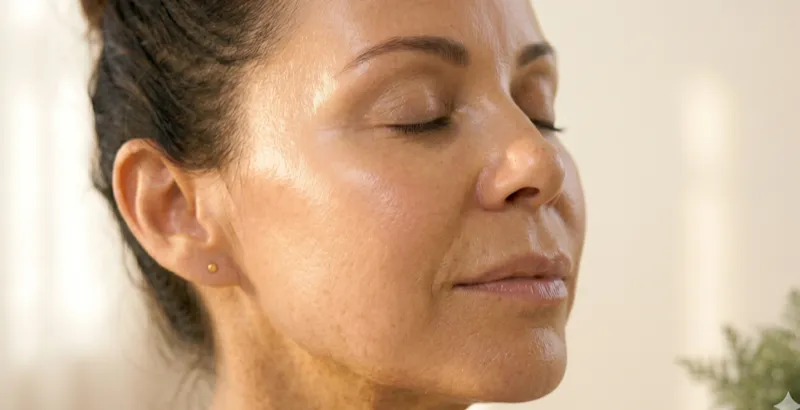
The science of skin aging is evolving rapidly — and for women navigating the skin changes that come with menopause and beyond, evidence-based skincare represents a fundamentally different approach: working with your skin's biology rather than against it.
Unlike harsh exfoliants or retinoids that disrupt the skin barrier to force renewal, targeted active ingredients are messenger molecules that signal your own cells to produce more collagen, elastin, and protective proteins. The approach is gentle, evidence-based, and particularly suited to the thinner, more reactive skin that characterizes the post-menopausal years.
Why Pigmentation Changes and How to Restore Even Tone After 40
Dark spots and uneven skin tone in the 40s represent the cumulative convergence of decades of UV exposure, hormonal fluctuations, and the natural decline in the skin's melanin-regulation mechanisms. Melanocytes — the pigment-producing cells scattered throughout the basal epidermis — undergo age-related changes that fundamentally alter their behavior: while their total number decreases by approximately 6-8% per decade after age 30, the remaining melanocytes become irregularly distributed and functionally dysregulated, producing melanin in unpredictable patterns rather than the even distribution characteristic of younger skin. A 2010 study in Pigment Cell & Melanoma Research documented that melanocytes in chronically sun-exposed skin of women over 40 showed 2.3 times greater variability in melanin output compared to sun-protected skin of the same individuals, with some melanocytes producing excessive melanin (creating dark spots) while adjacent melanocytes produced minimal melanin (creating lighter areas). This cellular-level heterogeneity creates the mottled, uneven complexion perceived as both dull and aged.[1]
Hormonal contributions to uneven pigmentation become particularly significant during perimenopause, when estrogen fluctuations directly modulate melanocyte activity through estrogen receptor beta (ERβ) signaling. Estrogen stimulates melanin synthesis — this is why pregnancy frequently triggers melasma (the 'mask of pregnancy') — and the erratic estrogen surges of perimenopause can reactivate dormant melasma patterns or create new areas of hormonally-driven hyperpigmentation. A 2015 study in the Journal of the American Academy of Dermatology found that 33% of women aged 40-55 reported new-onset or worsening facial pigmentation during perimenopause, with the distribution favoring estrogen-receptor-dense areas: the cheeks, upper lip, forehead, and jawline. Progesterone decline adds a secondary mechanism: progesterone normally inhibits tyrosinase (the rate-limiting enzyme in melanin synthesis), and its decline removes this natural brake on melanin production. The combined effect — estrogen surging to stimulate melanocytes while progesterone declines to release the inhibitory brake — creates a hormonal environment that strongly favors hyperpigmentation.
Clinical research confirms that post-inflammatory hyperpigmentation (PIH) becomes increasingly problematic after 40 because the mature skin's inflammatory response is simultaneously more easily triggered and slower to resolve. Minor insults that would have produced transient redness in younger skin — acne lesions, friction, harsh products, insect bites — now trigger prolonged inflammatory cascades that stimulate melanocytes to deposit excess melanin in the affected area. This melanin deposition persists long after the inflammation resolves because the slowed cell turnover cycle means melanin-laden keratinocytes remain on the surface for 40-60 days instead of being shed within 28 days. The result is a progressive accumulation of PIH marks that creates an increasingly mottled complexion. A 2017 study in the International Journal of Women's Dermatology confirmed that PIH resolution time increases by approximately 50% in women over 40 compared to younger women, with darker skin tones (Fitzpatrick IV-VI) experiencing even longer resolution times due to higher baseline melanin production.
Evidence-based treatment of dark spots and uneven tone in the 40s requires a multi-target approach that addresses melanin production, melanin transfer, melanin in existing cells, and prevention of new pigmentation. The most effective combination regimen validated by clinical evidence includes: a tyrosinase inhibitor (vitamin C 15% or hydroquinone 2-4% for short-term use) to reduce new melanin production, niacinamide 4-5% to block melanin transfer from melanocytes to keratinocytes, a retinoid to accelerate the shedding of melanin-laden cells through enhanced cell turnover, and daily broad-spectrum SPF 30-50 to prevent UV-induced melanocyte stimulation. A 2019 randomized controlled trial in the Journal of Cosmetic Dermatology demonstrated that this four-ingredient combination produced 62% greater improvement in pigmentation uniformity at 16 weeks compared to any single ingredient alone. For hormonal pigmentation specifically, tranexamic acid (orally at 250mg twice daily or topically at 3-5%) has shown remarkable efficacy — a 2020 meta-analysis in the Journal of the American Academy of Dermatology confirmed that tranexamic acid reduced melasma severity scores by 49% over 8-12 weeks through inhibition of plasminogen-to-plasmin conversion, which disrupts the UV-melanocyte signaling pathway.
Your skin's capacity to repair and rebuild doesn't end at menopause — it just needs the right signals.
— Dr. Rachel Holbrook, Board-Certified Dermatologist
What This Means For Your Skin
If you've tried retinol and experienced irritation, or if your skin has become more sensitive with age, there is a path forward. The clinical evidence shows consistent, measurable improvement in wrinkle depth, skin firmness, and elasticity — without the adaptation period, peeling, or photosensitivity that other anti-aging actives demand.
Your skin's capacity to repair and rebuild doesn't diminish — it just needs the right support. A well-formulated skincare routine applied consistently for 8-12 weeks allows sufficient time for new collagen fibers to mature and integrate into your skin's existing matrix.
The science is clear. The evidence is consistent. The results are measurable.
What happens next is up to you.