
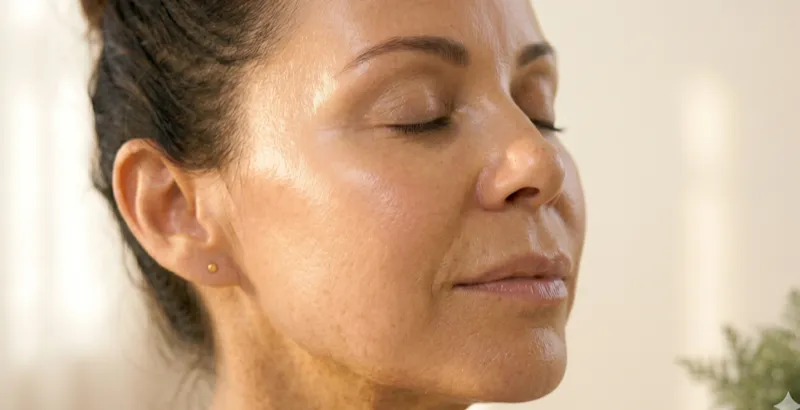
The science of skin aging is evolving rapidly — and for women navigating the skin changes that come with menopause and beyond, evidence-based skincare represents a fundamentally different approach: working with your skin's biology rather than against it.
Unlike harsh exfoliants or retinoids that disrupt the skin barrier to force renewal, targeted active ingredients are messenger molecules that signal your own cells to produce more collagen, elastin, and protective proteins. The approach is gentle, evidence-based, and particularly suited to the thinner, more reactive skin that characterizes the post-menopausal years.
Dehydration Dullness vs. Age-Related Radiance Loss
Differentiating between dehydration-based dullness and age-related dullness is clinically important because the two conditions — while producing similar visual outcomes — require fundamentally different treatment approaches. Dehydration dullness is a transient state caused by insufficient water content in the stratum corneum, producing a flat, lackluster appearance that can affect women of any age and responds dramatically to hydration within hours. Age-related dullness is a chronic structural condition involving slowed cell turnover, accumulated photodamage, and altered melanin distribution that requires weeks to months of targeted intervention. The diagnostic distinction matters because treating age-related dullness with hydration alone produces minimal improvement, while treating dehydration dullness with aggressive exfoliation can worsen the condition by further compromising the water-retention capacity of the stratum corneum. A 2016 study in Skin Research and Technology developed a clinical algorithm distinguishing the two: dehydration dullness presents with fine dehydration lines that disappear when skin is moisturized, responds to the 'pinch test' with slow snapback, and affects the entire face uniformly; age-related dullness presents with persistent textural roughness, visible pores, uneven pigmentation, and disproportionately affects sun-exposed zones.[1]
Dehydration dullness in women over 40 has distinct hormonal drivers that differentiate it from simple environmental dehydration. Declining estrogen reduces the expression of aquaporin-3 — the transmembrane water channel that facilitates water transport between dermal capillaries and the epidermis — creating a fundamental bottleneck in the skin's ability to maintain epidermal hydration even when systemic hydration is adequate. A 2014 study in Experimental Dermatology demonstrated that aquaporin-3 expression decreases by 40% in facial skin of postmenopausal women compared to premenopausal controls, directly reducing the skin's water-holding capacity. Simultaneously, declining estrogen reduces hyaluronic acid production in the dermis — the molecule responsible for the water reservoir that feeds the epidermis — by approximately 30% in the first five postmenopausal years. The result is chronically sub-hydrated skin that appears dull regardless of water intake, moisturizer use, or environmental humidity. This hormonal dehydration is distinct from environmental dehydration (caused by dry air, wind, or harsh cleansing) and requires internal hydration support through oral hyaluronic acid supplementation and topical humectants rather than simply drinking more water.
Clinical research confirms that age-related dullness — the component that persists even when skin is adequately hydrated — involves structural changes that alter how skin interacts with light at the molecular level. The three primary structural contributors are: (1) surface irregularity from accumulated corneocytes that scatter light diffusely rather than reflecting it coherently, (2) dermal optical changes from glycation, solar elastosis, and collagen loss that alter the translucency and light-transmission properties of the dermis, and (3) chromatic heterogeneity from uneven melanin distribution that creates an optically 'noisy' surface the brain interprets as dull. Each contributor requires specific intervention: surface irregularity responds to exfoliation (AHAs, retinoids), dermal optical changes respond to collagen-stimulating treatments (vitamin C, retinoids, professional devices), and chromatic heterogeneity responds to pigment-regulating agents (niacinamide, vitamin C, arbutin). A 2018 study in the Journal of Biomedical Optics used spectrocolorimetry to quantify the relative contribution of each factor to perceived dullness in women aged 45-65 and found that surface irregularity accounted for 45%, chromatic heterogeneity for 35%, and dermal optical changes for 20% — suggesting that exfoliation is the highest-yield single intervention for age-related dullness.
The optimal approach for most women over 40 addresses both dehydration and aging components simultaneously, since the two conditions frequently coexist and compound each other. A 2020 prospective study in the Journal of Cosmetic Dermatology divided women with dull skin into dehydration-predominant and aging-predominant groups based on clinical assessment, then treated each with a combined protocol (hydration + exfoliation + antioxidant) versus a targeted protocol (hydration-only for dehydration group, exfoliation-only for aging group). The combined protocol produced 34% greater brightness improvement than targeted protocols in both groups, suggesting that even when one cause predominates, addressing the secondary cause provides additive benefit. The practical protocol: morning hydration and protection (hyaluronic acid + vitamin C + SPF) addresses the dehydration and chromatic components, while evening treatment (gentle AHA or retinoid + ceramide moisturizer) addresses the surface irregularity and dermal components. This dual approach typically produces visible brightness improvement within 2 weeks — the hydration component providing immediate glow, the turnover component providing progressive radiance as treated cells reach the surface.
Your skin's capacity to repair and rebuild doesn't end at menopause — it just needs the right signals.
— Dr. Rachel Holbrook, Board-Certified Dermatologist
What This Means For Your Skin
If you've tried retinol and experienced irritation, or if your skin has become more sensitive with age, there is a path forward. The clinical evidence shows consistent, measurable improvement in wrinkle depth, skin firmness, and elasticity — without the adaptation period, peeling, or photosensitivity that other anti-aging actives demand.
Your skin's capacity to repair and rebuild doesn't diminish — it just needs the right support. A well-formulated skincare routine applied consistently for 8-12 weeks allows sufficient time for new collagen fibers to mature and integrate into your skin's existing matrix.
The science is clear. The evidence is consistent. The results are measurable.
What happens next is up to you.