
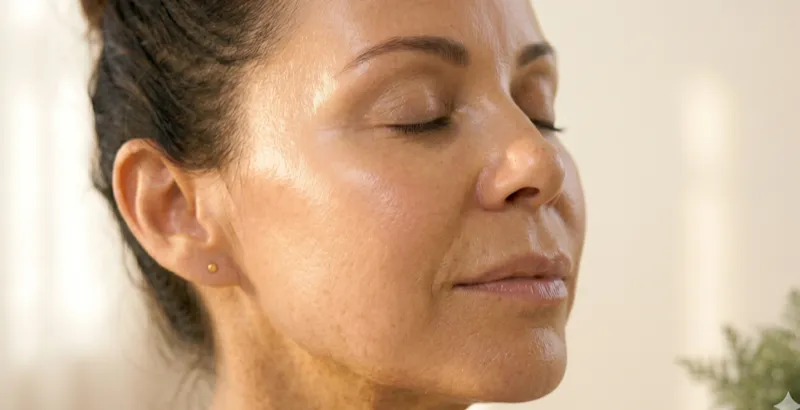
The science of skin aging is evolving rapidly — and for women navigating the skin changes that come with menopause and beyond, evidence-based skincare represents a fundamentally different approach: working with your skin's biology rather than against it.
Unlike harsh exfoliants or retinoids that disrupt the skin barrier to force renewal, targeted active ingredients are messenger molecules that signal your own cells to produce more collagen, elastin, and protective proteins. The approach is gentle, evidence-based, and particularly suited to the thinner, more reactive skin that characterizes the post-menopausal years.
A Targeted Protocol to Restore Glow During Hormonal Transition
Perimenopause presents unique brightening challenges because the hormonal fluctuations — estrogen surges followed by troughs, progesterone decline, and relative androgen excess — create simultaneously dull, oily, and sensitive skin that responds unpredictably to standard brightening protocols designed for stable hormonal environments. A 2018 survey in Menopause found that 71% of perimenopausal women reported a significant decline in skin radiance as one of their top three skin concerns, ranking it above wrinkles and sagging. The brightening routine for this population must be adaptive rather than static, with the flexibility to reduce active ingredient intensity during hormonal sensitivity peaks (typically the late luteal phase, days 21-28 of the cycle) while maintaining consistent baseline care. The foundation of a perimenopausal brightening routine prioritizes barrier integrity — because a compromised barrier amplifies every other dullness mechanism — followed by carefully titrated active ingredients that address cell turnover, pigmentation, and hydration without overwhelming the fluctuating sensitivity threshold.[1]
The morning routine for perimenopausal brightening focuses on antioxidant defense, hydration, and photoprotection — the three factors that prevent additional dullness accumulation during daylight hours. Begin with a gentle, slightly acidic cleanser (pH 5.0-5.5) that removes overnight sebum without disrupting the acid mantle. Apply vitamin C serum (15% L-ascorbic acid with ferulic acid) to bare skin, which provides tyrosinase inhibition for pigmentary brightness and antioxidant defense against the UV and pollution that generate dull-inducing free radicals. Follow with niacinamide serum (4-5%) — uniquely valuable during perimenopause because it simultaneously brightens (through melanin transfer inhibition), strengthens the barrier (through ceramide synthesis stimulation), and regulates the sebum fluctuations that create T-zone dullness during hormonal surges. Layer with hyaluronic acid moisturizer for the hydration-based optical brightening that provides immediate radiance improvement. Finish with broad-spectrum SPF 30-50 mineral sunscreen, which prevents the UV-induced melanin stimulation that creates the progressive darkening and unevenness contributing to dull appearance.
Clinical research confirms that the evening routine is where active brightening treatment occurs, centered on controlled exfoliation and cell turnover acceleration. Double cleanse with an oil-based cleanser followed by water-based cleanser to thoroughly remove the oxidized sebum, particulate pollution, and SPF residue that create a dull-looking film on the skin surface. On exfoliation nights (3 per week), apply glycolic acid 8-10% or a multi-acid serum containing glycolic, lactic, and salicylic acids, which addresses surface corneocyte accumulation, hydration, and follicular clarity simultaneously. On retinoid nights (2-3 per week, alternating with exfoliation), apply retinol 0.3-0.5% or retinaldehyde 0.05-0.1%, which drives the deeper cell turnover regulation that replaces dull, irregularly melanized cells with fresh, uniformly pigmented keratinocytes. On recovery nights (1-2 per week), skip all actives and apply a ceramide-hyaluronic acid night mask that allows the barrier to rebuild — these recovery nights are more critical during perimenopause than at any other life stage because the fluctuating estrogen reduces the skin's repair capacity.
Weekly and monthly additions provide the cyclical intensive treatments that produce breakthrough brightening beyond what daily maintenance achieves. A glycolic acid peel (15-20%, 10-minute application) once weekly provides deeper exfoliation than daily low-concentration use, reaching the granular layer where melanin-laden cells await their turn at the surface. A vitamin C sheet mask or sleeping mask once weekly delivers a sustained, high-concentration dose of L-ascorbic acid under occlusion, maximizing dermal penetration for both brightening and collagen benefits. For perimenopausal-specific brightening, products containing phytoestrogens (genistein, equol) applied 2-3 times weekly can partially compensate for declining endogenous estrogen, supporting the hyaluronic acid production and microcirculation that contribute to skin radiance — a 2015 study in Climacteric demonstrated that topical phytoestrogen treatment improved skin brightness and hydration scores in perimenopausal women within 8 weeks. The key scheduling principle is to concentrate active treatments in the follicular phase (days 1-14) when estrogen is higher and skin tolerance is greater, and reduce to maintenance levels during the luteal phase (days 15-28) when progesterone-driven sensitivity increases.
Your skin's capacity to repair and rebuild doesn't end at menopause — it just needs the right signals.
— Dr. Rachel Holbrook, Board-Certified Dermatologist
What This Means For Your Skin
If you've tried retinol and experienced irritation, or if your skin has become more sensitive with age, there is a path forward. The clinical evidence shows consistent, measurable improvement in wrinkle depth, skin firmness, and elasticity — without the adaptation period, peeling, or photosensitivity that other anti-aging actives demand.
Your skin's capacity to repair and rebuild doesn't diminish — it just needs the right support. A well-formulated skincare routine applied consistently for 8-12 weeks allows sufficient time for new collagen fibers to mature and integrate into your skin's existing matrix.
The science is clear. The evidence is consistent. The results are measurable.
What happens next is up to you.