
The science of skin aging is evolving rapidly — and for women navigating the skin changes that come with menopause and beyond, evidence-based skincare represents a fundamentally different approach: working with your skin's biology rather than against it.
Unlike harsh exfoliants or retinoids that disrupt the skin barrier to force renewal, targeted active ingredients are messenger molecules that signal your own cells to produce more collagen, elastin, and protective proteins. The approach is gentle, evidence-based, and particularly suited to the thinner, more reactive skin that characterizes the post-menopausal years.
Comparing LED Form Factors for At-Home Anti-Aging Treatment
The choice between LED masks (worn on the face like a visor or shield) and LED panels (freestanding devices positioned at a fixed distance from the face) involves trade-offs in coverage uniformity, power delivery, comfort, and practical usability that affect both treatment efficacy and long-term adherence. LED masks sit directly on or very close to the facial surface, ensuring minimal distance between the LEDs and the skin — since light energy decreases with the square of the distance (inverse square law), contact or near-contact positioning maximizes the power density reaching the skin for any given LED output. A 2020 bench-testing study in the Journal of Biophotonics measured power density from 6 LED masks and 4 LED panels at their recommended treatment distances and found that masks delivered a mean 28 mW/cm² at the skin surface versus 12 mW/cm² for panels at their typical 6-12 inch treatment distance, suggesting that masks deliver approximately 2.3 times more energy per unit time.[1]
LED panels offer advantages in coverage uniformity and treatment of the neck and décolleté that masks cannot easily provide. Masks are designed to conform to facial contours, creating variable distances between the LEDs and different facial zones — the bridge of the nose, the lateral cheeks, and the jawline often receive different power densities due to the geometric mismatch between the rigid or semi-rigid mask shape and the individual's facial anatomy. Panels emit light in a uniform field from a flat surface, providing consistent irradiance across the entire treatment area — including the neck and upper chest when the panel is positioned appropriately. For women over 40 who want to treat the face, neck, and décolleté in a single session, a panel positioned at 6-8 inches provides even coverage across all three areas simultaneously. Full-body LED panels (used in red light therapy beds or standing configurations) extend treatment to the entire body, offering systemic anti-inflammatory and wound-healing benefits that facial-only devices cannot provide.
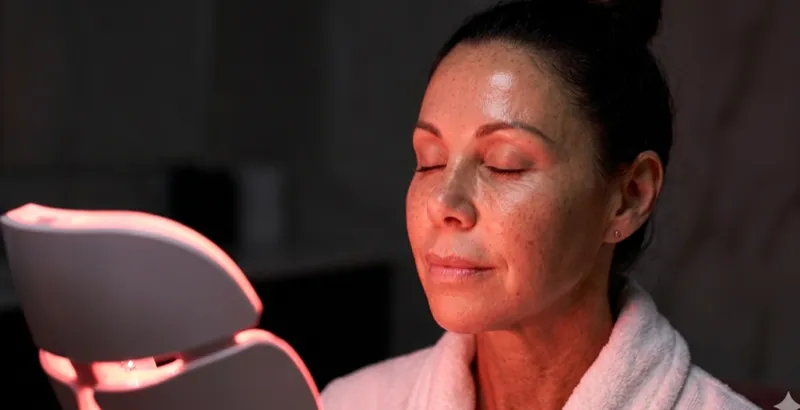
Clinical research confirms that comfort and adherence considerations often determine real-world effectiveness more than theoretical power density advantages. LED masks must be worn on the face, which many women find uncomfortable: the weight (200-400g for quality devices), heat generation, pressure on the nose and cheekbones, and the complete visual occlusion (most masks are opaque) limit the activities possible during treatment. Panel devices allow the user to recline comfortably in a chair or on a bed while the panel is positioned at the appropriate distance, typically on a stand or clamp — the user can read, watch media on a screen positioned behind the panel, or simply rest with eyes closed. This hands-free, weight-free positioning significantly improves comfort during the 10-20 minute treatment sessions required for at-home devices. A 2021 consumer satisfaction survey found that 82% of panel users described their treatment experience as 'relaxing' or 'enjoyable,' compared to 54% of mask users — and relaxation during treatment may itself contribute to anti-aging benefit through cortisol reduction.
The practical recommendation for most women over 40 is to match the device type to their specific needs and lifestyle. LED masks are the better choice for women who: prioritize maximum facial treatment power per session, have limited space (masks are portable and storable), want the shortest possible treatment time (the higher irradiance means less time needed to reach optimal J/cm²), and primarily want to treat the face only. LED panels are the better choice for women who: want to treat face, neck, and décolleté simultaneously, prioritize comfort and the ability to multitask during treatment, want a more relaxing treatment experience, and have space for a standing or tabletop panel setup. Regardless of form factor, the critical purchasing criteria remain the same: verified wavelengths of 630-660nm (red) and 810-850nm (near-infrared), documented power density ≥20 mW/cm² at treatment distance, FDA clearance for cosmetic use, and adequate eye protection. A device meeting these specifications in either form factor will deliver meaningful anti-aging benefit with consistent daily use.
Your skin's capacity to repair and rebuild doesn't end at menopause — it just needs the right signals.
— Dr. Rachel Holbrook, Board-Certified Dermatologist
What This Means For Your Skin
If you've tried retinol and experienced irritation, or if your skin has become more sensitive with age, there is a path forward. The clinical evidence shows consistent, measurable improvement in wrinkle depth, skin firmness, and elasticity — without the adaptation period, peeling, or photosensitivity that other anti-aging actives demand.
Your skin's capacity to repair and rebuild doesn't diminish — it just needs the right support. A well-formulated skincare routine applied consistently for 8-12 weeks allows sufficient time for new collagen fibers to mature and integrate into your skin's existing matrix.
The science is clear. The evidence is consistent. The results are measurable.
What happens next is up to you.