
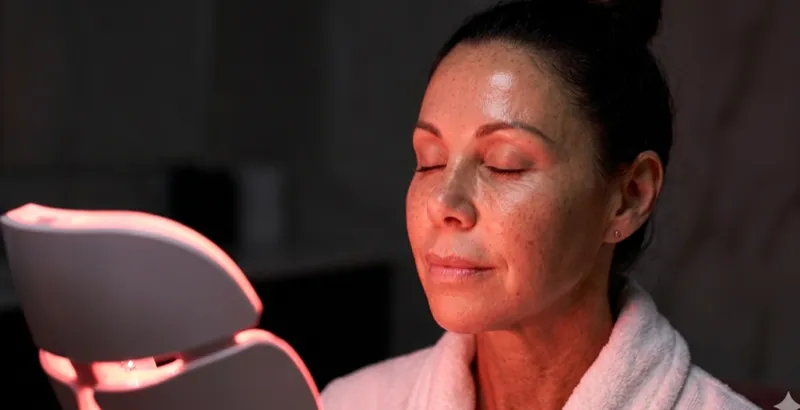
The science of skin aging is evolving rapidly — and for women navigating the skin changes that come with menopause and beyond, evidence-based skincare represents a fundamentally different approach: working with your skin's biology rather than against it.
Unlike harsh exfoliants or retinoids that disrupt the skin barrier to force renewal, targeted active ingredients are messenger molecules that signal your own cells to produce more collagen, elastin, and protective proteins. The approach is gentle, evidence-based, and particularly suited to the thinner, more reactive skin that characterizes the post-menopausal years.
How Light Therapy Stimulates Collagen Production
LED (Light Emitting Diode) light therapy — clinically termed photobiomodulation (PBM) — represents one of the most promising non-invasive anti-aging technologies for women over 40, with a growing body of controlled clinical evidence demonstrating measurable improvements in wrinkle depth, skin firmness, and collagen density. The mechanism is fundamentally different from topical or mechanical anti-aging treatments: specific wavelengths of visible and near-infrared light penetrate the skin and are absorbed by chromophores within dermal cells — primarily cytochrome c oxidase in mitochondria — triggering a cascade of cellular responses that increase ATP production, upregulate growth factor expression, and stimulate fibroblast collagen synthesis. A 2014 randomized controlled trial in Photomedicine and Laser Surgery treated 113 subjects with LED therapy at 611-650nm (red) and 570-850nm (near-infrared) wavelengths twice weekly for 30 sessions and documented statistically significant improvements in intradermal collagen density on ultrasound measurement, with clinical photography confirming visible wrinkle reduction in 91% of the treatment group versus 13% of controls.[1]
The wavelength-specific effects of LED therapy are critical for understanding which devices and protocols deliver anti-aging benefit. Red light at 620-660nm penetrates 2-3mm into the skin, reaching the papillary dermis where fibroblasts reside, and has been shown to directly stimulate procollagen I synthesis, increase fibroblast proliferation, and upregulate transforming growth factor-beta (TGF-β) — the same growth factor that bakuchiol activates topically. Near-infrared light at 810-850nm penetrates 5-10mm, reaching the reticular dermis, subcutaneous tissue, and even muscle, providing deeper tissue stimulation and anti-inflammatory effects through modulation of NF-κB signaling. A 2019 study in the Journal of Cosmetic and Laser Therapy compared red-only versus combined red and near-infrared LED treatment for facial aging and found that the combination produced 34% greater improvement in wrinkle scores and 28% greater improvement in skin elasticity at 12 weeks, confirming the additive benefit of treating multiple dermal depths simultaneously.
Clinical research confirms that blue light (415-450nm) is primarily used for acne treatment through its bactericidal effect on Cutibacterium acnes rather than anti-aging, but it has relevance for perimenopausal women who experience hormonal acne alongside aging concerns. Blue light penetrates only 1-2mm (epidermis and upper papillary dermis) and has no documented collagen-stimulating effect. Amber/yellow light (570-590nm) has modest evidence for reducing redness and inflammation, potentially benefiting women with rosacea-complicated aging. Green light (520-560nm) has limited evidence suggesting melanin-regulating properties, but clinical trials are insufficient to recommend it for hyperpigmentation treatment. For women over 40 whose primary concern is anti-aging collagen stimulation and wrinkle reduction, red (630-660nm) and near-infrared (830-850nm) are the only wavelengths with robust clinical evidence — devices offering these wavelengths at sufficient power density should be prioritized over multi-color devices that include wavelengths without anti-aging validation.
The clinical evidence for at-home LED devices is encouraging but requires realistic expectations about the difference between clinical-grade and consumer-grade devices. Professional LED panels deliver energy densities of 50-100 mW/cm² (milliwatts per square centimeter), while most consumer devices deliver 10-30 mW/cm². Since the total energy delivered to the skin (measured in joules per square centimeter, J/cm²) equals power density multiplied by treatment time, consumer devices can theoretically match professional energy delivery by extending treatment duration — a professional 10-minute session at 60 mW/cm² delivers 36 J/cm², which a consumer device at 20 mW/cm² could match in 30 minutes. A 2018 study in the Journal of Clinical and Aesthetic Dermatology evaluated a consumer LED device (20 mW/cm², 660nm + 850nm) used for 10 minutes daily for 12 weeks and documented a 36% improvement in periorbital wrinkle scores — significant improvement, though approximately 60% of that achieved by clinical-grade devices in comparable studies. The practical implication: at-home LED therapy works but requires consistent daily use for 10-20 minutes to compensate for lower power output.
Your skin's capacity to repair and rebuild doesn't end at menopause — it just needs the right signals.
— Dr. Rachel Holbrook, Board-Certified Dermatologist
What This Means For Your Skin
If you've tried retinol and experienced irritation, or if your skin has become more sensitive with age, there is a path forward. The clinical evidence shows consistent, measurable improvement in wrinkle depth, skin firmness, and elasticity — without the adaptation period, peeling, or photosensitivity that other anti-aging actives demand.
Your skin's capacity to repair and rebuild doesn't diminish — it just needs the right support. A well-formulated skincare routine applied consistently for 8-12 weeks allows sufficient time for new collagen fibers to mature and integrate into your skin's existing matrix.
The science is clear. The evidence is consistent. The results are measurable.
What happens next is up to you.