
The science of skin aging is evolving rapidly — and for women navigating the skin changes that come with menopause and beyond, evidence-based skincare represents a fundamentally different approach: working with your skin's biology rather than against it.
Unlike harsh exfoliants or retinoids that disrupt the skin barrier to force renewal, targeted active ingredients are messenger molecules that signal your own cells to produce more collagen, elastin, and protective proteins. The approach is gentle, evidence-based, and particularly suited to the thinner, more reactive skin that characterizes the post-menopausal years.
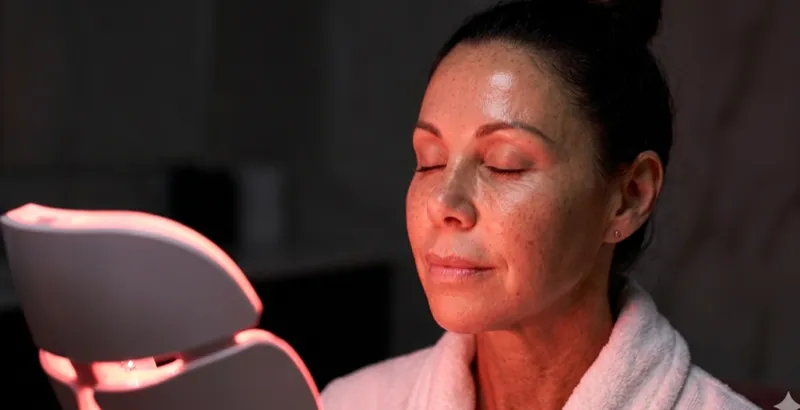
Using Light Therapy to Counter Menopausal Collagen Loss
Menopausal collagen loss — the accelerated decline of approximately 30% of dermal collagen in the first five postmenopausal years — creates an urgent need for collagen-stimulating interventions, and LED photobiomodulation offers a unique advantage in this context: its mechanism of action is completely independent of estrogen signaling pathways. While many skin-rejuvenating processes are estrogen-dependent (hyaluronic acid production, ceramide synthesis, melanocyte regulation), collagen synthesis stimulated by LED occurs through the mitochondrial respiratory chain — specifically cytochrome c oxidase photoacceptor activation leading to increased ATP production and growth factor release — a pathway that functions identically regardless of hormonal status. This estrogen independence was confirmed by a 2016 study in Experimental Dermatology that compared LED-stimulated collagen synthesis in fibroblasts from premenopausal versus postmenopausal women and found no statistically significant difference in collagen upregulation, confirming that LED efficacy is maintained through the menopausal transition when estrogen-dependent pathways are declining.[1]
The timing of LED therapy initiation relative to menopause may influence its preventive versus restorative impact. Women who begin LED therapy during perimenopause — before the most dramatic collagen loss occurs — may preserve a greater proportion of their existing collagen through the anti-MMP effects of photobiomodulation. Red and near-infrared light have been shown to suppress MMP-1 and MMP-3 expression in dermal tissue, protecting existing collagen from enzymatic degradation while simultaneously stimulating new collagen synthesis. A 2017 animal model study in the Journal of Photochemistry and Photobiology demonstrated that LED-treated skin maintained 23% greater collagen density during estrogen withdrawal (simulating menopause) compared to untreated controls, suggesting that LED therapy provides a degree of collagen preservation beyond its collagen-stimulating function. For women already in postmenopause with established collagen depletion, LED therapy stimulates replacement collagen production to partially restore the deficit.
Clinical research confirms that combining LED therapy with other collagen-stimulating modalities creates a multi-pathway approach that maximizes collagen rebuilding during the critical menopausal window. The three primary non-hormonal collagen stimulation pathways are: (1) photobiomodulation (LED) — mitochondrial activation and growth factor release, (2) retinoid therapy — RAR/RXR nuclear receptor-mediated gene transcription, and (3) peptide therapy — TGF-β and wound-healing signal mimicry. Each pathway activates collagen genes through different transcription factor complexes, meaning their effects are additive rather than redundant. A comprehensive menopausal anti-aging protocol combining all three pathways might include: morning LED treatment (5-10 minutes) followed by vitamin C serum (cofactor for collagen crosslinking), and evening retinol application (direct gene activation for collagen synthesis), with peptide-containing moisturizer providing continuous fibroblast stimulation between treatments.
The psychological and quality-of-life benefits of LED therapy during menopause extend beyond the objective skin improvements. Menopause is frequently accompanied by mood changes, reduced self-confidence, and a sense of loss of control over physical appearance — concerns that are compounded by visible skin aging. LED therapy provides a daily self-care ritual that produces tangible, visible results, creating a sense of agency over the aging process. A 2019 quality-of-life study in Menopause found that menopausal women using LED therapy reported 34% higher skin-related quality-of-life scores compared to women using topical products alone, with the difference attributed to both objective skin improvement and the empowering experience of actively treating their skin with a technology-based intervention. The ritual of daily LED use — a quiet 5-10 minute treatment that can be combined with meditation, deep breathing, or simply rest — also addresses the stress management component that is critical for skin health during the hormonally turbulent menopausal transition.
Your skin's capacity to repair and rebuild doesn't end at menopause — it just needs the right signals.
— Dr. Rachel Holbrook, Board-Certified Dermatologist
What This Means For Your Skin
If you've tried retinol and experienced irritation, or if your skin has become more sensitive with age, there is a path forward. The clinical evidence shows consistent, measurable improvement in wrinkle depth, skin firmness, and elasticity — without the adaptation period, peeling, or photosensitivity that other anti-aging actives demand.
Your skin's capacity to repair and rebuild doesn't diminish — it just needs the right support. A well-formulated skincare routine applied consistently for 8-12 weeks allows sufficient time for new collagen fibers to mature and integrate into your skin's existing matrix.
The science is clear. The evidence is consistent. The results are measurable.
What happens next is up to you.