
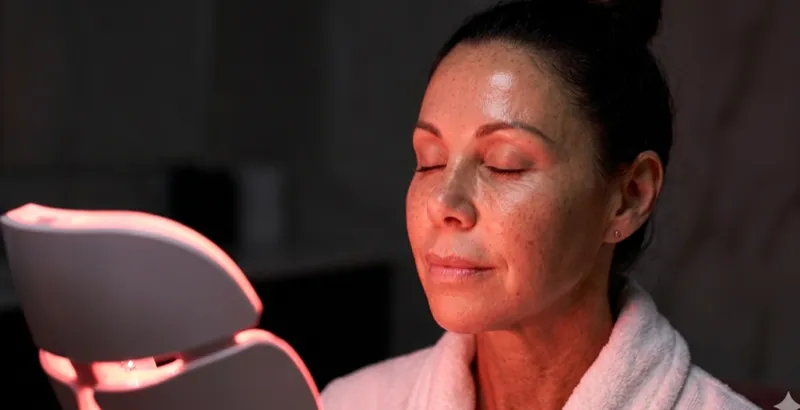
The science of skin aging is evolving rapidly — and for women navigating the skin changes that come with menopause and beyond, evidence-based skincare represents a fundamentally different approach: working with your skin's biology rather than against it.
Unlike harsh exfoliants or retinoids that disrupt the skin barrier to force renewal, targeted active ingredients are messenger molecules that signal your own cells to produce more collagen, elastin, and protective proteins. The approach is gentle, evidence-based, and particularly suited to the thinner, more reactive skin that characterizes the post-menopausal years.
What Clinical Studies Show About Red Light and Wrinkle Reduction
The clinical evidence for red light therapy reducing wrinkles has grown substantially over the past decade, with multiple randomized controlled trials demonstrating statistically significant improvements in wrinkle depth, skin texture, and dermal collagen density. The Wunsch and Matuschka (2014) trial — the largest and most cited LED anti-aging study — remains the benchmark: 113 subjects randomized to treatment (red 611-650nm and near-infrared 570-850nm) or sham control, with 30 treatments over 15 weeks. The treatment group showed significant improvements in complexion (measured by clinical grading), skin feeling (self-reported softness and smoothness), and intradermal collagen density (measured by ultrasound sonography). Clinical photography assessed by blinded evaluators confirmed visible wrinkle reduction in 91% of the treatment group. Importantly, the improvements were not transient — follow-up assessments showed maintenance of results at 6 months post-treatment in subjects who continued once-weekly maintenance sessions.[1]
A 2006 study by Lee et al. in the Journal of Investigative Dermatology provided histological evidence supporting the clinical observations. Fifteen subjects received LED treatment (633nm red and 830nm near-infrared) to one side of the face with the other side serving as untreated control. Skin biopsies at 12 weeks revealed significant increases in procollagen I, MMP-9 (which paradoxically aids in remodeling by clearing damaged collagen), and elastin content in the treated side versus control. The procollagen increase was particularly noteworthy — a 31% increase confirmed that the clinical wrinkle improvement was driven by genuine new collagen synthesis rather than temporary tissue edema or optical effects. This histological validation distinguishes LED therapy from many cosmetic claims where visible improvement lacks documented structural change. The elastin increase (17%) was equally significant, as elastin provides the recoil that allows skin to snap back after compression — a property that diminishes markedly after 40 and contributes to the persistent creasing that forms wrinkles.
Clinical research confirms that dose-response relationships have been elucidated by studies comparing different energy densities and treatment durations. The concept of a 'biphasic dose response' (also known as the Arndt-Schulz Law) is well-established in photobiomodulation: insufficient energy produces no biological effect, optimal energy produces maximum cellular stimulation, and excessive energy paradoxically inhibits cellular function or causes damage. For anti-aging applications, the optimal energy density appears to fall between 3-6 J/cm² per session for red light (630-660nm), based on a 2017 dose-response study in Lasers in Surgery and Medicine that compared 1, 3, 6, and 12 J/cm² and found that 3 and 6 J/cm² produced comparable collagen stimulation, while 12 J/cm² actually reduced fibroblast proliferation compared to the 6 J/cm² group. This biphasic response explains why longer treatment times with at-home devices do not always produce better results — there is an optimal dose window, and exceeding it may diminish returns.
The wrinkle types most responsive to LED therapy are static wrinkles caused by collagen and elastin loss rather than dynamic wrinkles caused by muscle contraction. Periorbital wrinkles (crow's feet), fine lines on the cheeks and forehead, and neck crepiness show the most consistent improvement in published studies, with mean wrinkle depth reductions of 25-36% across the clinical literature. Deep nasolabial folds and marionette lines show modest improvement (10-15%) because their formation involves tissue descent and volume loss in addition to collagen degradation. A 2020 meta-analysis in Dermatologic Surgery pooled data from 7 randomized controlled trials evaluating LED for facial aging and calculated a mean overall improvement score of 32% across all wrinkle types, with the highest improvement in periorbital areas (38%) and the lowest in nasolabial folds (14%). The meta-analysis concluded that LED light therapy produces 'moderate, clinically meaningful improvement in facial wrinkles with an excellent safety profile' — positioning it as a reliable adjunctive anti-aging treatment rather than a dramatic standalone solution.
Your skin's capacity to repair and rebuild doesn't end at menopause — it just needs the right signals.
— Dr. Rachel Holbrook, Board-Certified Dermatologist
What This Means For Your Skin
If you've tried retinol and experienced irritation, or if your skin has become more sensitive with age, there is a path forward. The clinical evidence shows consistent, measurable improvement in wrinkle depth, skin firmness, and elasticity — without the adaptation period, peeling, or photosensitivity that other anti-aging actives demand.
Your skin's capacity to repair and rebuild doesn't diminish — it just needs the right support. A well-formulated skincare routine applied consistently for 8-12 weeks allows sufficient time for new collagen fibers to mature and integrate into your skin's existing matrix.
The science is clear. The evidence is consistent. The results are measurable.
What happens next is up to you.