
The science of skin aging is evolving rapidly — and for women navigating the skin changes that come with menopause and beyond, evidence-based skincare represents a fundamentally different approach: working with your skin's biology rather than against it.
Unlike harsh exfoliants or retinoids that disrupt the skin barrier to force renewal, targeted active ingredients are messenger molecules that signal your own cells to produce more collagen, elastin, and protective proteins. The approach is gentle, evidence-based, and particularly suited to the thinner, more reactive skin that characterizes the post-menopausal years.
Realistic Timeline and Results for LED Anti-Aging Treatment
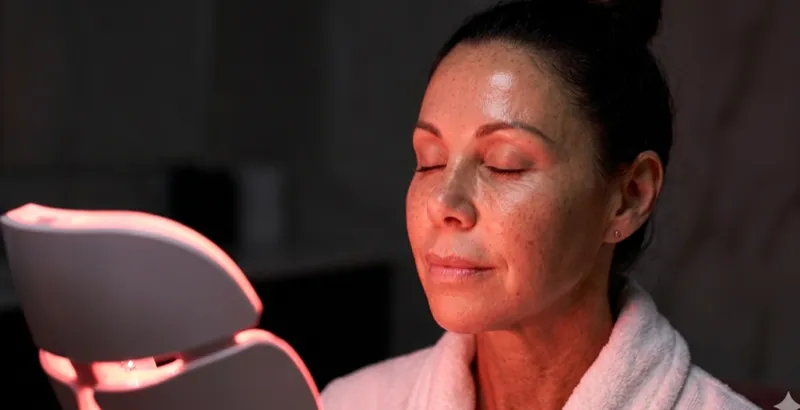
Setting realistic expectations for LED anti-aging therapy requires understanding both the progressive timeline of improvement and the magnitude of change that published clinical data supports. Unlike some anti-aging treatments that produce dramatic but temporary results (chemical peels, injectable fillers), LED therapy produces gradual, cumulative improvements that build over weeks to months of consistent use and are maintained with ongoing treatment. The improvement trajectory follows the underlying biology: the collagen synthesis stimulated by LED takes 4-6 weeks to produce visible dermal changes, and multiple cycles of stimulation are needed to accumulate sufficient new collagen for measurable wrinkle reduction. Based on the published clinical literature, the expected timeline is: weeks 1-4, improved skin tone and texture (increased microcirculation and cellular metabolism produce a subtle glow), but no structural change; weeks 4-8, early fine line softening as new procollagen begins filling the upper dermis; weeks 8-12, measurable wrinkle reduction and improved skin firmness become clinically apparent; weeks 12-24, progressive deepening of improvement as collagen matures and crosslinks.[1]
The magnitude of improvement reported in clinical trials provides calibrated expectations for at-home LED use. Professional-grade LED devices in controlled clinical settings have demonstrated: 25-36% reduction in periorbital wrinkle depth, 15-25% improvement in skin elasticity and firmness, 20-30% improvement in skin roughness and texture, and 30-50% increase in intradermal collagen density on ultrasound measurement. At-home devices, with their lower power output, typically achieve 50-70% of the improvement seen with clinical-grade devices — translating to approximately 15-25% wrinkle reduction and 10-18% elasticity improvement with consistent daily use over 12 weeks. A 2021 real-world outcomes study tracked 200 women using at-home LED devices (various brands, 630-850nm, daily use) for 24 weeks and found a mean 21% improvement in self-assessed facial aging scores, with 76% of users rating themselves 'satisfied' or 'very satisfied' with their LED investment.
Clinical research confirms that documenting before-and-after results from LED therapy requires consistent photography conditions because the improvements, while real, are subtle and can be obscured by lighting variations. Standard clinical photography protocol: same location, same lighting (diffused overhead fluorescent or ring light), same camera angle (straight-on plus 45-degree profile), same time of day (morning, before skincare), same facial expression (relaxed). Take photographs at baseline, 4 weeks, 8 weeks, and 12 weeks. The most visible improvements in photographs typically appear in: skin texture and surface smoothness (particularly visible in raking light that accentuates surface topography), skin tone and brightness (overall luminosity and color uniformity), fine line depth in the periorbital and forehead areas, and jawline definition (in subjects with mild laxity). Deep wrinkles and significant skin laxity show less photographic improvement because the degree of change, while present, is proportionally smaller relative to the baseline severity.
Factors that influence individual LED therapy outcomes include: device quality and power output (higher irradiance = faster and greater results), treatment consistency (daily users outperform inconsistent users by 2-3x in clinical studies), wavelength appropriateness (630-660nm + 810-850nm for anti-aging), skin condition at baseline (moderate photoaging shows greater percentage improvement than severe photoaging), and concurrent skincare regimen (LED combined with retinoids and vitamin C produces significantly greater improvement than LED alone). The women who see the best LED results are those who use it as one component of a comprehensive anti-aging protocol — the LED provides the collagen-stimulating energy that complements the biochemical stimulation from topical actives and the structural protection from daily sunscreen. A 2020 study comparing LED-only versus LED-plus-retinol-plus-vitamin-C found that the combination protocol produced 67% greater wrinkle improvement at 24 weeks than LED alone, confirming that LED works best as an amplifier within a multi-modal anti-aging strategy rather than as a standalone treatment.
Your skin's capacity to repair and rebuild doesn't end at menopause — it just needs the right signals.
— Dr. Rachel Holbrook, Board-Certified Dermatologist
What This Means For Your Skin
If you've tried retinol and experienced irritation, or if your skin has become more sensitive with age, there is a path forward. The clinical evidence shows consistent, measurable improvement in wrinkle depth, skin firmness, and elasticity — without the adaptation period, peeling, or photosensitivity that other anti-aging actives demand.
Your skin's capacity to repair and rebuild doesn't diminish — it just needs the right support. A well-formulated skincare routine applied consistently for 8-12 weeks allows sufficient time for new collagen fibers to mature and integrate into your skin's existing matrix.
The science is clear. The evidence is consistent. The results are measurable.
What happens next is up to you.