
The science of skin aging is evolving rapidly — and for women navigating the skin changes that come with menopause and beyond, evidence-based skincare represents a fundamentally different approach: working with your skin's biology rather than against it.
Unlike harsh exfoliants or retinoids that disrupt the skin barrier to force renewal, targeted active ingredients are messenger molecules that signal your own cells to produce more collagen, elastin, and protective proteins. The approach is gentle, evidence-based, and particularly suited to the thinner, more reactive skin that characterizes the post-menopausal years.
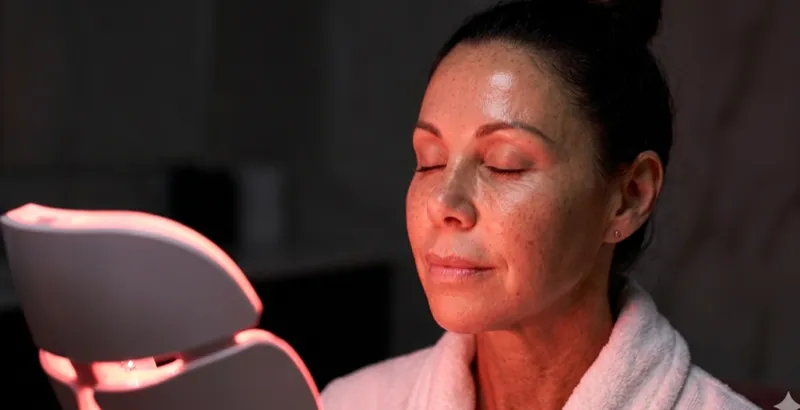
Integrating LED Light Into Your Skincare Routine
Integrating LED therapy into an existing skincare routine requires understanding the interaction between light transmission and topical products — specifically, that anything applied to the skin surface before LED treatment can absorb, scatter, or reflect the therapeutic wavelengths, potentially reducing the energy delivered to the dermal target cells. A 2019 study in the Journal of Biophotonics measured the light transmission through various skincare product layers applied to porcine skin (a validated model for human skin optics) and found that a typical serum layer (0.1mm thickness) reduced red light transmission by 12-18%, while a thicker moisturizer layer (0.3mm) reduced transmission by 25-35%. Sunscreen — particularly mineral formulations with zinc oxide and titanium dioxide, which are specifically designed to scatter and reflect light — reduced transmission by 45-65%. These findings have direct practical implications: LED treatment should be performed on clean, product-free skin to maximize energy delivery to the dermis.[1]
The optimal position of LED treatment in the skincare routine — before or after products — depends on whether the goal is maximizing LED efficacy or maximizing topical product absorption. For anti-aging collagen stimulation (the primary goal for women over 40), LED treatment should come first, on clean skin, to ensure maximum photon delivery to dermal fibroblasts. The post-LED application of serums and moisturizers then capitalizes on the LED-induced increase in microcirculation and transient tissue warming, which enhance topical ingredient penetration. A 2020 clinical study in Dermatologic Surgery compared two protocols — LED followed by retinol serum versus retinol serum followed by LED — and found that the LED-first protocol produced 23% greater improvement in wrinkle scores at 12 weeks, attributed to both maximized LED energy delivery and enhanced post-LED retinol absorption.
Clinical research confirms that the morning LED-skincare routine for mature skin follows this evidence-based sequence: (1) gentle cleanse with pH-balanced cleanser, (2) LED treatment on clean skin (3-10 minutes per device instructions), (3) vitamin C serum immediately post-LED (the enhanced microcirculation improves vitamin C delivery to the dermis), (4) niacinamide serum or hydrating serum, (5) moisturizer, (6) mineral sunscreen. The evening routine: (1) double cleanse to remove makeup and SPF, (2) LED treatment on clean skin, (3) hyaluronic acid serum post-LED, (4) retinol or bakuchiol (on treatment nights), (5) ceramide night cream. For women who use microneedling in their routine, LED and microneedling can be performed on the same day — LED after microneedling has been shown to accelerate the wound-healing response through enhanced growth factor expression. A 2017 pilot study found that microneedling followed by immediate LED treatment produced 28% greater collagen induction at 8 weeks compared to microneedling alone.
LED therapy is compatible with all common skincare actives and does not create contraindications with any topical ingredient. Unlike UV-based treatments or chemical peels that require temporary cessation of retinoids, LED therapy can be used alongside retinol, AHAs, BHAs, vitamin C, niacinamide, peptides, and growth factors without any risk of adverse interaction. In fact, LED therapy may enhance the efficacy of several actives: the increased ATP production and fibroblast activation from LED creates a more metabolically active cellular environment that is more responsive to the biochemical signals from topical collagen-stimulating agents. The one consideration is photosensitizing medications (tetracyclines, fluoroquinolones, certain diuretics) — while LED wavelengths do not cause the UV-mediated phototoxicity associated with these medications, the theoretical possibility of light-medication interaction suggests consulting a physician before combining LED therapy with photosensitizing drug regimens. For topical photosensitizers (retinoids, benzoyl peroxide), the concern is moot because LED treatment occurs on clean skin before these products are applied.
Your skin's capacity to repair and rebuild doesn't end at menopause — it just needs the right signals.
— Dr. Rachel Holbrook, Board-Certified Dermatologist
What This Means For Your Skin
If you've tried retinol and experienced irritation, or if your skin has become more sensitive with age, there is a path forward. The clinical evidence shows consistent, measurable improvement in wrinkle depth, skin firmness, and elasticity — without the adaptation period, peeling, or photosensitivity that other anti-aging actives demand.
Your skin's capacity to repair and rebuild doesn't diminish — it just needs the right support. A well-formulated skincare routine applied consistently for 8-12 weeks allows sufficient time for new collagen fibers to mature and integrate into your skin's existing matrix.
The science is clear. The evidence is consistent. The results are measurable.
What happens next is up to you.