
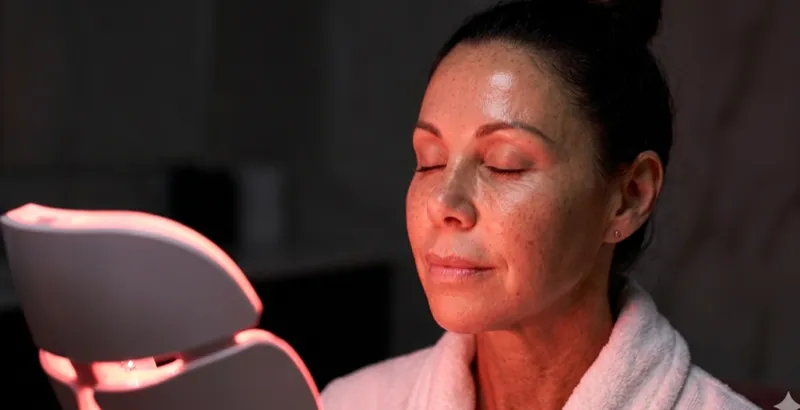
The science of skin aging is evolving rapidly — and for women navigating the skin changes that come with menopause and beyond, evidence-based skincare represents a fundamentally different approach: working with your skin's biology rather than against it.
Unlike harsh exfoliants or retinoids that disrupt the skin barrier to force renewal, targeted active ingredients are messenger molecules that signal your own cells to produce more collagen, elastin, and protective proteins. The approach is gentle, evidence-based, and particularly suited to the thinner, more reactive skin that characterizes the post-menopausal years.
How to Choose and Use an LED Device That Actually Works After 40
The at-home LED device market has expanded rapidly, with products ranging from $30 to $2,000 — but the clinical efficacy of these devices varies enormously based on three critical specifications that determine whether the device delivers therapeutic energy levels or merely decorative colored light. The three specifications that matter are: (1) wavelength accuracy — the device must emit light at the specific wavelengths proven to stimulate collagen (630-660nm for red, 810-850nm for near-infrared), not merely 'red-colored' light that could be any wavelength in the 600-700nm range; (2) power density (irradiance) — measured in milliwatts per square centimeter (mW/cm²), this determines whether sufficient photons reach the dermis to trigger photobiomodulation; and (3) total energy delivery — power density multiplied by treatment time gives joules per square centimeter (J/cm²), which must fall within the therapeutic window of 3-6 J/cm² per session for anti-aging benefit. A 2019 consumer device evaluation in the Journal of Cosmetic Dermatology tested 12 commercially available at-home LED devices and found that only 5 delivered power densities above 10 mW/cm² at the skin surface — the minimum threshold for any biological effect.[1]
Device form factors for at-home LED therapy include handheld wands, flexible panel masks, goggles for periorbital treatment, and full-face rigid masks. For women over 40 seeking anti-aging benefit across the full face, full-face masks or large flexible panels offer the most practical design because they treat all facial zones simultaneously without requiring manual repositioning. Handheld wands are effective for targeted treatment of specific concern areas (crow's feet, lip lines, forehead) but require the user to hold the device in position for 3-10 minutes per zone, making full-face treatment sessions 20-40 minutes — a time commitment that significantly reduces adherence. A 2020 adherence study found that women using hands-free mask devices maintained 87% treatment compliance at 12 weeks, versus 52% for handheld device users — and since LED therapy requires consistent daily or near-daily use for cumulative benefit, this adherence difference translates directly to clinical outcome differences.
Clinical research confirms that the minimum effective specifications for an at-home LED device targeting anti-aging in mature skin, based on published clinical evidence, are: red LED at 630-660nm with power density ≥20 mW/cm² at skin contact distance, near-infrared LED at 810-850nm with power density ≥20 mW/cm² (near-infrared is invisible, so devices should indicate when it is active), and a recommended treatment time that delivers 3-6 J/cm² per session (at 20 mW/cm², this is approximately 3-5 minutes; at 10 mW/cm², this is 5-10 minutes). Devices should be FDA-cleared for 'cosmetic' use (over-the-counter LED devices are classified as Class II medical devices) and should provide third-party tested power density specifications rather than vague claims of 'clinical-grade' or 'professional-strength.' Eye protection is required for any device emitting near-infrared wavelengths, as IR radiation can damage the retina and lens at therapeutic power densities — built-in eye shields or provided goggles are mandatory safety features.
Integration of LED therapy into the mature skin anti-aging routine follows a specific sequencing protocol. LED treatment is most effective on clean, product-free skin — serums and moisturizers can scatter and absorb light before it reaches the dermis, reducing the energy delivered to target cells. The recommended protocol: cleanse face, perform LED treatment (3-10 minutes per manufacturer instructions), then immediately apply skincare products (serums, moisturizers). The post-LED window is an optimal time for topical application because LED exposure temporarily increases microcirculation and creates mild tissue warming that enhances topical ingredient absorption. Apply hyaluronic acid serum immediately after LED for enhanced dermal hydration, followed by vitamin C or niacinamide serum, then moisturizer and sunscreen (if morning treatment). LED therapy does not conflict with any topical active — it can be safely used on the same days as retinol, AHAs, vitamin C, and peptides, and may actually enhance their efficacy by improving the dermal blood flow that delivers nutrients to fibroblasts. Treatment frequency for anti-aging: daily for the first 8-12 weeks (induction phase), then 3-4 times weekly for maintenance.
Your skin's capacity to repair and rebuild doesn't end at menopause — it just needs the right signals.
— Dr. Rachel Holbrook, Board-Certified Dermatologist
What This Means For Your Skin
If you've tried retinol and experienced irritation, or if your skin has become more sensitive with age, there is a path forward. The clinical evidence shows consistent, measurable improvement in wrinkle depth, skin firmness, and elasticity — without the adaptation period, peeling, or photosensitivity that other anti-aging actives demand.
Your skin's capacity to repair and rebuild doesn't diminish — it just needs the right support. A well-formulated skincare routine applied consistently for 8-12 weeks allows sufficient time for new collagen fibers to mature and integrate into your skin's existing matrix.
The science is clear. The evidence is consistent. The results are measurable.
What happens next is up to you.