
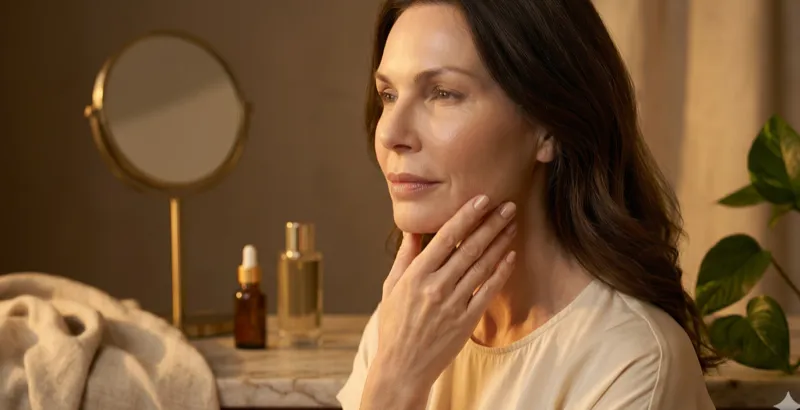
The science of skin aging is evolving rapidly — and for women navigating the skin changes that come with menopause and beyond, evidence-based skincare represents a fundamentally different approach: working with your skin's biology rather than against it.
Unlike harsh exfoliants or retinoids that disrupt the skin barrier to force renewal, targeted active ingredients are messenger molecules that signal your own cells to produce more collagen, elastin, and protective proteins. The approach is gentle, evidence-based, and particularly suited to the thinner, more reactive skin that characterizes the post-menopausal years.
How Dermal Thinning Creates the Conditions for Permanent Folds
Collagen loss is the permissive factor for marionette line formation — without sufficient collagen degradation, the other contributing factors (fat descent, muscle pull) cannot produce a visible fold. The dermis in the perioral region contains a dense collagen network that, when intact, distributes mechanical stress from the DAO muscle across a broad area, preventing focal crease formation. As collagen density decreases below a critical threshold, the stress concentrates along the line of maximum muscle pull, creating a permanent fold. A biomechanical modeling study estimated this threshold at approximately 60-65% of youthful collagen density — a level typically reached between ages 42-48, which correlates with the clinical observation that marionette lines become apparent in the mid-40s.[1]
The collagen loss in the perioral area is not uniform — it follows the pattern of maximum mechanical stress. Fibroblasts in skin that is repeatedly deformed (by the DAO muscle pull) produce more collagen-degrading MMPs (matrix metalloproteinases) than fibroblasts in mechanically quiet skin. This creates a negative feedback loop: the area most prone to fold formation loses collagen fastest because the repeated mechanical stress accelerates degradation. A study measuring MMP levels in perioral skin found 40% higher MMP-1 (collagenase) activity in the marionette fold area compared to adjacent cheek skin of the same subject.
Clinical research confirms that estrogen decline compounds the collagen loss in the marionette area. Estrogen directly stimulates fibroblast collagen production through ER-alpha and ER-beta receptors on dermal fibroblasts. Post-menopausal women lose collagen at 2.1% per year — roughly double the pre-menopausal rate. This accelerated loss brings many women to the critical collagen threshold for marionette line formation within 3-5 years of menopause. A longitudinal study tracking facial aging across the menopausal transition found that marionette line depth increased 65% faster in the 5 years post-menopause compared to the 5 years pre-menopause.
The clinical implication is that collagen preservation and stimulation in the perioral area should begin before marionette lines become established — ideally in the late 30s to early 40s. Retinoid therapy started before the collagen threshold is reached prevents marionette line formation more effectively than the same therapy started after lines have formed. This is because preventing a fold from forming requires maintaining collagen above the critical threshold, while reversing an established fold requires rebuilding collagen to a level that can resist the now-habitual crease pattern plus the muscle forces that maintain it. Prevention is 3-5 times more effective than correction for marionette lines, making early retinoid initiation one of the highest-return anti-aging investments.
Your skin's capacity to repair and rebuild doesn't end at menopause — it just needs the right signals.
— Dr. Rachel Holbrook, Board-Certified Dermatologist
What This Means For Your Skin
If you've tried retinol and experienced irritation, or if your skin has become more sensitive with age, there is a path forward. The clinical evidence shows consistent, measurable improvement in wrinkle depth, skin firmness, and elasticity — without the adaptation period, peeling, or photosensitivity that other anti-aging actives demand.
Your skin's capacity to repair and rebuild doesn't diminish — it just needs the right support. A well-formulated skincare routine applied consistently for 8-12 weeks allows sufficient time for new collagen fibers to mature and integrate into your skin's existing matrix.
The science is clear. The evidence is consistent. The results are measurable.
What happens next is up to you.