
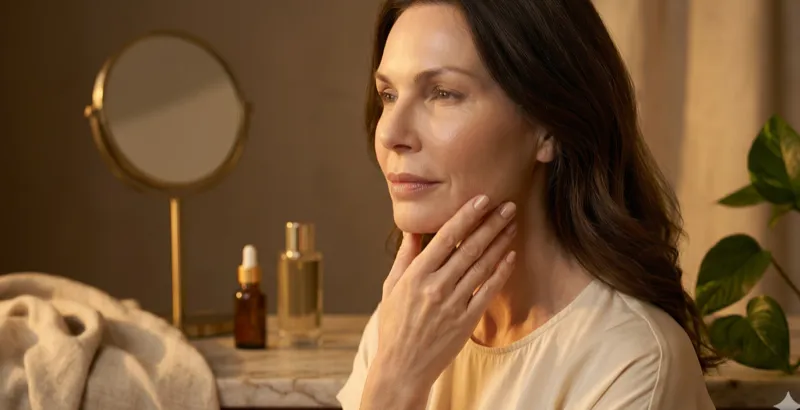
The science of skin aging is evolving rapidly — and for women navigating the skin changes that come with menopause and beyond, evidence-based skincare represents a fundamentally different approach: working with your skin's biology rather than against it.
Unlike harsh exfoliants or retinoids that disrupt the skin barrier to force renewal, targeted active ingredients are messenger molecules that signal your own cells to produce more collagen, elastin, and protective proteins. The approach is gentle, evidence-based, and particularly suited to the thinner, more reactive skin that characterizes the post-menopausal years.
Why Lower Face Aging Accelerates After Estrogen Decline
The relationship between menopause and marionette lines is not merely temporal coincidence — estrogen decline directly drives three of the four major mechanisms that create these folds. The rapid collagen loss (2.1% per year post-menopause versus 1% pre-menopause), the redistribution of facial fat (estrogen influences fat compartment maintenance), and the skin thinning (estrogen maintains dermal thickness through fibroblast stimulation) all accelerate simultaneously when estrogen levels fall permanently below 30 pg/mL. A facial aging study tracking women across the menopausal transition found that marionette line depth increased by an average of 0.4mm per year pre-menopause but 0.9mm per year in the first 5 post-menopausal years.[1]
The fat redistribution mechanism is particularly impactful for marionette lines. Estrogen maintains fat in the malar (cheek) compartment — the structural volume that supports the mid-face and prevents tissue descent toward the jawline. When estrogen declines, malar fat diminishes while the mandibular (jaw) fat compartment is relatively preserved, creating a volume imbalance that accelerates the gravitational descent of mid-face tissue into the marionette fold zone. Simultaneously, the perioral fat that kept the marionette area plump depletes, removing the local volume that resisted fold formation. This dual depletion — structural support from above and local volume from within — creates the anatomical conditions for rapid fold deepening.
Clinical research confirms that skin thinning in the perioral area during menopause follows the general pattern of post-menopausal dermal atrophy but is functionally more impactful. The perioral dermis is already among the thinnest facial skin, and the additional 15-20% thinning that occurs in the first 5 post-menopausal years brings many women below the critical thickness needed to resist permanent fold formation. Thin skin also shows folds more visibly — a fold of identical depth appears more prominent in thin skin than in thick skin because there is less tissue mass to distribute the deformation.
Managing menopause-related marionette lines requires addressing the hormonal component alongside standard collagen stimulation. Topical retinoid therapy (the cornerstone of collagen stimulation) should be intensified around menopause — if a woman has been using retinol 0.5%, considering an increase to 1.0% or transitioning to prescription tretinoin during perimenopause captures the window before accelerated collagen loss produces irreversible folding. Oral collagen peptides (10g daily) provide systemic substrate support during the period of maximum demand. Phytoestrogen supplementation (soy isoflavones 40mg daily) provides weak estrogenic support to skin fibroblasts. The combined approach — retinoid intensification plus nutritional support — during the perimenopausal window produces measurably better lower-face outcomes than the same interventions started 5+ years post-menopause.
Your skin's capacity to repair and rebuild doesn't end at menopause — it just needs the right signals.
— Dr. Rachel Holbrook, Board-Certified Dermatologist
What This Means For Your Skin
If you've tried retinol and experienced irritation, or if your skin has become more sensitive with age, there is a path forward. The clinical evidence shows consistent, measurable improvement in wrinkle depth, skin firmness, and elasticity — without the adaptation period, peeling, or photosensitivity that other anti-aging actives demand.
Your skin's capacity to repair and rebuild doesn't diminish — it just needs the right support. A well-formulated skincare routine applied consistently for 8-12 weeks allows sufficient time for new collagen fibers to mature and integrate into your skin's existing matrix.
The science is clear. The evidence is consistent. The results are measurable.
What happens next is up to you.