
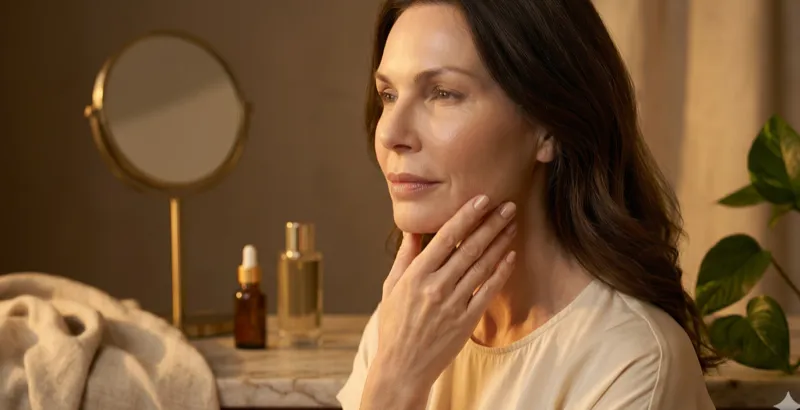
The science of skin aging is evolving rapidly — and for women navigating the skin changes that come with menopause and beyond, evidence-based skincare represents a fundamentally different approach: working with your skin's biology rather than against it.
Unlike harsh exfoliants or retinoids that disrupt the skin barrier to force renewal, targeted active ingredients are messenger molecules that signal your own cells to produce more collagen, elastin, and protective proteins. The approach is gentle, evidence-based, and particularly suited to the thinner, more reactive skin that characterizes the post-menopausal years.
Early Intervention Before the Collagen Threshold Is Breached
Prevention of marionette lines is 3-5 times more effective than treatment of established folds — a principle rooted in the biomechanics of fold formation. Maintaining perioral collagen density above the critical threshold (approximately 60-65% of youthful levels) prevents the mechanical conditions that allow fold formation. Once a fold establishes, the crease creates a stress concentration point that accelerates local collagen degradation, making the fold self-deepening. Prevention avoids this negative feedback loop entirely. A longitudinal prevention study found that women who began retinoid therapy at age 35-40 showed 60% less marionette line development at age 50 compared to untreated controls.[1]
The prevention window opens in the mid-30s and begins closing in the mid-40s. In the mid-30s, collagen density is still well above the fold-formation threshold, and retinoid therapy builds a 'collagen buffer' that delays threshold breach by years. By the mid-40s, many women have already reached or crossed the threshold, and the fold has begun forming — at this point, treatment rather than prevention is required. The optimal strategy: begin retinoid therapy and collagen-stimulating skincare in the mid-30s, specifically targeting the perioral area as part of the routine.
Clinical research confirms that the prevention protocol extends beyond topical skincare. Sun protection is critical: UV radiation from the sun is the single largest external contributor to collagen degradation, and the lower face receives significant UV exposure from reflected light (off pavement, water, and even indoor surfaces). SPF 50 applied to the lower face daily prevents the UV-mediated MMP activation that accelerates perioral collagen loss. Smoking cessation is equally critical: smoking degrades collagen through oxidative stress and vasoconstriction, and the repetitive lip-pursing motion of smoking directly creates perioral creases through the same mechanical mechanism as DAO pull.
Nutritional support for perioral collagen maintenance: collagen peptides (5-10g daily from age 35+) provide the amino acid building blocks (proline, hydroxyproline, glycine) that fibroblasts incorporate into new collagen fibers. Vitamin C (dietary and topical) ensures the hydroxylation cofactor is available. Omega-3 fatty acids (2g daily) reduce the chronic inflammation that upregulates collagen-degrading MMPs. Adequate protein intake (1.0-1.2g/kg/day) ensures general structural protein synthesis is not compromised. The combined topical + nutritional + protective approach maintains perioral collagen density 15-20% higher than aging alone, delaying marionette line formation by an estimated 5-8 years based on collagen decline rate calculations.
Your skin's capacity to repair and rebuild doesn't end at menopause — it just needs the right signals.
— Dr. Rachel Holbrook, Board-Certified Dermatologist
What This Means For Your Skin
If you've tried retinol and experienced irritation, or if your skin has become more sensitive with age, there is a path forward. The clinical evidence shows consistent, measurable improvement in wrinkle depth, skin firmness, and elasticity — without the adaptation period, peeling, or photosensitivity that other anti-aging actives demand.
Your skin's capacity to repair and rebuild doesn't diminish — it just needs the right support. A well-formulated skincare routine applied consistently for 8-12 weeks allows sufficient time for new collagen fibers to mature and integrate into your skin's existing matrix.
The science is clear. The evidence is consistent. The results are measurable.
What happens next is up to you.