
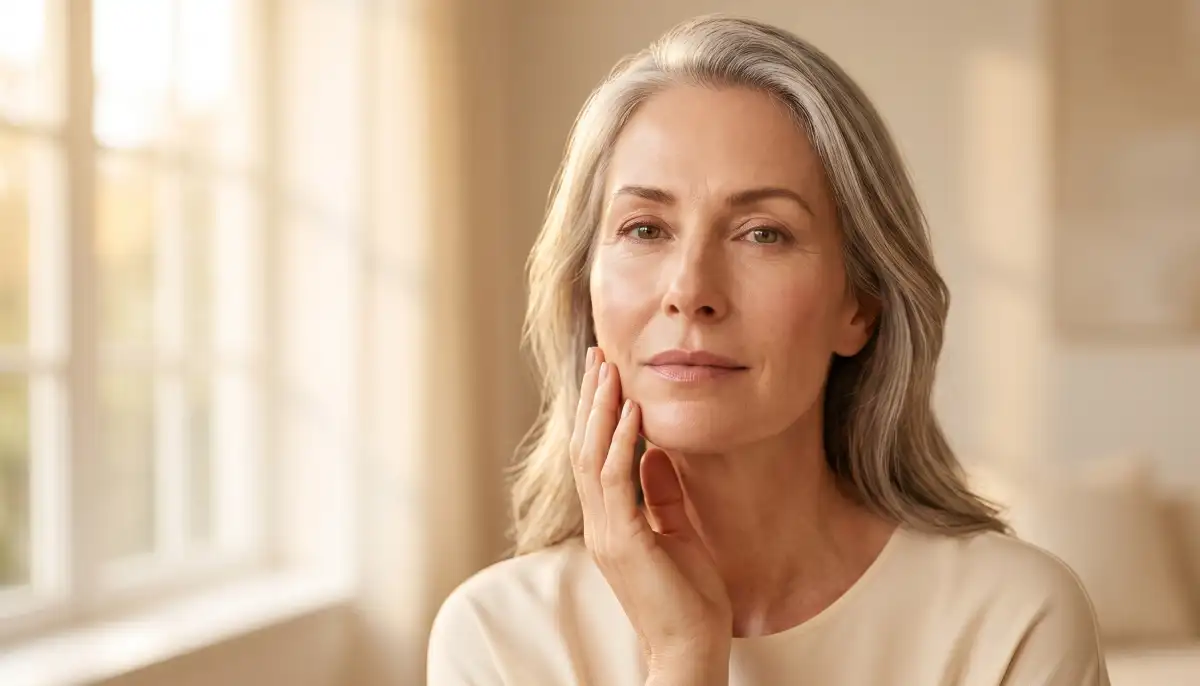
The science of skin aging is evolving rapidly — and for women navigating the skin changes that come with menopause and beyond, evidence-based skincare represents a fundamentally different approach: working with your skin's biology rather than against it.
Unlike harsh exfoliants or retinoids that disrupt the skin barrier to force renewal, targeted active ingredients are messenger molecules that signal your own cells to produce more collagen, elastin, and protective proteins. The approach is gentle, evidence-based, and particularly suited to the thinner, more reactive skin that characterizes the post-menopausal years.
The Androgen Unmasking Effect That Changes Your Skin Type
Sudden oily skin during menopause seems paradoxical — most women expect dryness — but it affects approximately 25% of menopausal women and has a specific hormonal explanation. The mechanism is called 'androgen unmasking': while total androgen levels remain stable or even decrease slightly during menopause, the dramatic drop in estrogen removes the opposition that previously kept androgen effects in check. The result is increased relative androgen activity in hormone-sensitive tissues — particularly the sebaceous glands of the T-zone, jawline, and chin.[1]
This effect is mediated through 5-alpha reductase — the enzyme that converts testosterone to its more potent form, dihydrotestosterone (DHT), within the sebaceous gland. Estrogen normally suppresses 5-alpha reductase expression. As estrogen declines, DHT production within the gland increases, stimulating sebum output even though circulating androgens have not increased. A study published in the Journal of Investigative Dermatology confirmed that post-menopausal skin showed increased 5-alpha reductase activity in androgen-sensitive areas compared to pre-menopausal controls.
Clinical research confirms that the clinical presentation creates a frustrating paradox: oily, potentially acne-prone skin in the T-zone and jawline coexisting with severe dryness on the cheeks, temples, and neck. This dual presentation — termed 'combination skin' in consumer language but more accurately described as androgen-mediated zonal oiliness with estrogen-deficiency dryness — requires zone-specific treatment rather than a single routine. A study in the British Journal of Dermatology found that 34% of women aged 45-54 reported adult-onset acne, often alongside self-reported dry skin.
Managing menopausal oily skin requires targeting the androgen pathway without worsening dryness elsewhere. Niacinamide at 4-5% reduces sebum production by 20-30% through sebocyte regulation, without affecting barrier lipids. Retinoids normalize keratinization within the pore, preventing the comedone formation that leads to breakouts. For the dry zones, ceramide-rich moisturizers and hyaluronic acid serums maintain hydration without adding oil. The key clinical principle is zone-specific treatment — not choosing between 'oily skin' and 'dry skin' products, but using both strategically.
Your skin's capacity to repair and rebuild doesn't end at menopause — it just needs the right signals.
— Dr. Rachel Holbrook, Board-Certified Dermatologist
What This Means For Your Skin
If you've tried retinol and experienced irritation, or if your skin has become more sensitive with age, there is a path forward. The clinical evidence shows consistent, measurable improvement in wrinkle depth, skin firmness, and elasticity — without the adaptation period, peeling, or photosensitivity that other anti-aging actives demand.
Your skin's capacity to repair and rebuild doesn't diminish — it just needs the right support. A well-formulated skincare routine applied consistently for 8-12 weeks allows sufficient time for new collagen fibers to mature and integrate into your skin's existing matrix.
The science is clear. The evidence is consistent. The results are measurable.
What happens next is up to you.