
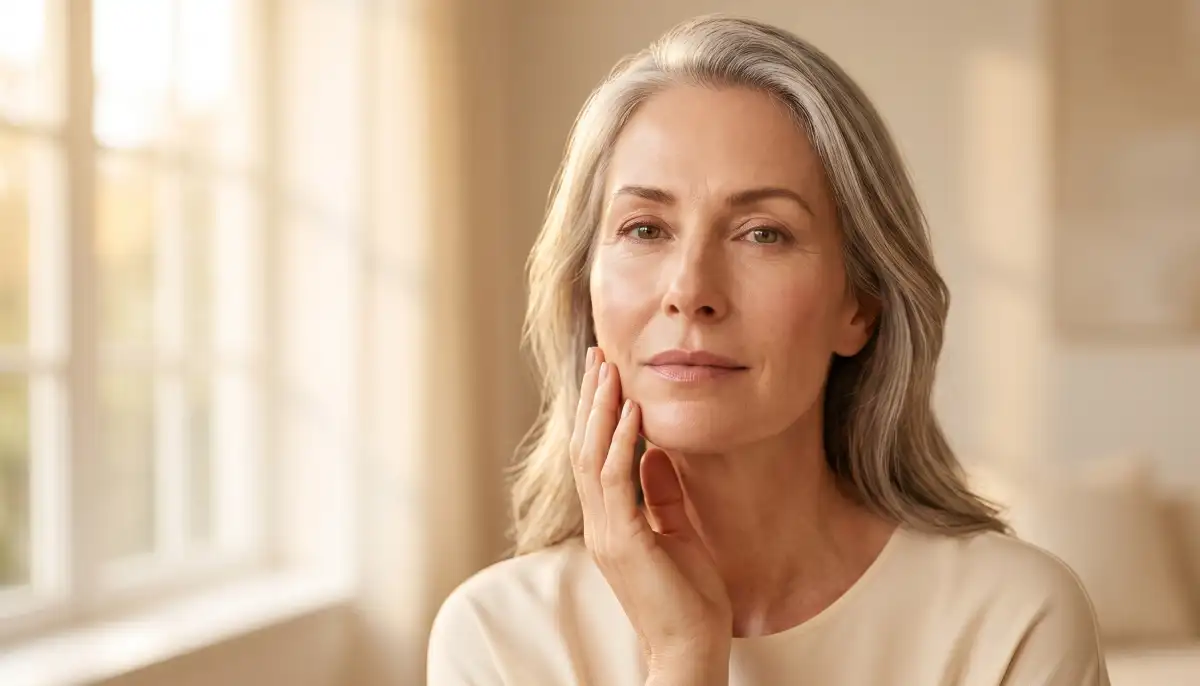
The science of skin aging is evolving rapidly — and for women navigating the skin changes that come with menopause and beyond, evidence-based skincare represents a fundamentally different approach: working with your skin's biology rather than against it.
Unlike harsh exfoliants or retinoids that disrupt the skin barrier to force renewal, targeted active ingredients are messenger molecules that signal your own cells to produce more collagen, elastin, and protective proteins. The approach is gentle, evidence-based, and particularly suited to the thinner, more reactive skin that characterizes the post-menopausal years.
How Hormonal Decline Simultaneously Transforms Skin and Hair
Skin and hair share a common hormonal regulator — estrogen — which explains why menopause transforms both simultaneously. Estrogen receptors are present in hair follicles, sebaceous glands, and dermal fibroblasts, meaning that declining estrogen affects the entire integumentary system rather than individual tissues. A comprehensive review published in the International Journal of Women's Dermatology documented that 52% of menopausal women report hair thinning alongside skin changes, yet the two are rarely addressed as connected symptoms.[1]
The hair-specific mechanism involves estrogen's role in prolonging the anagen (growth) phase of the hair cycle. As estrogen declines, the anagen phase shortens and the telogen (resting) phase lengthens, resulting in thinner, shorter hair strands and increased daily shedding. Simultaneously, the relative increase in androgen activity — not from increased androgen production, but from reduced estrogen opposition — stimulates vellus-to-terminal hair conversion in androgen-sensitive areas: the chin, upper lip, and jawline. This dual effect — thinning where you want hair, growing where you don't — is one of the most distressing aspects of menopausal change.
Clinical research confirms that for skin, the shared pathway manifests as concurrent sebum reduction and barrier compromise. Estrogen stimulates both sebaceous gland function and ceramide synthesis in the epidermis. Its decline produces the paradox of oily, acne-prone skin in androgen-sensitive zones (jawline, chin) alongside severe dryness everywhere else. A 2021 study in Skin Research and Technology confirmed that this pattern — localized oiliness with generalized dryness — is pathognomonic for menopausal skin and requires zone-specific treatment rather than a single routine.
The clinical approach that addresses both skin and hair involves targeting the shared hormonal deficit. Topical peptides that stimulate fibroblast activity benefit both dermal collagen and hair follicle support structures. Antioxidants that protect against oxidative stress benefit both skin cell turnover and hair follicle cycling. And barrier-repair formulations that restore ceramide ratios benefit both epidermal integrity and the scalp barrier that supports healthy hair growth.
Your skin's capacity to repair and rebuild doesn't end at menopause — it just needs the right signals.
— Dr. Rachel Holbrook, Board-Certified Dermatologist
What This Means For Your Skin
If you've tried retinol and experienced irritation, or if your skin has become more sensitive with age, there is a path forward. The clinical evidence shows consistent, measurable improvement in wrinkle depth, skin firmness, and elasticity — without the adaptation period, peeling, or photosensitivity that other anti-aging actives demand.
Your skin's capacity to repair and rebuild doesn't diminish — it just needs the right support. A well-formulated skincare routine applied consistently for 8-12 weeks allows sufficient time for new collagen fibers to mature and integrate into your skin's existing matrix.
The science is clear. The evidence is consistent. The results are measurable.
What happens next is up to you.