
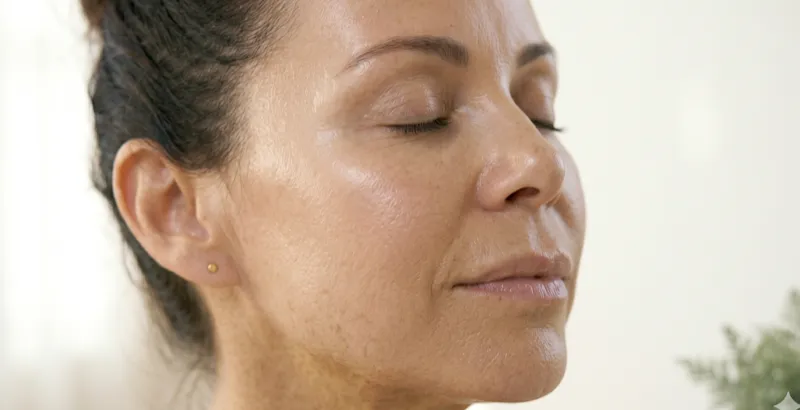
The science of skin aging is evolving rapidly — and for women navigating the skin changes that come with menopause and beyond, evidence-based skincare represents a fundamentally different approach: working with your skin's biology rather than against it.
Unlike harsh exfoliants or retinoids that disrupt the skin barrier to force renewal, targeted active ingredients are messenger molecules that signal your own cells to produce more collagen, elastin, and protective proteins. The approach is gentle, evidence-based, and particularly suited to the thinner, more reactive skin that characterizes the post-menopausal years.
Why Pores Enlarge After 40 and What Actually Minimizes Them
Pore enlargement in women over 40 results from a convergence of structural collagen loss, cumulative photodamage, and hormonal shifts that compromise the periostial architecture surrounding each follicular opening. The pore itself is the visible opening of the pilosebaceous unit, and its apparent size depends on the integrity of the surrounding dermal scaffold. Research published in Clinical, Cosmetic and Investigational Dermatology demonstrates that dermal collagen density decreases by approximately 1% per year after age 30, with accelerated losses during perimenopause — this structural decline directly weakens the collagen ring that maintains pore tautness. Elastin fiber fragmentation, documented at 2-4% annual degradation after age 40, further reduces the elastic recoil that helps pores return to a contracted state after stretching. Histological studies comparing facial skin biopsies from women aged 25-35 versus 45-55 show a 40% reduction in type I collagen fiber density around pilosebaceous units in the older cohort.[1]
Hormonal fluctuations during perimenopause alter sebum composition and volume in ways that directly affect pore appearance. While total sebum production typically decreases with declining estrogen, the ratio of oleic acid to linoleic acid shifts unfavorably — increased oleic acid produces a thicker, more occlusive sebum that is less efficiently cleared from follicular canals. Research in the Journal of the European Academy of Dermatology and Venereology shows that this altered sebum composition leads to greater follicular retention and comedonal plugging, which mechanically distends pores over time. Additionally, declining estrogen reduces the expression of aquaporin-3 in keratinocytes, diminishing the water content of the stratum corneum and creating a rougher skin surface texture that optically exaggerates pore visibility. Progesterone fluctuations during perimenopause can trigger transient sebum surges that further stretch already-weakened pore walls.
Clinical research confirms that cumulative ultraviolet damage compounds age-related pore enlargement through matrix metalloproteinase (MMP) activation that degrades the perifollicular collagen framework. UV-A radiation penetrates to the deep dermis and activates MMP-1, MMP-3, and MMP-9, which collectively break down collagen types I and III, elastin, and proteoglycans surrounding the pilosebaceous unit. A 2018 study in Photodermatology, Photoimmunology & Photomedicine demonstrated that chronically sun-exposed facial skin shows pore diameters 30-45% larger than sun-protected skin of the same individual, independent of age. The damage is cumulative and largely irreversible — decades of UV exposure create a zone of solar elastosis in the upper dermis that displaces normal collagen architecture and permanently undermines pore structural support. Infrared radiation and visible light contribute additional oxidative stress that accelerates this degradation.
Evidence-based pore minimization in mature skin requires a multi-modal approach targeting both structural reinforcement and surface refinement. Topical retinoids remain the gold standard, with a 2015 meta-analysis in the Journal of Drugs in Dermatology confirming that 12-24 weeks of retinoid therapy produces measurable increases in perifollicular collagen and statistically significant reductions in pore cross-sectional area. Niacinamide at 2-5% concentrations reduces pore appearance through dual mechanisms: stimulating collagen synthesis and normalizing sebum composition. Chemical exfoliation with alpha-hydroxy acids (glycolic acid 8-15%) or beta-hydroxy acids (salicylic acid 1-2%) addresses surface-level pore visibility by removing corneocyte buildup that shadows pore openings. For women over 40, the most effective protocols combine retinoid therapy for structural collagen rebuilding with regular chemical exfoliation for surface refinement, supported by consistent broad-spectrum photoprotection to prevent further matrix degradation.
Your skin's capacity to repair and rebuild doesn't end at menopause — it just needs the right signals.
— Dr. Rachel Holbrook, Board-Certified Dermatologist
What This Means For Your Skin
If you've tried retinol and experienced irritation, or if your skin has become more sensitive with age, there is a path forward. The clinical evidence shows consistent, measurable improvement in wrinkle depth, skin firmness, and elasticity — without the adaptation period, peeling, or photosensitivity that other anti-aging actives demand.
Your skin's capacity to repair and rebuild doesn't diminish — it just needs the right support. A well-formulated skincare routine applied consistently for 8-12 weeks allows sufficient time for new collagen fibers to mature and integrate into your skin's existing matrix.
The science is clear. The evidence is consistent. The results are measurable.
What happens next is up to you.