
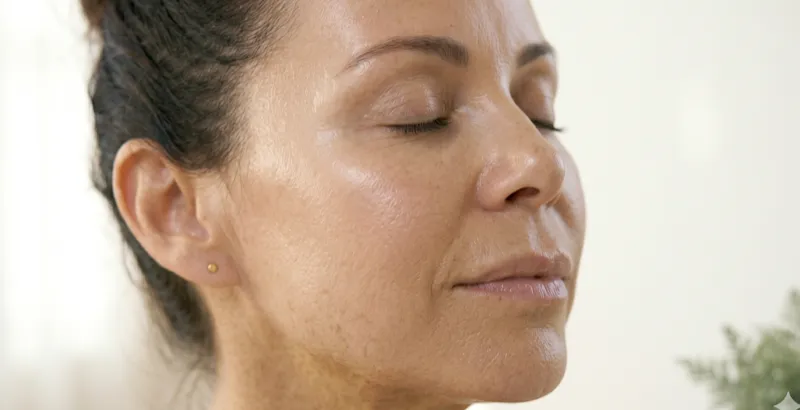
The science of skin aging is evolving rapidly — and for women navigating the skin changes that come with menopause and beyond, evidence-based skincare represents a fundamentally different approach: working with your skin's biology rather than against it.
Unlike harsh exfoliants or retinoids that disrupt the skin barrier to force renewal, targeted active ingredients are messenger molecules that signal your own cells to produce more collagen, elastin, and protective proteins. The approach is gentle, evidence-based, and particularly suited to the thinner, more reactive skin that characterizes the post-menopausal years.
How Vitamin B3 Tightens Pores and Strengthens Mature Skin
Niacinamide — the active form of vitamin B3 — has accumulated robust clinical evidence as one of the most effective topical ingredients for pore reduction in mature skin, with a mechanism profile uniquely suited to the multi-factorial causes of age-related pore enlargement. Unlike many cosmetic actives that address a single pathway, niacinamide simultaneously targets three of the four primary drivers of pore visibility in women over 40: it stimulates collagen synthesis to reinforce perifollicular structure, it normalizes sebum composition to reduce follicular distension, and it strengthens the epidermal barrier to maintain surface hydration that optically smooths pore appearance. A 2004 study in the International Journal of Cosmetic Science was among the first to quantify niacinamide's pore-minimizing effect, demonstrating a statistically significant reduction in pore size with 2% topical niacinamide over 4 weeks — an unusually rapid onset that researchers attributed to the barrier-strengthening and sebum-normalizing effects occurring before the slower collagen-rebuilding process.[1]
The collagen-stimulating mechanism of niacinamide is particularly relevant for women in perimenopause and menopause, when estrogen-dependent collagen synthesis declines precipitously. Niacinamide serves as a precursor to NAD+ and NADP+ — coenzymes essential for cellular energy metabolism, DNA repair, and protein synthesis including collagen. In vitro studies on human dermal fibroblasts demonstrate that niacinamide at concentrations achievable through topical application (0.5-2.0 mM) increases collagen production by 54-116%, with the effect being independent of estrogen signaling pathways. This estrogen-independence is critically important: while many skin-rejuvenating ingredients show diminished efficacy in postmenopausal women due to estrogen receptor downregulation, niacinamide maintains its collagen-stimulating potency regardless of hormonal status. A 2013 study in Experimental Dermatology confirmed that niacinamide-treated fibroblasts from postmenopausal women showed equivalent collagen synthesis upregulation as those from premenopausal women.
Clinical research confirms that sebum normalization by niacinamide directly addresses the pore-distending effect of altered sebum composition during hormonal transition. Niacinamide reduces total sebum excretion through inhibition of sebocyte lipogenesis — a 2006 randomized controlled trial in Dermatologic Surgery found that 2% topical niacinamide reduced casual sebum levels by 23% over 4 weeks. More importantly for pore size, niacinamide shifts the sebum fatty acid profile toward higher linoleic acid and lower oleic acid concentrations, producing a thinner, more fluid sebum that clears follicular channels more efficiently. This normalized sebum flow prevents the chronic mechanical distension that permanently stretches pore walls in mature skin. Additionally, niacinamide inhibits the vacuolar transport of melanosomes from melanocytes to surrounding keratinocytes, reducing the perifolicular hyperpigmentation that creates shadow effects making pores appear larger than their actual physical dimensions.
Optimal niacinamide protocols for pore reduction in women over 40 involve specific concentration, pH, and combination strategies validated by clinical data. Concentrations of 4-5% appear to be the efficacy plateau for pore minimization — higher concentrations (10%) do not produce proportionally greater pore reduction but do increase the risk of facial flushing in sensitive skin types. The ingredient is pH-flexible (stable and active at pH 3.0-7.0), making it compatible with virtually all other actives including retinoids, vitamin C, AHAs, and peptides. A 2021 clinical study in the Journal of Dermatological Treatment found that the combination of 4% niacinamide with 1% retinol produced 41% greater pore area reduction compared to either ingredient alone, with the niacinamide mitigating 78% of the retinol-associated irritation events. For mature skin, twice-daily application (AM and PM) produces superior results to once-daily, as the barrier-strengthening ceramide synthesis follows a dose-dependent curve. The clinical consensus recommends a minimum 8-week commitment to observe structural pore changes, with maximal results typically achieved at 16-24 weeks of consistent use.
Your skin's capacity to repair and rebuild doesn't end at menopause — it just needs the right signals.
— Dr. Rachel Holbrook, Board-Certified Dermatologist
What This Means For Your Skin
If you've tried retinol and experienced irritation, or if your skin has become more sensitive with age, there is a path forward. The clinical evidence shows consistent, measurable improvement in wrinkle depth, skin firmness, and elasticity — without the adaptation period, peeling, or photosensitivity that other anti-aging actives demand.
Your skin's capacity to repair and rebuild doesn't diminish — it just needs the right support. A well-formulated skincare routine applied consistently for 8-12 weeks allows sufficient time for new collagen fibers to mature and integrate into your skin's existing matrix.
The science is clear. The evidence is consistent. The results are measurable.
What happens next is up to you.