
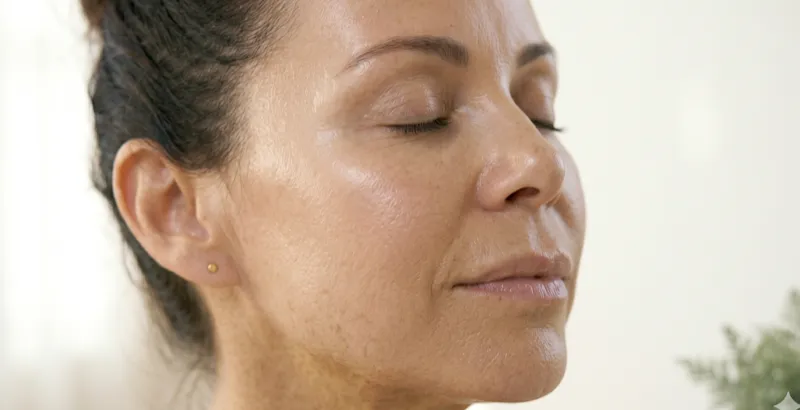
The science of skin aging is evolving rapidly — and for women navigating the skin changes that come with menopause and beyond, evidence-based skincare represents a fundamentally different approach: working with your skin's biology rather than against it.
Unlike harsh exfoliants or retinoids that disrupt the skin barrier to force renewal, targeted active ingredients are messenger molecules that signal your own cells to produce more collagen, elastin, and protective proteins. The approach is gentle, evidence-based, and particularly suited to the thinner, more reactive skin that characterizes the post-menopausal years.
Natural Pore-Minimizing Methods That Work After 40
Natural pore minimization on mature skin focuses on restoring the dermal architecture that keeps pore walls taut and promoting efficient cell turnover that prevents follicular congestion. Unlike younger skin where excess sebum is the primary driver of pore visibility, mature skin pore enlargement is predominantly structural — the collagen and elastin matrix surrounding each pilosebaceous unit has degraded to the point where the pore cannot maintain its compact configuration. This distinction is clinically important because it means that aggressive sebum-stripping approaches commonly recommended for younger skin are counterproductive in women over 40, where the skin barrier is already compromised. A 2019 study in Skin Research and Technology confirmed that in women aged 40-60, pore size correlates more strongly with dermal density measurements than with sebum excretion rates, validating the structural-first treatment approach.[1]
Niacinamide (vitamin B3) has emerged as one of the most effective natural pore-minimizing ingredients for mature skin, with a mechanism that addresses both structural and functional aspects of pore enlargement. A landmark 2006 study in the British Journal of Dermatology demonstrated that 5% niacinamide applied topically for 12 weeks significantly reduced pore area, improved skin texture, and reduced fine lines — effects attributed to stimulation of ceramide synthesis, increased collagen production, and normalization of the linoleic acid to oleic acid ratio in sebum. For women in perimenopause, niacinamide offers additional benefits: it suppresses the transfer of melanosomes to keratinocytes, reducing the periorbital hyperpigmentation that visually accentuates pore shadow, and it strengthens the skin barrier through increased ceramide production that maintains optimal hydration. Unlike retinoids, niacinamide does not cause purging, photosensitivity, or barrier disruption, making it suitable for sensitive mature skin.
Clinical research confirms that botanical extracts with evidence-based pore-minimizing properties include green tea polyphenols (EGCG), bakuchiol, and centella asiatica, each addressing different aspects of pore enlargement. EGCG has been shown in controlled studies to inhibit 5-alpha reductase — the enzyme that converts testosterone to the more potent dihydrotestosterone, which stimulates sebaceous gland activity — effectively reducing the sebum overproduction that can persist during hormonal fluctuations. Bakuchiol, derived from Psoralea corylifolia seeds, functions as a retinol-like compound that stimulates collagen synthesis and accelerates cell turnover without the irritation profile of traditional retinoids. A 2019 clinical trial in the British Journal of Dermatology directly compared bakuchiol and retinol, finding comparable improvements in fine lines and pigmentation with significantly fewer side effects. Centella asiatica stimulates fibroblast proliferation and collagen synthesis through its active compounds asiaticoside and madecassoside, supporting the structural matrix around pore walls.
Effective natural pore care for mature skin requires a protocol that balances collagen stimulation with barrier protection. The clinical literature supports a layered approach: gentle cleansing that removes oxidized sebum without stripping the acid mantle, followed by niacinamide serum to normalize sebum and stimulate collagen, then a retinoid or bakuchiol to accelerate cell turnover and reinforce perifollicular collagen. Hydration with hyaluronic acid or glycerin-based formulations plumps the skin surface, creating an optical smoothing effect that reduces pore visibility. A 2021 review in the Journal of Cosmetic Dermatology found that women over 40 who followed consistent multi-step protocols for 16 weeks showed 2.3 times greater pore reduction than those using single-ingredient approaches. The critical principle is consistency over intensity — gentle daily maintenance produces superior long-term results compared to aggressive weekly treatments that compromise the skin barrier and paradoxically increase pore visibility through chronic inflammation.
Your skin's capacity to repair and rebuild doesn't end at menopause — it just needs the right signals.
— Dr. Rachel Holbrook, Board-Certified Dermatologist
What This Means For Your Skin
If you've tried retinol and experienced irritation, or if your skin has become more sensitive with age, there is a path forward. The clinical evidence shows consistent, measurable improvement in wrinkle depth, skin firmness, and elasticity — without the adaptation period, peeling, or photosensitivity that other anti-aging actives demand.
Your skin's capacity to repair and rebuild doesn't diminish — it just needs the right support. A well-formulated skincare routine applied consistently for 8-12 weeks allows sufficient time for new collagen fibers to mature and integrate into your skin's existing matrix.
The science is clear. The evidence is consistent. The results are measurable.
What happens next is up to you.