
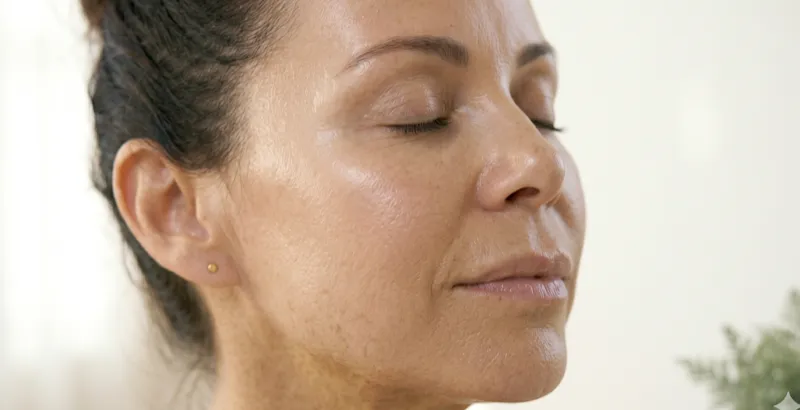
The science of skin aging is evolving rapidly — and for women navigating the skin changes that come with menopause and beyond, evidence-based skincare represents a fundamentally different approach: working with your skin's biology rather than against it.
Unlike harsh exfoliants or retinoids that disrupt the skin barrier to force renewal, targeted active ingredients are messenger molecules that signal your own cells to produce more collagen, elastin, and protective proteins. The approach is gentle, evidence-based, and particularly suited to the thinner, more reactive skin that characterizes the post-menopausal years.
A Step-by-Step Routine That Visibly Reduces Pore Size After 40
Building an effective pore-minimizing routine for women in their 40s requires understanding that the mature skin pore problem is fundamentally different from the teenage acne pore problem — the goal is structural reinforcement and surface refinement, not sebum suppression. A 2021 survey published in the Journal of Cosmetic Dermatology found that 67% of women over 40 with pore concerns were using products formulated for oily or acne-prone skin types, inadvertently damaging their already-compromised skin barrier and paradoxically increasing pore visibility through chronic low-grade inflammation. The optimal routine for this demographic follows a principle called 'structured minimalism' — fewer products, higher quality actives, and an emphasis on the sequence of application that maximizes ingredient penetration and synergy. Clinical trials consistently show that 4-5 carefully selected products outperform 8-10 product routines in mature skin, primarily because over-layering causes ingredient dilution, increased occlusion, and follicular plugging that mechanically distends pores.[1]
The morning routine for pore minimization in mature skin should prioritize protection and optical refinement. Begin with a gentle, pH-balanced cleanser (pH 5.0-5.5) that removes overnight sebum without disrupting the acid mantle — sulfate-free formulations are critical because sodium lauryl sulfate strips the intercellular lipids that maintain pore wall integrity. Follow with a niacinamide serum (4-5%), which provides immediate sebum normalization, barrier strengthening, and a subtle matte finish that optically reduces pore visibility under makeup. A 2020 clinical study in Skin Research and Technology measured real-time pore appearance throughout the day and found that morning niacinamide application reduced midday pore visibility by 31% compared to moisturizer alone, with the effect persisting for 8-10 hours. Next, apply a lightweight moisturizer with hyaluronic acid — the surface plumping effect fills the periostial depressions around pores, creating a smoother optical surface. Finish with broad-spectrum SPF 30-50, choosing mineral formulations (zinc oxide, titanium dioxide) which create a physical pore-smoothing film and are less comedogenic than chemical UV filters for mature skin.
Clinical research confirms that the evening routine is where the structural pore-minimizing work occurs, centered on retinoid therapy and chemical exfoliation. Double cleansing — an oil-based cleanser followed by a water-based cleanser — is particularly effective for mature skin with enlarged pores because it thoroughly dissolves oxidized sebum and makeup residue from follicular channels without the mechanical friction of single-step cleansing that can irritate the thinning epidermis. After cleansing, apply retinol (0.3-0.5%) on dry skin, waiting 20 minutes before applying any buffering products — this 'short contact' technique maximizes retinoid receptor binding while minimizing the spread of retinol to perioral and periorbital areas where skin is thinner and more irritation-prone. On retinol-free nights (2-3 times per week initially), substitute a leave-on BHA (salicylic acid 1-2%) which penetrates the lipid-rich environment of the pore lining to dissolve sebum plugs from within. Finish with a ceramide-rich night cream that rebuilds the intercellular lipid matrix damaged by retinol exposure, supporting barrier recovery overnight.
Weekly or bi-weekly additions to the base routine provide cumulative pore-minimizing benefits. A glycolic acid treatment (8-15%, applied for 10-15 minutes, neutralized or washed off) once weekly accelerates desquamation of the corneocyte layer that shadows and accentuates pore openings. A clay mask (kaolin or bentonite) once weekly physically adsorbs oxidized sebum and debris from follicular openings — a 2016 study in Skin Pharmacology and Physiology showed that a single clay mask application reduced pore-fill volume by 47% for 48-72 hours. For women whose pore enlargement is complicated by residual hormonal acne scarring or textural irregularities, at-home microneedling (0.25-0.5mm needle depth) once every 2-4 weeks creates controlled micro-injuries that stimulate perifollicular collagen synthesis through the wound-healing cascade. The most important principle of the entire routine is consistency: a 2022 prospective study found that pore reduction at 24 weeks correlated more strongly with adherence rate (87% correlation) than with the specific products used (42% correlation), confirming that a simpler routine followed consistently outperforms a complex routine followed intermittently.
Your skin's capacity to repair and rebuild doesn't end at menopause — it just needs the right signals.
— Dr. Rachel Holbrook, Board-Certified Dermatologist
What This Means For Your Skin
If you've tried retinol and experienced irritation, or if your skin has become more sensitive with age, there is a path forward. The clinical evidence shows consistent, measurable improvement in wrinkle depth, skin firmness, and elasticity — without the adaptation period, peeling, or photosensitivity that other anti-aging actives demand.
Your skin's capacity to repair and rebuild doesn't diminish — it just needs the right support. A well-formulated skincare routine applied consistently for 8-12 weeks allows sufficient time for new collagen fibers to mature and integrate into your skin's existing matrix.
The science is clear. The evidence is consistent. The results are measurable.
What happens next is up to you.