
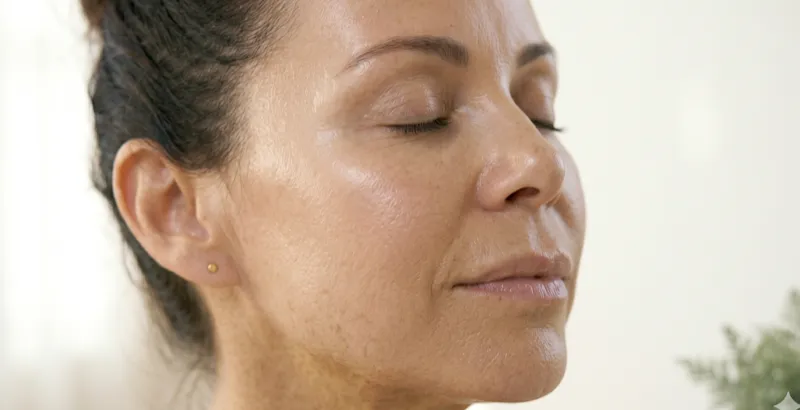
The science of skin aging is evolving rapidly — and for women navigating the skin changes that come with menopause and beyond, evidence-based skincare represents a fundamentally different approach: working with your skin's biology rather than against it.
Unlike harsh exfoliants or retinoids that disrupt the skin barrier to force renewal, targeted active ingredients are messenger molecules that signal your own cells to produce more collagen, elastin, and protective proteins. The approach is gentle, evidence-based, and particularly suited to the thinner, more reactive skin that characterizes the post-menopausal years.
Everything Women Over 40 Need to Know About Retinol and Pore Size
Retinol is the most extensively studied topical ingredient for pore reduction across all age groups, with a mechanism of action that simultaneously addresses the structural collagen deficit and the epidermal thickening that characterize pore enlargement in women over 40. Retinol converts through a two-step enzymatic process to retinoic acid within skin cells, where it binds nuclear retinoic acid receptors (RARs and RXRs) to activate gene transcription for collagen synthesis, elastin production, and glycosaminoglycan expression. A 2017 study in the Journal of Drugs in Dermatology quantified retinol's pore effects specifically: 0.5% retinol applied for 12 weeks produced a 16% reduction in mean pore area on the cheeks of women aged 40-65, with a 22% improvement in skin smoothness scores. The pore reduction correlated with a measurable increase in perifollicular collagen density on optical coherence tomography imaging, confirming that the visible pore minimization reflects genuine structural remodeling rather than a superficial optical effect.[1]
The retinol concentration and introduction schedule for women over 40 requires different calibration than for younger skin due to the thinner epidermis, reduced barrier function, and lower inflammatory threshold that characterize mature skin. Clinical dermatology guidelines recommend initiating retinol at 0.25% concentration, applied twice weekly for the first 2 weeks, advancing to every other night for weeks 3-4, then nightly from week 5 onward — a protocol that minimizes the retinization period (the transient phase of redness, flaking, and sensitivity). For women over 50 or those with rosacea-prone skin, starting at 0.1% or using retinaldehyde (retinal) — which requires only one enzymatic conversion step and produces less irritation — is often more appropriate. A 2020 dose-response study in the British Journal of Dermatology found that the pore-minimizing threshold begins at 0.3% retinol, with maximum benefit at 0.5-1.0% — concentrations above 1.0% did not produce additional pore reduction but doubled the incidence of adverse events in women over 40.
Clinical research confirms that the retinol purging phase — a temporary worsening of skin texture during the first 4-8 weeks as accelerated cell turnover pushes existing microcomedones to the surface — is particularly concerning for women with enlarged pores because these emerging microcomedones can temporarily make pores appear even larger. Understanding this pharmacological mechanism prevents premature discontinuation: the purge represents the clearing of months of accumulated sebum plugs, dead cells, and oxidized debris from follicular channels that were mechanically distending pore walls. Once purging completes (typically by week 8-12), the follicular channels are clearer, cell turnover has normalized at a faster rate preventing future plugging, and new collagen synthesis has begun reinforcing pore wall structure. Women who discontinue during the purge phase miss the structural benefits that develop in the post-purge period. A 2019 retrospective analysis found that 73% of women who persisted through the purge phase reported visible pore improvement by week 16, compared to only 12% of those who discontinued during purging.
Combination strategies maximize retinol's pore-minimizing effects while managing its side effect profile. The most evidence-supported combination is retinol with niacinamide: niacinamide's barrier-strengthening effect through increased ceramide production directly counteracts retinol's barrier-disrupting tendency, while both ingredients independently stimulate collagen synthesis through different pathways, producing additive structural reinforcement around pore walls. Retinol with hyaluronic acid is another validated pairing — hyaluronic acid provides immediate surface hydration that plumps the skin around pore openings for instant visual improvement while retinol works on the deeper structural remodeling over weeks to months. Retinol should generally be separated from direct acids (AHA, BHA) by at least 30 minutes or alternated on different days to prevent excessive irritation, though the combination is not truly contraindicated as commonly believed — a 2018 study showed that appropriately buffered retinol-glycolic acid combinations were tolerated by 82% of women over 40 with adequate gradual introduction.
Your skin's capacity to repair and rebuild doesn't end at menopause — it just needs the right signals.
— Dr. Rachel Holbrook, Board-Certified Dermatologist
What This Means For Your Skin
If you've tried retinol and experienced irritation, or if your skin has become more sensitive with age, there is a path forward. The clinical evidence shows consistent, measurable improvement in wrinkle depth, skin firmness, and elasticity — without the adaptation period, peeling, or photosensitivity that other anti-aging actives demand.
Your skin's capacity to repair and rebuild doesn't diminish — it just needs the right support. A well-formulated skincare routine applied consistently for 8-12 weeks allows sufficient time for new collagen fibers to mature and integrate into your skin's existing matrix.
The science is clear. The evidence is consistent. The results are measurable.
What happens next is up to you.