
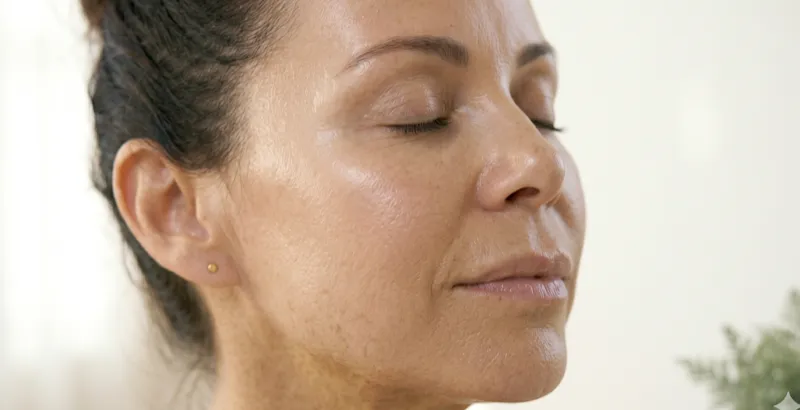
The science of skin aging is evolving rapidly — and for women navigating the skin changes that come with menopause and beyond, evidence-based skincare represents a fundamentally different approach: working with your skin's biology rather than against it.
Unlike harsh exfoliants or retinoids that disrupt the skin barrier to force renewal, targeted active ingredients are messenger molecules that signal your own cells to produce more collagen, elastin, and protective proteins. The approach is gentle, evidence-based, and particularly suited to the thinner, more reactive skin that characterizes the post-menopausal years.
Safe At-Home Peeling Protocols That Minimize Pores on Mature Skin
At-home chemical peels offer a controlled method for accelerating the surface refinement component of pore minimization, addressing the accumulated corneocyte layer that shadows pore openings and the superficial debris that fills follicular channels. For women over 40, the selection of peel acid, concentration, and frequency must account for the thinner epidermis, reduced barrier recovery rate, and heightened sensitivity that characterize mature skin. Glycolic acid — the smallest alpha-hydroxy acid with the deepest penetration profile — is the most studied peel acid for pore improvement. A 2010 clinical trial in the Journal of Cosmetic Dermatology demonstrated that serial at-home glycolic acid treatments (10% concentration, 10-minute application, twice weekly for 12 weeks) produced a 24% reduction in pore visibility scores and a 31% improvement in skin texture in women aged 40-55. The mechanism involves dissolution of the desmosomal bonds between corneocytes, accelerating the shedding of the thick, irregular surface layer that creates optical shadows around pore openings.[1]
Lactic acid peels present a particularly suitable option for mature skin pore treatment due to their dual exfoliating and hydrating properties. As a larger AHA molecule than glycolic acid, lactic acid penetrates more gradually and distributes more evenly across the skin surface, reducing the risk of focal over-exfoliation that can create texture irregularities on the thinner mature epidermis. Crucially, lactic acid stimulates ceramide synthesis in the stratum corneum — a 2003 study in Experimental Dermatology demonstrated that lactic acid at concentrations as low as 5% increased ceramide levels by 23%, directly strengthening the barrier function that other peel acids compromise. For pore minimization, lactic acid's humectant properties draw moisture to the skin surface, creating a plumping effect that fills the concavity around pore openings. At-home protocols typically use 10-15% lactic acid, applied for 5-10 minutes, 2-3 times per week, with results comparable to glycolic acid for pore metrics but with 45% fewer reported sensitivity events according to a 2016 head-to-head comparison in Dermatologic Surgery.
Clinical research confirms that mandelic acid, derived from bitter almonds, has gained recognition as the gentlest effective peel acid for pore treatment in sensitive mature skin. Its large molecular size (152.15 g/mol versus glycolic acid's 76.03 g/mol) means extremely slow, uniform penetration that virtually eliminates the stinging and burning associated with smaller AHAs. Despite this gentleness, mandelic acid retains the keratolytic and comedolytic effects necessary for pore improvement — a 2019 study in the Indian Journal of Dermatology comparing mandelic and glycolic acid peels for large pores found equivalent pore reduction at 12 weeks, with mandelic acid producing zero grade 2+ erythema events versus 18% with glycolic acid. Mandelic acid also possesses inherent antibacterial properties against Cutibacterium acnes, reducing the inflammatory component that can exaggerate pore appearance. For women with rosacea-prone skin or significant perioral sensitivity — common in the menopausal population — mandelic acid peels at 10-20% concentration offer pore-minimizing benefits without triggering reactive flare-ups.
The post-peel recovery protocol is critical for maximizing pore-minimizing results while protecting the mature skin barrier. After removing the peel solution (at the first sign of tingling for beginners, or at the prescribed time for experienced users), immediate application of a ceramide and cholesterol-containing moisturizer reseals the barrier and traps the hydration released by the exfoliation process. Sun protection for the 72 hours following a peel is non-negotiable — freshly exfoliated skin is 40% more susceptible to UV-induced MMP activation, and a single unprotected sun exposure can negate weeks of pore-minimizing progress. A 2018 protocol study in the Journal of Clinical and Aesthetic Dermatology recommended the following escalation for at-home peels in women over 40: begin with mandelic acid 10% for 4 weeks, advance to lactic acid 10-15% for 4 weeks, then glycolic acid 10% for ongoing maintenance — with each acid applied twice weekly and separated from retinol use by 48 hours. This progressive approach respects the mature skin's extended barrier recovery timeline while delivering cumulative pore improvements.
Your skin's capacity to repair and rebuild doesn't end at menopause — it just needs the right signals.
— Dr. Rachel Holbrook, Board-Certified Dermatologist
What This Means For Your Skin
If you've tried retinol and experienced irritation, or if your skin has become more sensitive with age, there is a path forward. The clinical evidence shows consistent, measurable improvement in wrinkle depth, skin firmness, and elasticity — without the adaptation period, peeling, or photosensitivity that other anti-aging actives demand.
Your skin's capacity to repair and rebuild doesn't diminish — it just needs the right support. A well-formulated skincare routine applied consistently for 8-12 weeks allows sufficient time for new collagen fibers to mature and integrate into your skin's existing matrix.
The science is clear. The evidence is consistent. The results are measurable.
What happens next is up to you.