
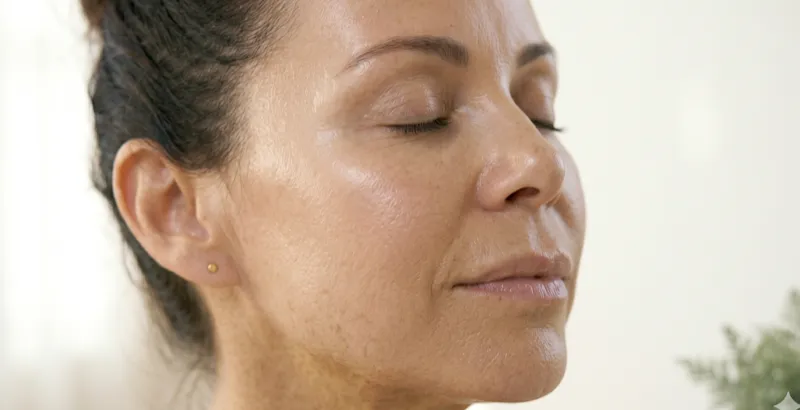
The science of skin aging is evolving rapidly — and for women navigating the skin changes that come with menopause and beyond, evidence-based skincare represents a fundamentally different approach: working with your skin's biology rather than against it.
Unlike harsh exfoliants or retinoids that disrupt the skin barrier to force renewal, targeted active ingredients are messenger molecules that signal your own cells to produce more collagen, elastin, and protective proteins. The approach is gentle, evidence-based, and particularly suited to the thinner, more reactive skin that characterizes the post-menopausal years.
Using BHA Safely and Effectively for Pore Minimization After 40
Salicylic acid (beta-hydroxy acid, BHA) occupies a unique position among pore-minimizing ingredients due to its lipophilic nature — it dissolves in oil, allowing it to penetrate the sebum-filled follicular canal and exfoliate from within the pore rather than only affecting the skin surface. This property is particularly valuable for mature skin with enlarged pores because the follicular plugging that mechanically distends pore walls occurs deep within the pilosebaceous unit, beyond the reach of water-soluble exfoliants. A 2009 study in the Journal of Clinical and Aesthetic Dermatology demonstrated that 2% salicylic acid applied twice daily for 12 weeks reduced comedone counts by 53% and pore size by 18% in women aged 35-55, with the pore reduction correlating with follicular clearance rather than collagen stimulation — confirming salicylic acid's primary mechanism as decongestion rather than structural repair. For women over 40, this makes salicylic acid an essential complement to, but not replacement for, collagen-stimulating ingredients like retinol and niacinamide.[1]
The application strategy for salicylic acid on mature skin differs significantly from protocols designed for younger, oilier skin types. Mature skin's thinner epidermis, reduced barrier function, and lower sebum output mean that the aggressive twice-daily application common in acne regimens often creates chronic low-grade inflammation that paradoxically increases pore visibility through periostial edema. Clinical dermatology literature supports a modified approach for women over 40: salicylic acid at 1-2% concentration applied as a leave-on treatment 3-4 times per week rather than daily, or as a short-contact treatment (applied for 3-5 minutes then rinsed) daily. A 2017 comparative study in the British Journal of Dermatology found that every-other-day BHA application produced equivalent pore clearance to daily application in women over 40, with 60% fewer reported adverse events including stinging, tightness, and visible flaking. This reduced frequency is sufficient because follicular re-plugging occurs over 3-5 day cycles in mature skin, versus 1-2 day cycles in adolescent skin.
Clinical research confirms that the interaction between salicylic acid and the mature skin barrier requires careful management to prevent the counterproductive cycle of over-exfoliation. Salicylic acid functions by dissolving the desmosomes — protein bridges connecting adjacent corneocytes — which accelerates desquamation and clears follicular plugs. However, in skin where natural desquamation has already slowed due to aging (the corneocyte turnover cycle extends from 28 days to 40-60 days after age 40), excessive BHA exposure can outpace the skin's ability to regenerate its protective layer. The result is a compromised barrier with increased transepidermal water loss, surface dehydration that accentuates pore visibility, and heightened sensitivity that limits the use of other beneficial actives like retinol. Monitoring for barrier compromise is essential: if the skin feels tight within 30 minutes of application, or if the characteristic BHA tingle persists beyond 2 minutes, the frequency or concentration should be reduced. Using a ceramide-rich moisturizer 15-20 minutes after BHA application helps reseal the barrier while the salicylic acid continues working within the follicular canal.
Combining salicylic acid with other pore-minimizing actives requires strategic scheduling to maximize efficacy while protecting the mature skin barrier. The most effective evidence-based combination alternates salicylic acid with retinol on different evenings — BHA on Monday-Wednesday-Friday, retinol on Tuesday-Thursday-Saturday, with Sunday as a barrier-recovery day using only hydrating and ceramide products. This alternating schedule prevents the cumulative irritation that occurs when both exfoliating agents are layered on the same evening, while maintaining sufficient frequency of each to produce meaningful pore improvement. Niacinamide can be safely layered over salicylic acid in the same routine — a 2020 study confirmed no negative interaction and demonstrated that the combination produced 23% greater pore reduction than either ingredient alone over 12 weeks. Hyaluronic acid applied over BHA further enhances tolerability by providing immediate hydration that counteracts the mild dehydrating effect of salicylic acid on the stratum corneum.
Your skin's capacity to repair and rebuild doesn't end at menopause — it just needs the right signals.
— Dr. Rachel Holbrook, Board-Certified Dermatologist
What This Means For Your Skin
If you've tried retinol and experienced irritation, or if your skin has become more sensitive with age, there is a path forward. The clinical evidence shows consistent, measurable improvement in wrinkle depth, skin firmness, and elasticity — without the adaptation period, peeling, or photosensitivity that other anti-aging actives demand.
Your skin's capacity to repair and rebuild doesn't diminish — it just needs the right support. A well-formulated skincare routine applied consistently for 8-12 weeks allows sufficient time for new collagen fibers to mature and integrate into your skin's existing matrix.
The science is clear. The evidence is consistent. The results are measurable.
What happens next is up to you.