
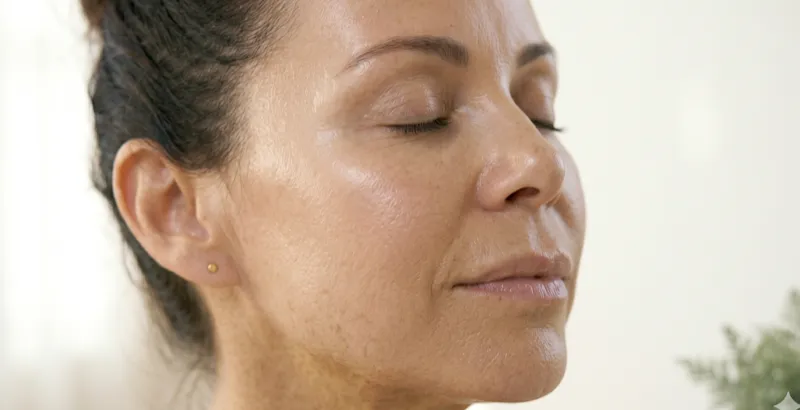
The science of skin aging is evolving rapidly — and for women navigating the skin changes that come with menopause and beyond, evidence-based skincare represents a fundamentally different approach: working with your skin's biology rather than against it.
Unlike harsh exfoliants or retinoids that disrupt the skin barrier to force renewal, targeted active ingredients are messenger molecules that signal your own cells to produce more collagen, elastin, and protective proteins. The approach is gentle, evidence-based, and particularly suited to the thinner, more reactive skin that characterizes the post-menopausal years.
Managing the Paradox of Oilier Skin and Bigger Pores After 40
The perimenopause paradox — experiencing both increased oiliness and enlarged pores simultaneously — confounds many women who expected their skin to become drier with age. This seemingly contradictory presentation has a clear hormonal explanation: during the perimenopausal transition (typically ages 40-55), estrogen levels decline faster than androgen levels, creating a state of relative androgen excess even as total hormone levels decrease. Testosterone and its more potent metabolite dihydrotestosterone (DHT) directly stimulate sebaceous gland activity through androgen receptors densely expressed on sebocytes. A 2011 study in the Journal of the European Academy of Dermatology and Venereology documented that 38% of perimenopausal women reported increased facial oiliness despite no previous history of oily skin, with the onset correlating with declining estrogen-to-testosterone ratios rather than absolute androgen levels. This increased sebum production occurs precisely when the collagen scaffold supporting pore walls is weakening, creating a double mechanism of pore enlargement: structural loosening from collagen loss combined with mechanical distension from increased sebum volume.[1]
The altered sebum composition during perimenopause differs qualitatively from the sebum of younger oily skin, requiring different treatment approaches. Perimenopausal sebum has higher proportions of squalene and branched-chain fatty acids relative to triglycerides, creating a thicker, more oxidation-prone secretion. When squalene oxidizes upon contact with air and UV radiation, it generates squalene peroxide — a potent comedogenic compound that inflames follicular walls and promotes the formation of microcomedones that physically distend pores. A 2013 study in the Journal of Lipid Research demonstrated that oxidized squalene in perimenopausal sebum was 2.3 times more inflammatory than squalene from younger skin, contributing to the periostial micro-inflammation that further weakens collagen around pore openings. This unique sebum profile explains why products designed for teenage oily skin — which target triglyceride-rich sebum — are ineffective and often counterproductive in perimenopausal women, where the problem is squalene oxidation and altered fatty acid composition rather than simple sebum excess.
Clinical research confirms that managing the perimenopause oily skin-large pore combination requires a strategy that simultaneously controls sebum without stripping the barrier and reinforces collagen without increasing comedogenicity. Niacinamide at 4-5% concentration is the cornerstone ingredient for this specific skin state: it reduces total sebum output by inhibiting sebocyte lipogenesis, shifts sebum fatty acid composition toward less occlusive profiles, and stimulates collagen synthesis — all without the barrier disruption that would worsen both conditions. BHA (salicylic acid 1-2%) used 3-4 times per week dissolves the oxidized squalene within follicular channels that standard cleansing cannot remove, preventing the mechanical pore distension caused by chronic sebum retention. For retinoid therapy — essential for collagen rebuilding — choosing retinaldehyde over retinol minimizes the purging phase that can be particularly aggressive in perimenopausal skin where increased sebum is pushing existing microcomedones to the surface. A 2018 clinical study in the Journal of Cosmetic Dermatology found that the niacinamide-salicylic acid-retinaldehyde triple combination reduced both sebum output (by 34%) and pore area (by 21%) over 16 weeks in perimenopausal women.
Moisturizer selection for oily, large-pored perimenopausal skin requires navigating between the need for barrier support and the risk of pore-occluding formulations. The common instinct to skip moisturizer on oily skin is counterproductive: dehydrated skin upregulates sebum production as a compensatory barrier-repair response, creating a cycle of increasing oiliness and pore distension. The clinical solution is lightweight, oil-free moisturizers based on humectants (hyaluronic acid, glycerin) and ceramides rather than occlusive emollients (mineral oil, petrolatum, coconut oil). Gel-cream textures deliver adequate hydration without the filmogenic properties that trap sebum under the skin surface. A 2020 formulation study in Skin Pharmacology and Physiology tested 12 commercial moisturizer types on perimenopausal facial skin and found that gel-cream formulations with ceramides and niacinamide produced the best outcomes for both sebum regulation and pore appearance at 12 weeks, while rich cream formulations — even those labeled 'non-comedogenic' — increased follicular plugging by 18% as measured by porphyrin fluorescence photography. For SPF, mineral sunscreens (zinc oxide) provide pore-smoothing, oil-absorbing benefits that chemical UV filters lack, making them the preferred choice for this skin type.
Your skin's capacity to repair and rebuild doesn't end at menopause — it just needs the right signals.
— Dr. Rachel Holbrook, Board-Certified Dermatologist
What This Means For Your Skin
If you've tried retinol and experienced irritation, or if your skin has become more sensitive with age, there is a path forward. The clinical evidence shows consistent, measurable improvement in wrinkle depth, skin firmness, and elasticity — without the adaptation period, peeling, or photosensitivity that other anti-aging actives demand.
Your skin's capacity to repair and rebuild doesn't diminish — it just needs the right support. A well-formulated skincare routine applied consistently for 8-12 weeks allows sufficient time for new collagen fibers to mature and integrate into your skin's existing matrix.
The science is clear. The evidence is consistent. The results are measurable.
What happens next is up to you.