
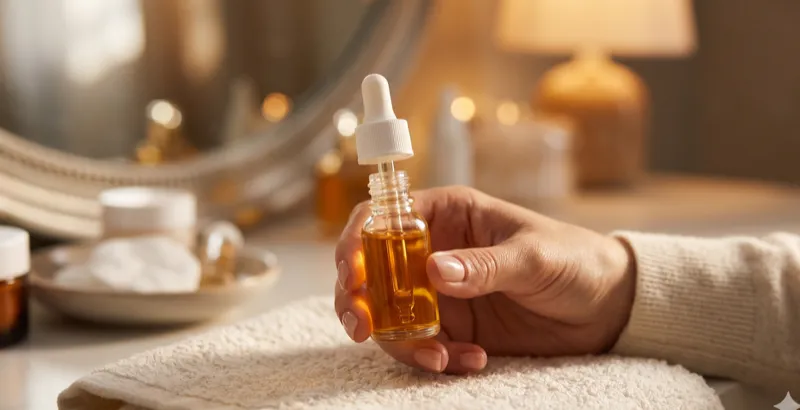
The science of skin aging is evolving rapidly — and for women navigating the skin changes that come with menopause and beyond, evidence-based skincare represents a fundamentally different approach: working with your skin's biology rather than against it.
Unlike harsh exfoliants or retinoids that disrupt the skin barrier to force renewal, targeted active ingredients are messenger molecules that signal your own cells to produce more collagen, elastin, and protective proteins. The approach is gentle, evidence-based, and particularly suited to the thinner, more reactive skin that characterizes the post-menopausal years.
Understanding the Retinoid Family and Their Conversion Pathway
The retinoid family encompasses multiple forms of vitamin A that all ultimately activate the same nuclear receptors (RAR and RXR) in skin cells — but they differ dramatically in potency, conversion pathway, availability, irritation potential, and clinical evidence. Understanding these differences prevents both under-treatment (using a weak retinoid and expecting prescription-strength results) and over-treatment (applying a potent retinoid without understanding its irritation profile). The retinoid conversion pathway in the skin follows a sequential chain: retinyl esters → retinol → retinaldehyde (retinal) → retinoic acid (tretinoin). Each step requires specific enzymes, and each conversion step reduces the amount of active retinoic acid that ultimately reaches the nuclear receptors. The fewer conversion steps required, the more potent the retinoid — but also the greater the irritation potential.[1]
Retinol (Vitamin A1) — the most popular OTC retinoid. Retinol requires TWO enzymatic conversion steps to reach the active form: retinol → retinaldehyde (via alcohol dehydrogenase) → retinoic acid (via retinaldehyde dehydrogenase). Each conversion step is rate-limited by enzyme availability, meaning the skin can only convert a certain amount of retinol per unit time. This rate-limitation is actually an advantage: it creates a built-in buffering effect that prevents sudden spikes of retinoic acid at the receptor level. The result is a gentler, more gradual retinoid effect compared to direct retinoic acid application. Clinical evidence: extensive, with dozens of controlled studies demonstrating efficacy for wrinkles, pigmentation, and texture at concentrations of 0.25-1.0%. Potency relative to tretinoin: approximately 10-20x less potent at equivalent concentrations, but this gap narrows with higher retinol concentrations and consistent use. Availability: over-the-counter worldwide.
Clinical research confirms that retinaldehyde (Retinal) — the emerging middle ground. Retinaldehyde requires only ONE enzymatic conversion step to reach the active form: retinaldehyde → retinoic acid (via retinaldehyde dehydrogenase). This single-step conversion means retinaldehyde is approximately 10x more potent than retinol at equivalent concentrations — it produces more retinoic acid per application because it bypasses the rate-limiting first conversion step. The single-step pathway also means retinal spends less time as intermediate metabolites that can cause irritation. Clinical evidence: growing but less extensive than retinol. Studies by Kwon et al. and Duperray et al. demonstrate anti-aging efficacy comparable to low-concentration tretinoin with significantly less irritation. Typical concentrations: 0.05-0.1%. Availability: over-the-counter in most countries, though fewer products are available compared to retinol. Best for: women who want greater efficacy than retinol but cannot access or tolerate prescription tretinoin.
Tretinoin (Retinoic Acid, Retin-A) — the prescription gold standard. Tretinoin IS the active form — it requires ZERO conversion steps and binds directly to nuclear retinoid receptors at full potency. This makes tretinoin the most potent topical retinoid, producing the fastest and most dramatic results for wrinkles, photodamage, and acne. It is also the most irritating — the lack of enzymatic buffering means full-strength retinoic acid hits the receptors immediately after absorption, producing intense receptor activation that the skin must adapt to over 6-12 weeks. Clinical evidence: the most extensive of any retinoid, with over 50 years of peer-reviewed research including the landmark Griffiths 1993 NEJM study. Typical concentrations: 0.025-0.1%. Availability: prescription only in most countries. Choosing between them: start with retinol 0.25-0.5% (safest, most accessible, well-tolerated). If retinol at maximum tolerated dose produces insufficient results after 6-12 months, consider retinaldehyde 0.05-0.1% (greater potency, still OTC). If retinaldehyde is insufficient, consult a dermatologist for prescription tretinoin (maximum potency, requires medical supervision). Each step up the ladder produces greater efficacy but also greater irritation — match the retinoid to your skin's tolerance and your treatment goals.
Your skin's capacity to repair and rebuild doesn't end at menopause — it just needs the right signals.
— Dr. Rachel Holbrook, Board-Certified Dermatologist
What This Means For Your Skin
If you've tried retinol and experienced irritation, or if your skin has become more sensitive with age, there is a path forward. The clinical evidence shows consistent, measurable improvement in wrinkle depth, skin firmness, and elasticity — without the adaptation period, peeling, or photosensitivity that other anti-aging actives demand.
Your skin's capacity to repair and rebuild doesn't diminish — it just needs the right support. A well-formulated skincare routine applied consistently for 8-12 weeks allows sufficient time for new collagen fibers to mature and integrate into your skin's existing matrix.
The science is clear. The evidence is consistent. The results are measurable.
What happens next is up to you.