
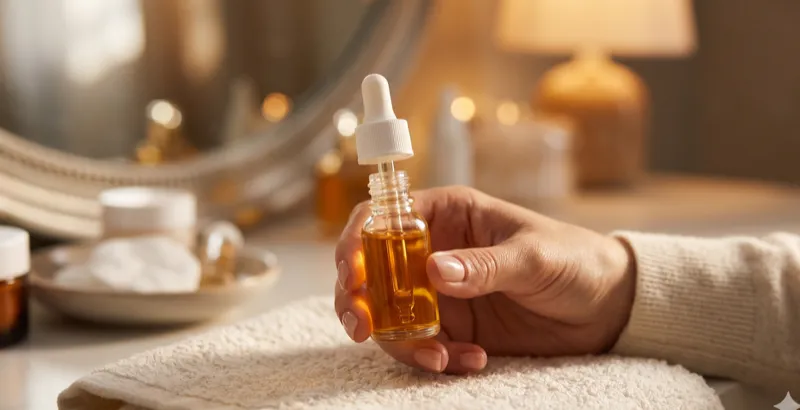
The science of skin aging is evolving rapidly — and for women navigating the skin changes that come with menopause and beyond, evidence-based skincare represents a fundamentally different approach: working with your skin's biology rather than against it.
Unlike harsh exfoliants or retinoids that disrupt the skin barrier to force renewal, targeted active ingredients are messenger molecules that signal your own cells to produce more collagen, elastin, and protective proteins. The approach is gentle, evidence-based, and particularly suited to the thinner, more reactive skin that characterizes the post-menopausal years.
The Concentration Sweet Spot Between Efficacy and Tolerability
The question of what retinol percentage is effective reveals one of the most counterintuitive truths in skincare: more is not always better, and the 'strongest' product often produces worse outcomes than a moderate one. The effective range for over-the-counter retinol is 0.25% to 1.0%, with the majority of clinical studies demonstrating significant anti-aging effects in the 0.3-0.5% range. The common consumer assumption — that 1.0% retinol must be twice as effective as 0.5% — is incorrect. The relationship between concentration and efficacy follows a logarithmic curve, not a linear one: doubling the concentration does not double the collagen stimulation, but it does approximately double the irritation potential. The clinical sweet spot for most women is the concentration that maximizes retinoid receptor activation while staying below the irritation threshold of their specific skin — and that threshold varies significantly between individuals.[1]
The concentration hierarchy explained: (1) 0.25% retinol — the entry point and the ideal concentration for sensitive skin, thin skin, post-menopausal skin, and body areas (neck, chest, hands). Clinical studies demonstrate measurable collagen stimulation at this concentration, though the magnitude of effect is smaller than higher concentrations. The advantage: near-zero irritation risk, allowing daily or near-daily application. The higher application frequency can compensate for the lower per-application potency — 7 applications of 0.25% per week may produce equivalent cumulative retinoid receptor activation to 3 applications of 0.5% per week, with far less irritation. (2) 0.5% retinol — the workhorse concentration for normal skin. Most clinical trials demonstrating significant wrinkle reduction, collagen stimulation, and pigmentation improvement used concentrations in this range. Typical tolerance: 3-4 applications per week after an 8-week introduction period. This concentration-frequency combination represents the most evidence-supported anti-aging protocol in OTC skincare.
Clinical research confirms that (3) 1.0% retinol — the maximum OTC concentration, appropriate only for skin that has built tolerance through months of lower-concentration use. The incremental benefit over 0.5% is modest (estimated 10-15% greater collagen stimulation per application) while the irritation risk is substantially higher. Many women who attempt to start at 1.0% or jump to it too quickly develop retinoid dermatitis — the resulting barrier damage and inflammation actually set back their anti-aging progress rather than advancing it. The counterintuitive reality: a woman who consistently uses 0.5% retinol 4 times per week for 12 months will have better skin than one who uses 1.0% retinol inconsistently because of recurrent irritation, breaks, and readaptation cycles. (4) Concentrations below 0.25% — some products contain 0.1% or even 0.05% retinol. At these concentrations, retinoid receptor activation is minimal and clinical effects are unlikely to differ meaningfully from placebo. Products listing retinol as the 15th or 20th ingredient likely fall into this sub-therapeutic range.
How to determine your optimal percentage: (1) Start at 0.25% for 8-12 weeks, applying once per week and gradually increasing to 3 times per week. (2) If tolerating well at 3 times per week (no persistent redness, peeling, or sensitivity), you have two options: increase frequency to 4-5 times per week at the same concentration (preferred — less irritation risk, similar cumulative benefit), or increase concentration to 0.5% while maintaining 3 times per week (more aggressive — slightly greater per-application efficacy). (3) If experiencing irritation at 0.25%, reduce frequency rather than abandoning retinol. Once per week for 8 weeks allows the skin's enzymatic capacity to adapt. (4) For women over 50 or with thin skin, 0.25% at the maximum tolerated frequency is often the lifetime optimal — the thinner dermis of aging skin absorbs more retinol per unit, making higher concentrations unnecessary and counterproductive. The principle: the best retinol percentage for you is the one you can use consistently, comfortably, and long-term. Consistency at a moderate concentration always outperforms intermittent use at a high concentration.
Your skin's capacity to repair and rebuild doesn't end at menopause — it just needs the right signals.
— Dr. Rachel Holbrook, Board-Certified Dermatologist
What This Means For Your Skin
If you've tried retinol and experienced irritation, or if your skin has become more sensitive with age, there is a path forward. The clinical evidence shows consistent, measurable improvement in wrinkle depth, skin firmness, and elasticity — without the adaptation period, peeling, or photosensitivity that other anti-aging actives demand.
Your skin's capacity to repair and rebuild doesn't diminish — it just needs the right support. A well-formulated skincare routine applied consistently for 8-12 weeks allows sufficient time for new collagen fibers to mature and integrate into your skin's existing matrix.
The science is clear. The evidence is consistent. The results are measurable.
What happens next is up to you.