
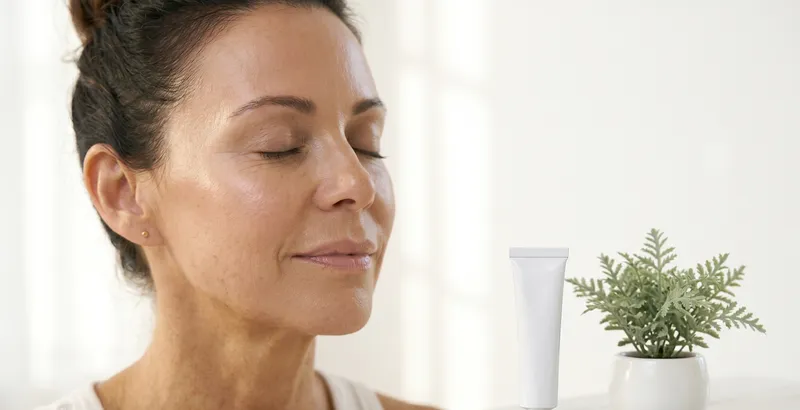
The science of skin aging is evolving rapidly — and for women navigating the skin changes that come with menopause and beyond, evidence-based skincare represents a fundamentally different approach: working with your skin's biology rather than against it.
Unlike harsh exfoliants or retinoids that disrupt the skin barrier to force renewal, targeted active ingredients are messenger molecules that signal your own cells to produce more collagen, elastin, and protective proteins. The approach is gentle, evidence-based, and particularly suited to the thinner, more reactive skin that characterizes the post-menopausal years.
When Rosacea Affects Your Eyes — Recognizing and Managing Ocular Involvement
Ocular rosacea — the eye manifestation of rosacea — affects an estimated 50-72% of rosacea patients according to a comprehensive review published in Survey of Ophthalmology, yet remains dramatically underdiagnosed because eye symptoms often precede or occur independently of skin findings. The condition involves chronic inflammation of the meibomian glands (modified sebaceous glands in the eyelid margins), conjunctiva, and in severe cases, the cornea itself. Symptoms include persistent burning or stinging sensation, foreign body feeling (grittiness), photosensitivity, tearing (paradoxically — reflexive tearing from irritation despite underlying dry eye), and visible telangiectasia of the lid margin and conjunctiva. In menopausal women, ocular rosacea is frequently misdiagnosed as simple age-related dry eye (keratoconjunctivitis sicca) because declining androgens also reduce meibomian gland function — but treatment approaches differ significantly.[1]
The pathophysiology of ocular rosacea involves meibomian gland dysfunction (MGD) as the central event. Meibomian glands secrete the lipid (oil) layer of the tear film that prevents aqueous tear evaporation. In ocular rosacea, chronic inflammation causes inspissation (thickening) of meibomian secretions, gland plugging, and eventually gland dropout — permanently reducing the eye's ability to maintain a stable tear film. Demodex folliculorum mites, implicated in cutaneous rosacea, also colonize the eyelash follicles and meibomian gland orifices, with studies showing 100% Demodex positivity in ocular rosacea patients versus 22% in age-matched controls. The inflammatory cascade involves toll-like receptor 2 activation, matrix metalloproteinase-9 overexpression (which degrades corneal epithelial basement membrane), and increased tear film osmolarity that damages the ocular surface epithelium — creating a self-perpetuating cycle of inflammation and surface damage.
Clinical research confirms that treatment of ocular rosacea follows a stepwise approach beginning with lid hygiene and advancing to systemic therapy as needed. First-line management includes daily warm compresses (40-45 degrees Celsius for 10 minutes) to liquefy inspissated meibomian secretions, followed by gentle lid margin massage and cleansing with diluted baby shampoo or commercially available hypochlorous acid lid scrubs. Tea tree oil-based lid wipes (at safe diluted concentrations) address Demodex colonization specifically. Preservative-free artificial tears (lipid-containing formulations preferred) supplement the deficient tear film. When these measures prove insufficient, low-dose oral doxycycline (40mg modified-release daily) provides both anti-inflammatory and anti-matrix metalloproteinase effects without reaching antimicrobial concentrations that would promote resistance. Topical cyclosporine 0.05% (Restasis) or lifitegrast 5% (Xiidra) address the T-cell mediated inflammation underlying chronic ocular surface disease.
For menopausal women with ocular rosacea, hormonal factors add an additional dimension to management. Androgens (primarily from adrenal sources in postmenopausal women) support meibomian gland function, and their age-related decline compounds the gland dysfunction caused by rosacea. Topical androgen replacement to the eyelids is under investigation but not yet clinically available. Omega-3 fatty acid supplementation (2-3g daily of combined EPA+DHA) has shown benefit specifically for ocular rosacea in a multicenter randomized trial published in Cornea, reducing tear film instability and lid margin inflammation over 12 weeks. Regular ophthalmological monitoring is essential because ocular rosacea can progress silently to corneal neovascularization, thinning, and in severe cases, perforation — vision-threatening complications that require aggressive immunosuppressive treatment. Any rosacea patient experiencing persistent eye redness, pain, or visual changes should receive urgent ophthalmological referral regardless of current dermatological disease severity.
Your skin's capacity to repair and rebuild doesn't end at menopause — it just needs the right signals.
— Dr. Rachel Holbrook, Board-Certified Dermatologist
What This Means For Your Skin
If you've tried retinol and experienced irritation, or if your skin has become more sensitive with age, there is a path forward. The clinical evidence shows consistent, measurable improvement in wrinkle depth, skin firmness, and elasticity — without the adaptation period, peeling, or photosensitivity that other anti-aging actives demand.
Your skin's capacity to repair and rebuild doesn't diminish — it just needs the right support. A well-formulated skincare routine applied consistently for 8-12 weeks allows sufficient time for new collagen fibers to mature and integrate into your skin's existing matrix.
The science is clear. The evidence is consistent. The results are measurable.
What happens next is up to you.