
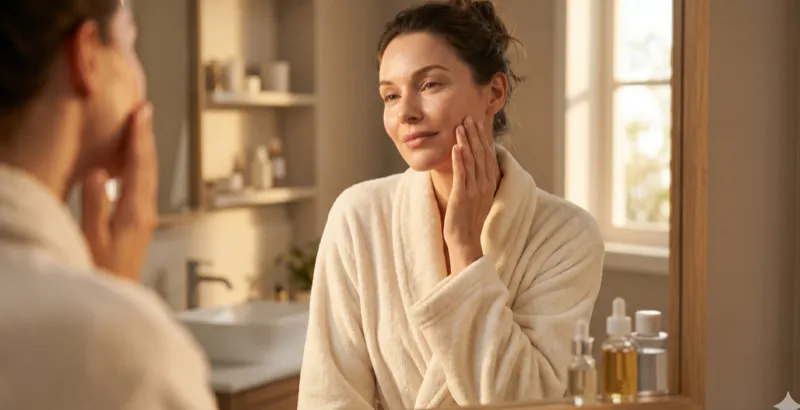
The science of skin aging is evolving rapidly — and for women navigating the skin changes that come with menopause and beyond, evidence-based skincare represents a fundamentally different approach: working with your skin's biology rather than against it.
Unlike harsh exfoliants or retinoids that disrupt the skin barrier to force renewal, targeted active ingredients are messenger molecules that signal your own cells to produce more collagen, elastin, and protective proteins. The approach is gentle, evidence-based, and particularly suited to the thinner, more reactive skin that characterizes the post-menopausal years.
Embracing Evidence-Based Skincare as an Act of Self-Investment, Not Vanity
Skin confidence after 50 is not about looking 30 — it is about knowing that your skin is being cared for with the same evidence-based approach you would apply to any other aspect of your health. The cultural framing of skincare as vanity is outdated and counterproductive — dermatological research has established that skin is the largest organ in the body, its structural integrity directly impacts quality of life (barrier protection, wound healing, thermoregulation, immune defense), and evidence-based treatment meaningfully improves both its function and appearance at any age. A woman who invests in retinol, peptides, and sunscreen is not being vain — she is maintaining an organ that serves essential biological functions. The confidence that comes from this reframing transforms skincare from a guilty indulgence into a proud act of self-care.[1]
The science of realistic expectations after 50: clinical evidence clearly demonstrates that anti-aging treatment produces measurable, visible improvement in skin over 50 — but the nature and magnitude of improvement differs from what younger skin achieves. Realistic expectations prevent both discouragement (expecting 30-year-old skin and being disappointed) and resignation (assuming nothing can be done and therefore doing nothing). What treatment can achieve after 50: 15-25% improvement in fine wrinkle depth over 12-18 months, measurable increase in skin firmness and elasticity, visible improvement in skin texture and radiance, reduction in hyperpigmentation and uneven tone, improved barrier function and reduced dryness, and skin that looks healthier, more vital, and more resilient. What treatment cannot achieve after 50: restoration to pre-menopausal skin quality, complete elimination of deep wrinkles (structural wrinkles can be improved but rarely eliminated topically), reversal of 30+ years of cumulative UV damage in 3 months.
Clinical research confirms that the mindset shift that builds confidence: (1) From 'anti-aging' to 'skin health' — framing the routine as health maintenance rather than age-fighting reduces the pressure to achieve impossibly youthful results and focuses on the genuine, achievable improvements in skin function and appearance. (2) From 'fixing flaws' to 'supporting an organ' — the skin is doing remarkable work: protecting from infection, regulating temperature, sensing the environment, and synthesizing vitamin D. Supporting it with evidence-based treatment is an act of respect for its function, not an attempt to hide its age. (3) From comparison to personal trajectory — the relevant comparison is not between your skin and a 30-year-old model's, but between your skin now and your skin 6-12 months from now. Monthly progress photographs tracking your individual trajectory build confidence far more effectively than comparison with unattainable standards.
The practical confidence protocol: (1) Establish and maintain a consistent, evidence-based routine — the knowledge that you are applying clinically validated ingredients correctly provides a quiet confidence independent of day-to-day appearance fluctuations. (2) Track your progress with monthly photographs — the gradual improvement becomes a source of genuine pride when documented and compared over time. (3) Educate yourself — understanding the mechanism of each product (retinol stimulates collagen through RAR/RXR receptors, peptides activate TGF-beta, vitamin C hydroxylates procollagen) transforms application from a hope-based ritual into an evidence-based intervention. Knowledge builds confidence. (4) Acknowledge what you are doing — you are not being vain. You are maintaining the structural integrity of your body's largest organ with the same scientific rigor that medicine applies to cardiovascular health, bone density, and cognitive function. Your skin deserves the same evidence-based attention as every other organ. (5) Start where you are — it is never too late. Fibroblasts retain retinoid responsiveness throughout life. The collagen built at 55 is as structurally valid as the collagen built at 35 — there is just less of it per stimulus. Every month of consistent treatment produces genuine structural improvement, regardless of the starting age.
Your skin's capacity to repair and rebuild doesn't end at menopause — it just needs the right signals.
— Dr. Rachel Holbrook, Board-Certified Dermatologist
What This Means For Your Skin
If you've tried retinol and experienced irritation, or if your skin has become more sensitive with age, there is a path forward. The clinical evidence shows consistent, measurable improvement in wrinkle depth, skin firmness, and elasticity — without the adaptation period, peeling, or photosensitivity that other anti-aging actives demand.
Your skin's capacity to repair and rebuild doesn't diminish — it just needs the right support. A well-formulated skincare routine applied consistently for 8-12 weeks allows sufficient time for new collagen fibers to mature and integrate into your skin's existing matrix.
The science is clear. The evidence is consistent. The results are measurable.
What happens next is up to you.