
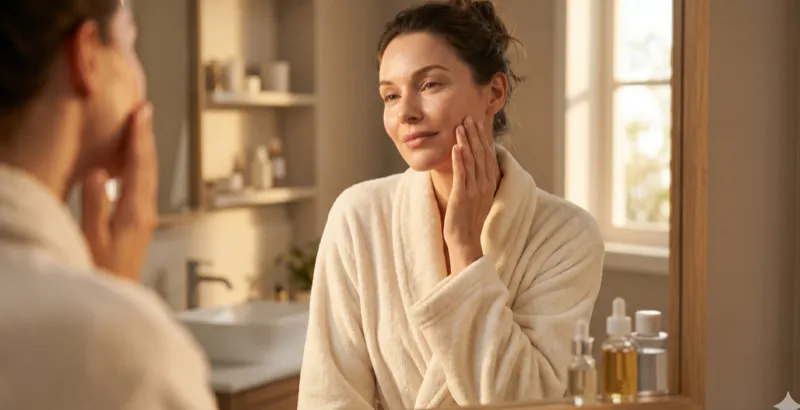
The science of skin aging is evolving rapidly — and for women navigating the skin changes that come with menopause and beyond, evidence-based skincare represents a fundamentally different approach: working with your skin's biology rather than against it.
Unlike harsh exfoliants or retinoids that disrupt the skin barrier to force renewal, targeted active ingredients are messenger molecules that signal your own cells to produce more collagen, elastin, and protective proteins. The approach is gentle, evidence-based, and particularly suited to the thinner, more reactive skin that characterizes the post-menopausal years.
Building a Sustainable Ritual That Nourishes Both Skin and Well-Being
The intersection of skincare and self-care is where the most sustainable anti-aging results are built. The clinical evidence for anti-aging ingredients — retinol, peptides, vitamin C — is clear, but the evidence is equally clear that these ingredients only work when applied consistently over months and years. The most common reason women abandon effective skincare routines is not product failure but behavioral failure: the routine feels like a chore, competes with evening fatigue, and is deprioritized when life becomes stressful — precisely when skin needs the most support. Reframing the skincare routine as a self-care ritual rather than a cosmetic obligation changes the behavioral equation. Self-care activities activate the parasympathetic nervous system (reducing cortisol), create predictable comfort anchors in chaotic schedules, and generate the intrinsic motivation that sustains long-term adherence. The woman who enjoys her routine applies it consistently; the woman who dreads it skips it regularly.[1]
The self-care skincare framework for women over 40: the routine must accomplish two goals simultaneously — deliver evidence-based anti-aging actives to the skin AND create a sensory experience that feels restorative rather than tedious. These goals are not competing — they are complementary. A well-designed routine takes 5-7 minutes, uses products with pleasant textures and minimal-to-no fragrance (functional, not perfumey), and follows a consistent sequence that becomes meditative through repetition. The morning ritual (5 minutes): Begin by holding a warm, damp washcloth against the face for 10 seconds — this sensory moment signals the transition from autopilot to intentional self-attention. Cleanse gently. Apply vitamin C serum with slow, deliberate upward strokes — this is collagen cofactor delivery AND a moment of facial self-massage that stimulates circulation and lymphatic drainage. Apply peptide cream with the same intentional strokes. Apply ceramide moisturizer. Apply SPF 50. Each step takes 30-60 seconds; the entire ritual takes 5 minutes but provides both the clinical actives and the sensory experience that makes consistency sustainable.
Clinical research confirms that the evening ritual (7 minutes, the more indulgent session): The evening routine is the primary self-care opportunity — it marks the transition from the day's demands to personal time. Double cleanse slowly (oil cleanser first, then cream cleanser) — this 2-minute step removes the day's physical and psychological residue. Apply hyaluronic acid serum to damp skin — the cool, gel texture is immediately soothing. On retinol nights: the ceramide sandwich method becomes a three-layer ritual — ceramide cream (warm, protective), retinol (the active treatment, applied with confidence), ceramide cream again (the comforting seal). On non-retinol nights: peptide cream applied with gentle upward massage strokes, followed by ceramide cream. Optional weekly intensive: the overnight mask night — apply a thick layer of squalane oil or healing ointment, put on a soft cotton sleep shirt, and feel the total cocooning effect. This is the most indulgent step in the weekly rotation.
Why the self-care framing produces better clinical outcomes: (1) Consistency — the primary determinant of anti-aging results. A routine experienced as self-care has intrinsic motivation (it feels good) rather than extrinsic motivation (you should do it). Intrinsically motivated behaviors are maintained 3-5x longer than extrinsically motivated ones in behavioral psychology research. (2) Stress reduction — the parasympathetic activation from a mindful skincare ritual directly reduces cortisol levels. Since cortisol suppresses collagen synthesis and upregulates MMPs, the stress reduction itself has anti-aging value independent of the products applied. A woman who applies retinol while stressed and rushing gets less collagen benefit than a woman who applies the same retinol in a calm, mindful state — because her lower cortisol creates a more permissive hormonal environment for collagen production. (3) Facial massage benefit — the deliberate, gentle strokes of mindful product application provide mechanical stimulation (mechanotransduction) that has been shown to enhance fibroblast collagen response. Quick, careless application misses this benefit. The self-care approach to skincare is not a luxury addition to the clinical routine — it is the behavioral infrastructure that makes the clinical routine sustainable, and the stress reduction it provides has its own measurable anti-aging value.
Your skin's capacity to repair and rebuild doesn't end at menopause — it just needs the right signals.
— Dr. Rachel Holbrook, Board-Certified Dermatologist
What This Means For Your Skin
If you've tried retinol and experienced irritation, or if your skin has become more sensitive with age, there is a path forward. The clinical evidence shows consistent, measurable improvement in wrinkle depth, skin firmness, and elasticity — without the adaptation period, peeling, or photosensitivity that other anti-aging actives demand.
Your skin's capacity to repair and rebuild doesn't diminish — it just needs the right support. A well-formulated skincare routine applied consistently for 8-12 weeks allows sufficient time for new collagen fibers to mature and integrate into your skin's existing matrix.
The science is clear. The evidence is consistent. The results are measurable.
What happens next is up to you.