
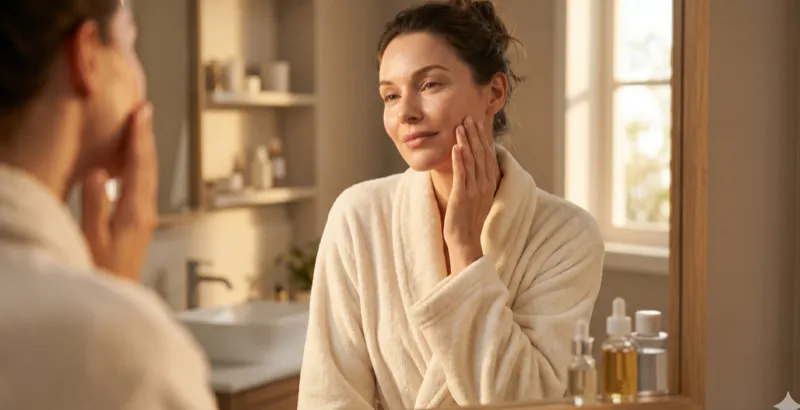
The science of skin aging is evolving rapidly — and for women navigating the skin changes that come with menopause and beyond, evidence-based skincare represents a fundamentally different approach: working with your skin's biology rather than against it.
Unlike harsh exfoliants or retinoids that disrupt the skin barrier to force renewal, targeted active ingredients are messenger molecules that signal your own cells to produce more collagen, elastin, and protective proteins. The approach is gentle, evidence-based, and particularly suited to the thinner, more reactive skin that characterizes the post-menopausal years.
How Present-Moment Awareness During Application Enhances Clinical Outcomes
Mindful skincare is the practice of applying skincare products with full present-moment awareness rather than on autopilot — attending to the sensory experience of each step (texture, temperature, scent, touch) while maintaining slow, deliberate application techniques. This approach produces measurably better clinical outcomes through three mechanisms: (1) improved application technique (more even product distribution, appropriate pressure, complete coverage), (2) reduced cortisol through parasympathetic activation (directly counteracting the stress-mediated skin damage pathway), and (3) enhanced consistency through intrinsic motivation (the routine becomes a desired experience rather than a dreaded obligation). The concept is supported by the broader mindfulness literature showing that present-moment awareness reduces cortisol, improves health behaviors, and enhances engagement with self-care activities.[1]
The cortisol reduction mechanism: when the skincare routine is performed mindfully — with deliberate attention to the sensory experience rather than while scrolling a phone, worrying about tomorrow, or rushing through steps — the nervous system shifts from sympathetic (stress/alertness) to parasympathetic (rest/repair) dominance. This shift produces measurable reductions in cortisol within minutes. Since cortisol directly suppresses collagen synthesis and upregulates MMPs, even a modest cortisol reduction during the 5-7 minutes of skincare application creates a more favorable hormonal environment for the active ingredients being applied. The retinol applied during a calm, mindful state encounters fibroblasts that are less cortisol-suppressed — potentially allowing greater collagen stimulation per application than the same retinol applied during a stressed, distracted state.
Clinical research confirms that how to practice mindful skincare — practical technique: (1) Transition signal — before starting the routine, take three slow, deep breaths. This activates the parasympathetic nervous system and signals the transition from task mode to self-care mode. (2) Single-tasking — put the phone in another room. The skincare routine is 5-7 minutes — it does not need to be multitasked. The undivided attention is both the self-care benefit and the technique improvement mechanism. (3) Sensory attention — as you apply each product, notice its texture, temperature, and feel against the skin. The cool slip of vitamin C serum, the rich cream of the peptide moisturizer, the protective feel of the ceramide seal. This attention is not forced — it is simply a gentle direction of awareness to what is already happening. (4) Intentional touch — apply each product with slow, deliberate strokes rather than quick, careless rubbing. Upward strokes on the face and neck, gentle circles around the eyes. This intentional touch provides mechanotransduction benefit while ensuring complete, even coverage.
(5) Gratitude micro-moment — as you apply the final product (ceramide cream or sunscreen), take one breath and appreciate what you just did for yourself. This is not new-age indulgence — it is a behavioral reinforcement technique that associates the routine with positive emotion, strengthening the neural pathways that drive future adherence. The compound effect of mindful skincare: the individual benefits — slightly better application technique, slightly lower cortisol, slightly stronger motivation — seem modest in isolation. But compounded over 365 applications per year, over 5-10 years of consistent use, these 'slight' improvements produce meaningfully different outcomes. The woman who applies retinol mindfully every evening for 10 years, with complete coverage, appropriate pressure, and parasympathetic-dominant cortisol levels, will have measurably better skin than the woman who applies the same retinol carelessly, inconsistently, and while stressed — even though they used identical products. Mindful skincare is not a replacement for effective ingredients — it is the behavioral framework that allows effective ingredients to deliver their full potential.
Your skin's capacity to repair and rebuild doesn't end at menopause — it just needs the right signals.
— Dr. Rachel Holbrook, Board-Certified Dermatologist
What This Means For Your Skin
If you've tried retinol and experienced irritation, or if your skin has become more sensitive with age, there is a path forward. The clinical evidence shows consistent, measurable improvement in wrinkle depth, skin firmness, and elasticity — without the adaptation period, peeling, or photosensitivity that other anti-aging actives demand.
Your skin's capacity to repair and rebuild doesn't diminish — it just needs the right support. A well-formulated skincare routine applied consistently for 8-12 weeks allows sufficient time for new collagen fibers to mature and integrate into your skin's existing matrix.
The science is clear. The evidence is consistent. The results are measurable.
What happens next is up to you.