
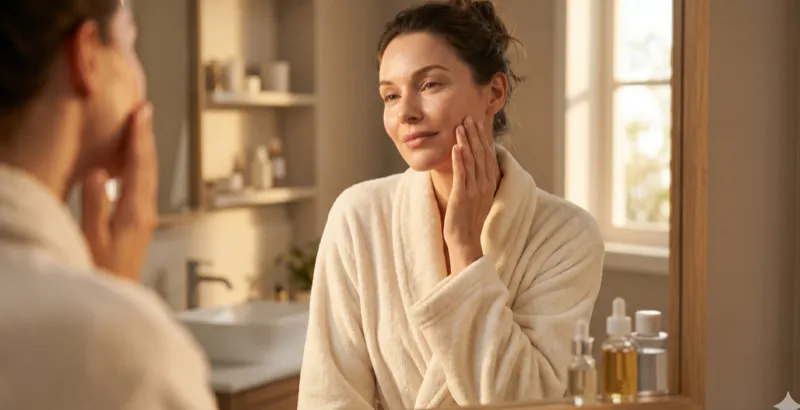
The science of skin aging is evolving rapidly — and for women navigating the skin changes that come with menopause and beyond, evidence-based skincare represents a fundamentally different approach: working with your skin's biology rather than against it.
Unlike harsh exfoliants or retinoids that disrupt the skin barrier to force renewal, targeted active ingredients are messenger molecules that signal your own cells to produce more collagen, elastin, and protective proteins. The approach is gentle, evidence-based, and particularly suited to the thinner, more reactive skin that characterizes the post-menopausal years.
How Manual Stimulation Enhances Collagen Production and Facial Contour
Facial massage for anti-aging is supported by clinical evidence that goes beyond the subjective 'feels good' to measurable structural and visible improvements. Alam et al. (2018) published a study in JAMA Dermatology demonstrating that 20 weeks of daily facial exercises and massage produced statistically significant improvement in upper and lower cheek fullness, with participants appearing an average of 3 years younger in blinded dermatologist evaluation. The mechanism is mechanotransduction — the biological process by which fibroblasts convert mechanical stimulation into cellular responses. Fibroblasts are mechanosensitive cells: they detect physical forces (stretching, compression, vibration) through integrin receptors on their cell surface and respond by increasing collagen production, proliferating, and reorganizing their extracellular matrix output. Facial massage provides the mechanical input; the fibroblasts translate it into structural improvement.[1]
The three anti-aging mechanisms of facial massage: Mechanism 1 — Mechanotransduction-stimulated collagen production. When facial massage applies gentle, repetitive mechanical forces to the skin, the transmitted stress reaches dermal fibroblasts through the extracellular matrix. Fibroblasts detect this mechanical input through integrin-mediated mechanosensing and respond by upregulating collagen production through the FAK/MAPK signaling pathway. This mechanical collagen stimulation operates independently of chemical stimulation (retinol, peptides), meaning it adds to rather than overlaps with topical treatment effects. Mechanism 2 — Lymphatic drainage and fluid redistribution. The face has an extensive superficial lymphatic network that drains interstitial fluid, metabolic waste, and inflammatory mediators. Gentle massage strokes directed toward the lymphatic drainage points (preauricular and submandibular nodes) enhance lymphatic flow, reducing puffiness, improving skin clarity, and removing inflammatory mediators that promote MMP activity.
Clinical research confirms that mechanism 3 — Enhanced product absorption. Massage during product application increases the contact time and mechanical penetration of active ingredients. The physical manipulation of the skin surface creates temporary microchannel enhancement in the stratum corneum (different from the permanent channels of microneedling) that modestly increases the penetration rate of subsequently applied actives. This means that applying peptide cream with massage delivers slightly more peptide to the dermis than applying the same cream without massage. The practical facial massage technique for anti-aging (5 minutes): (1) Apply peptide cream or facial oil to provide slip (never massage dry skin — friction without slip damages the barrier). (2) Forehead — using fingertips, make 10 upward strokes from brow to hairline, alternating hands. This counteracts the downward gravitational pull and stimulates the frontalis muscle zone. (3) Cheeks — using the knuckles of the index and middle fingers, make gentle sweeping strokes from the nose outward toward the ears. 10 repetitions per side. This follows the lymphatic drainage direction and stimulates the malar zone fibroblasts.
(4) Jawline — using the thumb and forefinger, pinch gently along the jawline from chin to ear. 5 repetitions per side. This provides compressive mechanotransduction to the perioral and mandibular fibroblasts while supporting jawline definition. (5) Under-eye — using the ring finger (lightest touch), make gentle tapping motions from the inner to outer corner of the under-eye area. 10 taps per side. The tapping stimulates lymphatic drainage (reducing dark circles and puffiness) without the stretching force that can damage the delicate periorbital skin. (6) Neck — using flat palms, make 10 upward strokes from clavicle to jawline. This drains cervical lymphatics and provides mechanotransduction to the thin neck dermis. Integration with the skincare routine: facial massage replaces the 30-second product application step with a 2-3 minute massage application step. The same products are used; the application method is enhanced. Morning vitamin C + peptide application with massage. Evening retinol sandwich or peptide cream with massage. The total routine time increases by 3-5 minutes, but the mechanotransduction benefit, lymphatic drainage, and enhanced product absorption justify the investment.
Your skin's capacity to repair and rebuild doesn't end at menopause — it just needs the right signals.
— Dr. Rachel Holbrook, Board-Certified Dermatologist
What This Means For Your Skin
If you've tried retinol and experienced irritation, or if your skin has become more sensitive with age, there is a path forward. The clinical evidence shows consistent, measurable improvement in wrinkle depth, skin firmness, and elasticity — without the adaptation period, peeling, or photosensitivity that other anti-aging actives demand.
Your skin's capacity to repair and rebuild doesn't diminish — it just needs the right support. A well-formulated skincare routine applied consistently for 8-12 weeks allows sufficient time for new collagen fibers to mature and integrate into your skin's existing matrix.
The science is clear. The evidence is consistent. The results are measurable.
What happens next is up to you.