
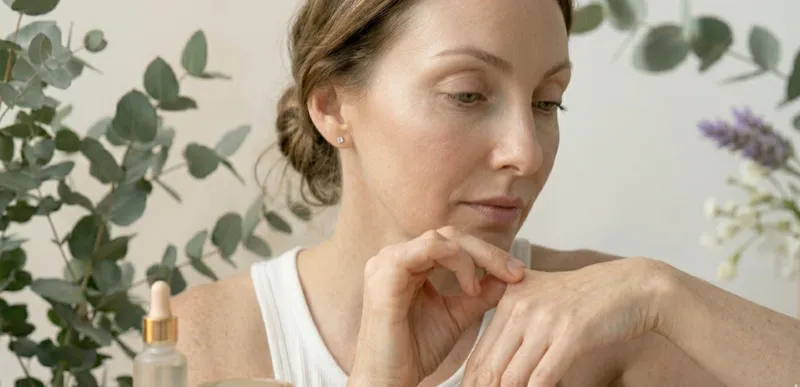
The science of skin aging is evolving rapidly — and for women navigating the skin changes that come with menopause and beyond, evidence-based skincare represents a fundamentally different approach: working with your skin's biology rather than against it.
Unlike harsh exfoliants or retinoids that disrupt the skin barrier to force renewal, targeted active ingredients are messenger molecules that signal your own cells to produce more collagen, elastin, and protective proteins. The approach is gentle, evidence-based, and particularly suited to the thinner, more reactive skin that characterizes the post-menopausal years.
The Science of Elastic Fiber Restoration in Adult Skin
The question of whether skin elasticity can be rebuilt requires a nuanced answer that distinguishes between what is biologically possible and what is practically achievable with current treatments. The short answer is: yes, skin elasticity can be meaningfully improved, but the mechanisms of improvement differ from what most people assume. The common assumption is that 'rebuilding elasticity' means producing new elastin fibers to replace those that have been lost or damaged. In reality, adult skin has very limited capacity for de novo elastin synthesis — tropoelastin gene expression in adult dermal fibroblasts is minimal compared to fetal and juvenile fibroblasts. The elastin present in a 40 or 50-year-old's dermis is essentially the same elastin that was deposited during development. This biological reality does not mean, however, that elasticity improvement is impossible. It means that the pathway to improved elasticity runs through multiple complementary mechanisms rather than through elastin replacement alone.[1]
Mechanism 1 — Collagen densification: the most achievable and impactful route to improved elasticity. Collagen and elastin work as an integrated mechanical system — collagen provides the structural scaffolding that elastic fibers are woven through, and the two proteins must be in proper ratio and spatial relationship for optimal skin resilience. When collagen density increases (through retinoid therapy, peptide stimulation, or vitamin C cofactor support), the overall dermal matrix becomes firmer, providing better mechanical context for the remaining elastic fibers to function. Think of it as tightening the frame around a trampoline — the elastic membrane (elastin) performs better when the frame (collagen) is solid. Clinical studies consistently show that treatments that increase collagen density also produce measurable improvements in skin elasticity parameters, even when elastic fiber density itself has not changed. Mechanism 2 — Microfibrillar scaffold repair: elastic fibers are not standalone structures — they are organized by a microfibrillar scaffold composed primarily of fibrillin-1. Peptide therapy (particularly Matrixyl 3000) stimulates fibroblast production of fibrillin-1, improving the organizational framework that determines how efficiently remaining elastic fibers function. Better-organized elastic fibers, even in reduced quantity, produce more effective elastic recoil than the same fibers in a disorganized state.
Clinical research confirms that mechanism 3 — Protection of remaining elastic fibers: preventing further loss is as therapeutically valuable as rebuilding. Elastic fibers are degraded by UV-activated MMPs (particularly MMP-12), neutrophil elastase released during inflammatory processes, and reactive oxygen species generated by both UV and metabolic processes. Rigorous UV protection (SPF 50 daily), retinoid-mediated MMP suppression, and antioxidant therapy (topical vitamin C, oral polyphenols) collectively reduce the rate of ongoing elastic fiber destruction. For a person losing elastic fibers at a rate of 3% per year, slowing that rate to 1% per year represents a cumulative preservation of substantial elastic function over a decade. Mechanism 4 — Hydration optimization: elastic fibers require adequate water content to maintain their mechanical properties. Dehydrated elastin becomes stiff and brittle — it resists deformation rather than stretching and recovering. Restoring and maintaining dermal hydration through hyaluronic acid and ceramide therapy can improve measurable elasticity without changing the quantity of elastic fibers, simply by restoring their functional hydration state.
What the clinical evidence shows: studies using the Cutometer (which measures skin deformation under negative pressure and subsequent recovery) demonstrate that 12-24 weeks of combined peptide and retinoid therapy produces 10-25% improvement in the R2 parameter (gross elasticity) and 15-30% improvement in the R7 parameter (biological elasticity). These are meaningful, measurable improvements that translate to visible changes in skin bounce, firmness, and resilience. The improvement reflects the cumulative effect of mechanisms 1-4 operating simultaneously rather than elastin replacement. The women who achieve the best elasticity improvement are those who implement comprehensive protocols addressing all four mechanisms: peptide cream twice daily (collagen and fibrillin stimulation), retinol 3-4 nights per week (collagen stimulation + MMP suppression), vitamin C serum morning (antioxidant + collagen cofactor), ceramide cream (barrier and hydration), SPF 50 daily (elastic fiber protection). Timeline: initial improvement at 8-12 weeks, progressive improvement continuing for 12-18 months. The honest clinical message: you cannot restore the elasticity of 25-year-old skin, but you can meaningfully improve your current elasticity by 15-25% — enough to produce visible, palpable improvement in skin bounce and firmness.
Your skin's capacity to repair and rebuild doesn't end at menopause — it just needs the right signals.
— Dr. Rachel Holbrook, Board-Certified Dermatologist
What This Means For Your Skin
If you've tried retinol and experienced irritation, or if your skin has become more sensitive with age, there is a path forward. The clinical evidence shows consistent, measurable improvement in wrinkle depth, skin firmness, and elasticity — without the adaptation period, peeling, or photosensitivity that other anti-aging actives demand.
Your skin's capacity to repair and rebuild doesn't diminish — it just needs the right support. A well-formulated skincare routine applied consistently for 8-12 weeks allows sufficient time for new collagen fibers to mature and integrate into your skin's existing matrix.
The science is clear. The evidence is consistent. The results are measurable.
What happens next is up to you.