
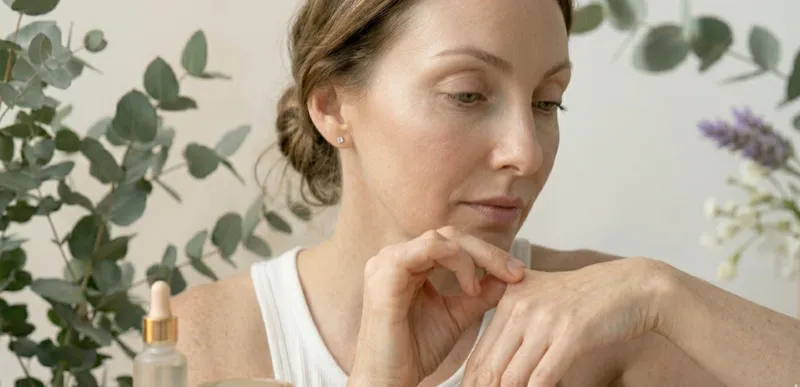
The science of skin aging is evolving rapidly — and for women navigating the skin changes that come with menopause and beyond, evidence-based skincare represents a fundamentally different approach: working with your skin's biology rather than against it.
Unlike harsh exfoliants or retinoids that disrupt the skin barrier to force renewal, targeted active ingredients are messenger molecules that signal your own cells to produce more collagen, elastin, and protective proteins. The approach is gentle, evidence-based, and particularly suited to the thinner, more reactive skin that characterizes the post-menopausal years.
A Multi-Pathway Approach to Rebuilding Skin Resilience
Restoring elasticity in aging skin is achievable when the treatment strategy aligns with the biological reality of how the dermal matrix ages. The elastic properties of skin arise from the coordinated function of three components: (1) the collagen network providing structural resistance to deformation, (2) the elastic fiber network providing recoil after deformation, and (3) the glycosaminoglycan ground substance providing hydrated volume that maintains tissue turgor. Aging degrades all three components simultaneously but at different rates and through different mechanisms — effective restoration must address each component through its specific pathway rather than relying on a single active ingredient. The most common failure in anti-aging skincare is applying one product (typically a moisturizer) and expecting it to address all three components of dermal aging. Meaningful elasticity restoration requires a deliberate multi-product protocol where each product targets a specific structural deficit.[1]
Phase 1 of restoration — Collagen rebuilding (the foundation): collagen density is the most addressable component of skin elasticity because fibroblasts retain the capacity for collagen synthesis throughout life. Two complementary stimulation pathways should be activated simultaneously: (a) the retinoid receptor pathway — retinol at 0.3-0.5% applied 3-4 evenings per week activates nuclear RAR/RXR receptors on fibroblasts, upregulating procollagen gene expression while suppressing MMP genes. This dual action increases production while decreasing destruction. Build frequency slowly over 8 weeks, using the ceramide sandwich method to manage irritation. (b) The growth factor pathway — peptide cream (Matrixyl 3000) applied morning and evening stimulates collagen production through TGF-beta signaling, a mechanism entirely independent of retinoid receptors. The combination of both pathways produces greater collagen stimulation than either alone because they operate through non-overlapping molecular mechanisms. Studies demonstrate that dual-pathway stimulation produces 30-40% greater collagen density increase compared to single-pathway treatment at 24 weeks.
Clinical research confirms that phase 2 of restoration — Elastic fiber preservation and support: since adult fibroblasts produce minimal new elastin, the strategy shifts from replacement to preservation and optimization. (a) MMP suppression — retinoid therapy (already initiated for collagen) simultaneously suppresses the expression of MMP-12 (macrophage elastase) and MMP-2/MMP-9, the primary enzymes responsible for elastic fiber degradation. (b) Antioxidant shielding — topical vitamin C (15-20% L-ascorbic acid) applied every morning neutralizes the reactive oxygen species generated by UV exposure that directly cleave elastic fiber proteins. Oral antioxidants (polyphenols from berries, green tea catechins) provide systemic support. (c) UV protection — SPF 50 applied daily prevents the UV-driven oxidative stress and MMP activation that are the primary extrinsic drivers of elastic fiber degradation. (d) Microfibrillar support — peptide therapy stimulates fibrillin-1 production, reinforcing the organizational scaffold that determines how efficiently remaining elastic fibers function. These four preservation strategies collectively maintain elastic fiber function at levels significantly higher than unprotected skin.
Phase 3 of restoration — Hydration and barrier optimization (the amplifier): the hydration state of the dermis has an outsized impact on measurable elasticity. The glycosaminoglycan ground substance — primarily hyaluronic acid — provides the water-retention matrix that keeps the dermis plump, hydrated, and mechanically resilient. Aging reduces endogenous HA production, and the resulting dermal dehydration makes skin feel and measure less elastic even when collagen and elastin levels are adequate. (a) Hyaluronic acid serum (multi-molecular-weight formulation) applied to damp skin morning and evening — provides both surface hydration (high MW HA) and dermal plumping (low MW HA). (b) Ceramide-rich cream as the sealing layer — restores the barrier function that prevents the HA-bound moisture from escaping through transepidermal water loss. Post-menopausal skin loses barrier lipids rapidly; external ceramide supplementation is essential rather than optional. (c) Overnight occlusion 2-3 nights per week — applying a thin layer of petrolatum or squalane oil over the evening routine creates maximum hydration retention that allows overnight dermal rehydration. The improvement in measurable elasticity from optimal hydration alone can be 15-20% — an immediate, visible improvement that makes the slower structural improvements from collagen and elastin treatment perceptible sooner.
Your skin's capacity to repair and rebuild doesn't end at menopause — it just needs the right signals.
— Dr. Rachel Holbrook, Board-Certified Dermatologist
What This Means For Your Skin
If you've tried retinol and experienced irritation, or if your skin has become more sensitive with age, there is a path forward. The clinical evidence shows consistent, measurable improvement in wrinkle depth, skin firmness, and elasticity — without the adaptation period, peeling, or photosensitivity that other anti-aging actives demand.
Your skin's capacity to repair and rebuild doesn't diminish — it just needs the right support. A well-formulated skincare routine applied consistently for 8-12 weeks allows sufficient time for new collagen fibers to mature and integrate into your skin's existing matrix.
The science is clear. The evidence is consistent. The results are measurable.
What happens next is up to you.