
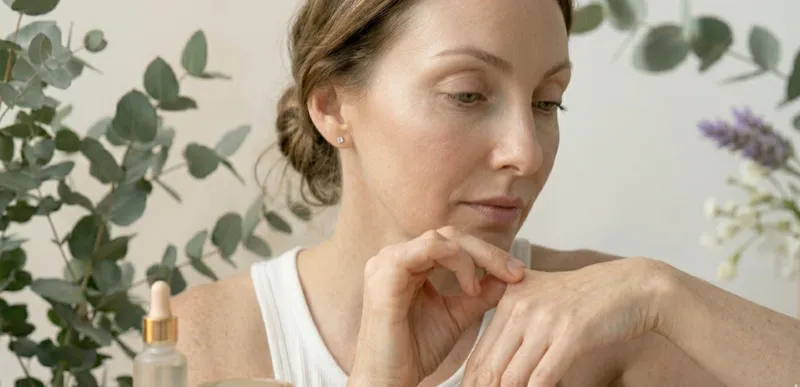
The science of skin aging is evolving rapidly — and for women navigating the skin changes that come with menopause and beyond, evidence-based skincare represents a fundamentally different approach: working with your skin's biology rather than against it.
Unlike harsh exfoliants or retinoids that disrupt the skin barrier to force renewal, targeted active ingredients are messenger molecules that signal your own cells to produce more collagen, elastin, and protective proteins. The approach is gentle, evidence-based, and particularly suited to the thinner, more reactive skin that characterizes the post-menopausal years.
Optimizing Retinoid Therapy for Maximum Dermal Rebuilding
Retinol (vitamin A1) is the most extensively validated topical active for improving skin elasticity, with over three decades of clinical research supporting its efficacy across multiple mechanisms of action. Unlike many cosmeceutical ingredients that rely on in vitro evidence or small pilot studies, retinoids have been evaluated in dozens of large, randomized, double-blind, placebo-controlled trials — the gold standard of clinical evidence. The seminal 1993 study by Griffiths et al., published in the New England Journal of Medicine, demonstrated that topical tretinoin (prescription retinoid) produced measurable increases in dermal collagen formation in photodamaged skin within 12 weeks. Subsequent studies confirmed that over-the-counter retinol, while less potent than prescription tretinoin, produces qualitatively similar effects through the same retinoid receptor pathway — it simply requires higher concentrations and longer treatment duration to achieve comparable results. For skin elasticity specifically, retinol works through dual mechanisms: (1) stimulating new collagen production (rebuilding the structural matrix) and (2) suppressing MMP expression (preventing the enzymatic degradation of existing collagen and elastin). This dual action makes retinol unique among topical actives — it simultaneously builds and protects.[1]
How to start retinol for elasticity — the progressive protocol: the most common reason retinol fails to improve elasticity is premature abandonment due to irritation. The thin, often dehydrated skin that needs elasticity improvement the most is also the most vulnerable to retinoid-induced irritation (retinoid dermatitis: dryness, peeling, redness, burning). The solution is a progressive introduction protocol that allows the skin to build enzymatic tolerance over 8-12 weeks. Week 1-2: Apply retinol 0.25% once per week, on the least sensitive night, using the sandwich method — apply ceramide cream first, wait 5 minutes, apply a pea-size amount of retinol over the ceramide layer, wait 5 minutes, apply another layer of ceramide cream. This buffers the retinol delivery, reducing peak concentration at the skin surface while maintaining dermal delivery. Week 3-4: Increase to twice per week if no irritation occurred. Week 5-8: Increase to three times per week. Week 9-12: Increase to alternate nights (every other night) if tolerated. After 12 weeks, some patients can progress to nightly use; others find alternate nights is their stable maximum frequency.
Clinical research confirms that concentration guidance for elasticity: (1) 0.25% retinol — the starting concentration for sensitive, thin, or post-menopausal skin. Provides meaningful retinoid receptor activation with minimal irritation risk. Appropriate for the neck, periorbital area, and anyone with compromised barrier function. (2) 0.5% retinol — the workhorse concentration for elasticity improvement in normal-tolerance skin. Most clinical studies demonstrating elasticity improvement used this concentration range. Provides robust collagen stimulation and MMP suppression with manageable irritation. (3) 1.0% retinol — the maximum over-the-counter concentration. Provides the greatest collagen stimulation but with significantly higher irritation risk. Reserved for patients who have built tolerance through months of lower-concentration use. Most people who need elasticity improvement (typically older, with thinner skin) do better at 0.25-0.5% than at 1.0%, where the irritation often outweighs the incremental benefit. (4) Retinaldehyde 0.05-0.1% — an alternative retinoid form that converts to retinoic acid in one enzymatic step (versus two for retinol). Offers better efficacy-to-irritation ratio than retinol for some patients.
Application technique for maximum elasticity benefit: (1) Apply retinol in the evening only — retinol degrades in sunlight and increases photosensitivity. (2) Apply to completely dry skin — water on the skin's surface accelerates retinol absorption through the compromised barrier, increasing irritation. Wait 20 minutes after washing before application, or pat face completely dry. (3) Use the sandwich method for the first 8 weeks minimum — the ceramide buffer reduces irritation without significantly reducing efficacy. (4) Apply a pea-size amount for the entire face; a second pea-size amount for the neck. More is not better — excess retinol does not increase collagen stimulation but does increase irritation. (5) Avoid the immediate periorbital area for the first 4 weeks — the thin eyelid skin is the most irritation-prone zone. (6) Follow with ceramide cream or niacinamide moisturizer — barrier repair after retinol application reduces overnight TEWL and supports the skin's recovery. (7) Apply SPF 50 every morning without exception during retinol use — the increased photosensitivity means that UV exposure during retinol therapy causes more damage than it would on untreated skin. Results timeline for elasticity: visible skin texture improvement at 4-8 weeks (surface smoothing), measurable firmness improvement at 12-16 weeks (dermal collagen increase), progressive elasticity improvement at 6-12 months (cumulative structural remodeling). The full benefit of retinol for elasticity requires 12+ months of consistent use.
Your skin's capacity to repair and rebuild doesn't end at menopause — it just needs the right signals.
— Dr. Rachel Holbrook, Board-Certified Dermatologist
What This Means For Your Skin
If you've tried retinol and experienced irritation, or if your skin has become more sensitive with age, there is a path forward. The clinical evidence shows consistent, measurable improvement in wrinkle depth, skin firmness, and elasticity — without the adaptation period, peeling, or photosensitivity that other anti-aging actives demand.
Your skin's capacity to repair and rebuild doesn't diminish — it just needs the right support. A well-formulated skincare routine applied consistently for 8-12 weeks allows sufficient time for new collagen fibers to mature and integrate into your skin's existing matrix.
The science is clear. The evidence is consistent. The results are measurable.
What happens next is up to you.