
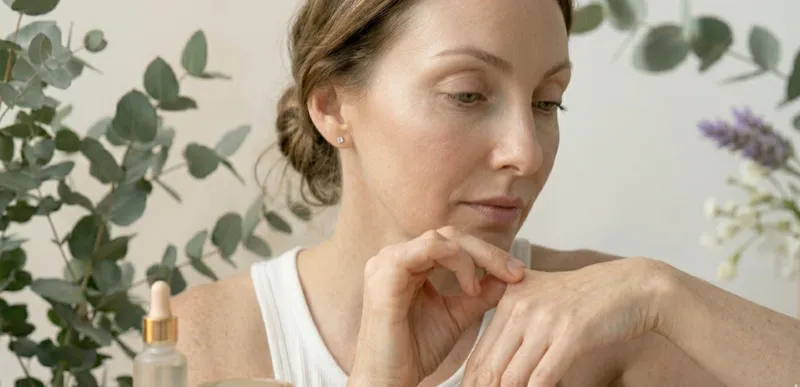
The science of skin aging is evolving rapidly — and for women navigating the skin changes that come with menopause and beyond, evidence-based skincare represents a fundamentally different approach: working with your skin's biology rather than against it.
Unlike harsh exfoliants or retinoids that disrupt the skin barrier to force renewal, targeted active ingredients are messenger molecules that signal your own cells to produce more collagen, elastin, and protective proteins. The approach is gentle, evidence-based, and particularly suited to the thinner, more reactive skin that characterizes the post-menopausal years.
Clinical Evidence for Peptide-Based Collagen Stimulation
Peptides for skin tightening represent one of the most evidence-supported categories in cosmeceutical science, yet they remain surrounded by both legitimate clinical validation and exaggerated marketing claims. Separating the two requires understanding which specific peptides have clinical evidence, what mechanism they operate through, what magnitude of improvement is realistic, and what timeframe is necessary. The peptides with the strongest evidence for skin tightening are signal peptides — short amino acid sequences that mimic the collagen fragment signals that naturally stimulate fibroblast activity. When collagen is degraded by MMPs, the resulting peptide fragments signal to fibroblasts that collagen needs to be replaced. Synthetic signal peptides exploit this feedback mechanism by providing the replacement signal without requiring actual collagen degradation — essentially tricking fibroblasts into producing more collagen in the absence of increased breakdown. Palmitoyl pentapeptide-4 (Matrixyl, the sequence Lys-Thr-Thr-Lys-Ser with a palmitoyl lipid tail for skin penetration) and the combination of palmitoyl tripeptide-1 plus palmitoyl tetrapeptide-7 (Matrixyl 3000) are the most extensively studied formulations.[1]
The clinical evidence: Robinson et al. (2005) conducted a double-blind, placebo-controlled study applying palmitoyl pentapeptide-4 (Matrixyl) cream to the periorbital area of 93 women for 12 weeks. The treatment group showed statistically significant reduction in wrinkle depth and improvement in skin roughness compared to placebo. Skin profilometry (surface topography measurement) confirmed the improvements were structural rather than cosmetic. A subsequent study by Trookman et al. demonstrated that 8 weeks of Matrixyl 3000 application increased collagen synthesis by 117% and hyaluronic acid synthesis by 267% in ex vivo skin models, with parallel in vivo improvements in skin firmness and elasticity. The magnitude of improvement was comparable to low-concentration retinol (0.05%), leading researchers to position peptides as a retinol alternative for patients who cannot tolerate retinoid therapy. Additional evidence from Lintner et al. showed that palmitoyl pentapeptide-4 at 3% concentration stimulated collagen I, collagen III, and fibronectin production in fibroblast cultures in a dose-dependent manner.
Clinical research confirms that what peptides can and cannot do: CAN — stimulate fibroblast collagen production through TGF-beta signaling, improve skin firmness and elasticity by 10-20% over 12-24 weeks of consistent use, reduce fine wrinkle depth through increased dermal collagen density, do so without causing irritation, photosensitivity, or adaptation period (making them suitable for sensitive skin, rosacea-prone skin, and post-menopausal thin skin). CANNOT — produce results comparable to prescription-strength retinoids (tretinoin at 0.05-0.1% produces greater collagen stimulation than any OTC peptide), reverse severe skin laxity that requires surgical intervention, work at the decorative concentrations found in many consumer products (peptides listed at the end of ingredient lists are present at fractions of a percent — insufficient for functional activity). The concentration threshold: most clinical studies used peptide concentrations of 3-8%. Products where the peptide is listed in the first 5-7 ingredients on the label are more likely to contain functional concentrations. Products where the peptide appears near the end of a long ingredient list likely contain 0.01-0.1% — enough to list on the label but insufficient for biological activity.
The practical protocol for peptide-based skin tightening: (1) Choose a product with Matrixyl 3000 or palmitoyl pentapeptide-4 listed in the top 5-7 ingredients — this suggests functional concentration. (2) Apply to clean skin morning and evening. The twice-daily application provides sustained growth factor signaling to fibroblasts throughout the 24-hour cycle. (3) Be consistent for a minimum of 12 weeks before evaluating results — collagen remodeling is slow, and the structural improvements that produce visible tightening require cumulative protein deposition over months. (4) For maximum tightening, combine peptide therapy with retinol 2-3 nights per week — this activates two independent collagen production pathways (TGF-beta and retinoid receptor) simultaneously, producing greater firmness improvement than either agent alone. (5) Seal with ceramide cream — the occlusive barrier prevents peptide evaporation and maintains the hydrated dermal environment that optimizes fibroblast activity. Expected results with consistent dual-pathway use: measurable firmness improvement at 12 weeks, progressive improvement through 6-12 months, with realistic total improvement of 15-25% in clinical elasticity measurements. This translates to visibly firmer skin with better bounce and resilience — not a transformation, but a meaningful improvement that most women can perceive.
Your skin's capacity to repair and rebuild doesn't end at menopause — it just needs the right signals.
— Dr. Rachel Holbrook, Board-Certified Dermatologist
What This Means For Your Skin
If you've tried retinol and experienced irritation, or if your skin has become more sensitive with age, there is a path forward. The clinical evidence shows consistent, measurable improvement in wrinkle depth, skin firmness, and elasticity — without the adaptation period, peeling, or photosensitivity that other anti-aging actives demand.
Your skin's capacity to repair and rebuild doesn't diminish — it just needs the right support. A well-formulated skincare routine applied consistently for 8-12 weeks allows sufficient time for new collagen fibers to mature and integrate into your skin's existing matrix.
The science is clear. The evidence is consistent. The results are measurable.
What happens next is up to you.